How to Start Investing With No Money (You Already Have It)
How to start investing with no money: Americans waste $314/month on impulse buys alone. You don't need new income. Redirect forgotten spending into wealth.

Most people can start investing without earning any additional income by redirecting money already being spent. The average American spends $314 per month on impulse purchases alone, plus roughly $219 per month on subscriptions, with many forgotten. Redirecting $300 per month into an S&P 500 index fund at a 10% average annual return produces approximately $62,600 over 10 years and $678,100 over 30 years.
You already have the money to start investing. You just don't know it yet.
That's not a motivational poster. It's math. The average American spends somewhere between $300 and $900 a month on things that vanish the second they buy them. Lottery tickets. Delivery app markups. Subscriptions they forgot existed. Coffee they could make at home. Impulse buys they can't even remember a week later.
That money is real. It exists. It's flowing out of your account right now, on autopilot, into other people's pockets. The only thing you need to start investing is a better destination for money you're already spending.
The average American spends $314/month on impulse buys alone (Slickdeals, 2023). Add in forgotten subscriptions, lottery tickets, and delivery markups, and most people can redirect $300/month without earning a single extra dollar. That $300/month in an S&P 500 index fund at 10% average returns becomes $62,600 in 10 years and $678,100 in 30 years. The money is already in your budget. You just need to see it.
Most people don't realize how much they're already burning:
The short version: You don't need extra income to start investing. You need to see where your current income already goes. Cancel what you forgot about, reduce what you won't miss, and redirect even $25 a week into something that grows. This article shows you exactly how.
Related: How to invest with $20 a week | The latte factor is bigger than coffee | DCA calculator
The Myth: "I Can't Afford to Invest"
This is the most common excuse for not investing. And it makes sense on the surface. Bills are real. Rent is real. Groceries cost more every year. 62% of Americans live paycheck to paycheck, and 59% can't cover a $1,000 emergency.
So when someone says "invest $20 a week," it sounds like advice from someone who has never worried about their bank balance.
But here's the thing most financial advice gets wrong: it assumes you need to find new money. An extra source of income. A side hustle. A raise.
You don't. You need to stop losing the money you already have.
Because somewhere in your spending, right now, there is $200 to $500 a month quietly disappearing into things that give you nothing back. Not savings. Not growth. Not security. Just a receipt and a dopamine hit that fades before the credit card statement arrives.
The problem isn't that you don't earn enough. The problem is that the money you do earn is being drained by a system designed to keep you spending. Companies profit from your ignorance, and they always have.
Where Your Money Actually Goes
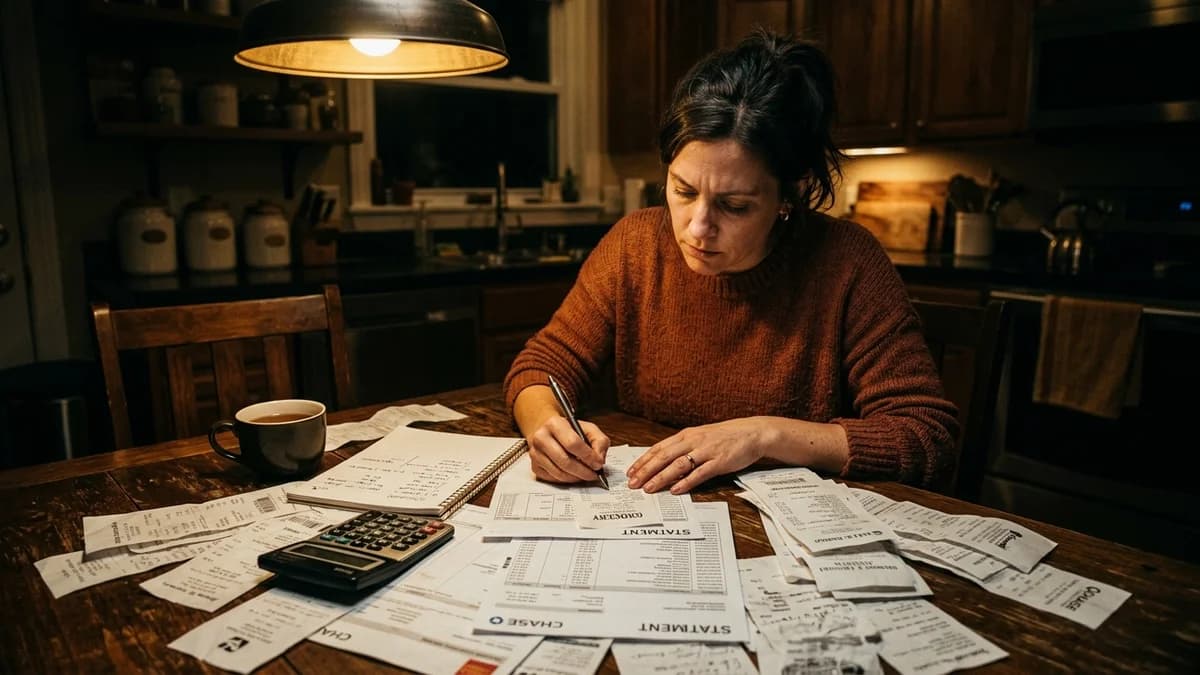
Pull up your bank statement. Not the one from last month. Right now. Scroll through the last 30 days and look at what you spent on things that no longer exist.
Here are the categories that add up fastest:
Daily coffee: 67% of Americans drink coffee every day, according to the National Coffee Association. A specialty coffee runs $5 to $7. At $6 a day, that's $180 a month. Making it at home costs about $0.50 a cup. Even switching three days a week saves you $45 a month.
Eating out for lunch: The average restaurant lunch costs $12 to $15. Pack your lunch three days a week instead, and you save $50 a month, at minimum. Over a year, that's $600.
Forgotten subscriptions: The average American pays $219 a month on subscriptions but thinks they pay $86. That $133 gap? It's money leaving your account for services you don't use. 42% of subscribers are paying for at least one subscription they've completely forgotten about.
Impulse purchases: That Slickdeals number at the top isn't a typo. $314 a month on things you didn't plan to buy. $3,768 a year on stuff you barely remember. Amazon one-click ordering, social media ads, "limited time" deals. The machine is very good at its job.
Lottery tickets: Regular lottery players spend $50 to $100 a month. In some states, much more. The odds of winning Powerball's jackpot are 1 in 292 million. You're more likely to be struck by lightning 300 times. That money is gone the second you buy the ticket.
Delivery app markups: A Gordon Haskett study found delivery app orders cost 91% more than dining in. That $12 burrito becomes $22 after fees. Skip four delivery orders a month and you save $40.
Where Your Daily Spending Actually Goes
Estimated annual cost of common daily habits for the average American
Sources: BLS Consumer Expenditure Survey, West Monroe, Gordon Haskett, USDA (2023-2024)
Add it all up and the picture gets uncomfortable fast. The average American wastes somewhere between $10,000 and $18,000 a year on nonessential spending they barely register. That's not a budgeting failure. That's a system working exactly as designed.
The Redirect: Specific Swaps That Add Up
You don't need to cut everything. You don't need to live on rice and beans. The goal is not deprivation. It's awareness.
Pick a few swaps. Start small. Build from there.
| Swap | What You Do | Monthly Savings |
|---|---|---|
| Coffee at home 3 days/week | Make coffee instead of buying it three days | ~$45 |
| Cancel unused subscriptions | Audit your subscriptions, cancel what you forgot | ~$60 |
| Pack lunch 3 days/week | Bring food instead of buying lunch three days | ~$50 |
| Skip lottery tickets | Redirect lottery spending to investing | ~$75 |
| Skip 4 delivery orders | Pick up food or cook instead of ordering delivery | ~$40 |
| 48-hour impulse rule | Wait 48 hours before any unplanned purchase | ~$30 |
| Total | ~$300/month |
That's $300 a month. $3,600 a year. Without earning a single extra dollar.
The Redirect Stack: Small Swaps, Real Money
Monthly savings from six simple spending swaps
Estimates based on BLS, Slickdeals, C+R Research, and NASPL data (2022-2024)
And here's the part that matters: you won't miss most of it. Studies show that most people who cancel forgotten subscriptions never re-subscribe. People who start making coffee at home adapt within a week. The 48-hour impulse rule eliminates most unplanned purchases because the urge simply passes.
The money was always there. You just needed to see it.
What $300 a Month Becomes
Here's where it gets real. Redirecting $300 a month sounds modest. But compound growth turns modest into something else entirely.
The shift from "I don't have anything to invest" to "I have $300 a month" happens on a spreadsheet, not in a pay stub. Nothing about your job has to change. Nothing about your lifestyle has to collapse. You just stop letting random charges walk off with your money and start sending that same money somewhere it can grow.
$62,600
What $300/month becomes in 10 years at 10% average return
S&P 500 historical average, NYU Stern
Let that sit for a moment. $62,600. From money you were spending on forgotten Netflix subscriptions and DoorDash markups.
Here's how it plays out over time:
| Timeframe | Total Contributed | Value at 4.5% (HYSA) | Value at 10% (S&P 500) |
|---|---|---|---|
| 5 years | $18,000 | $20,100 | $23,200 |
| 10 years | $36,000 | $44,500 | $62,600 |
| 20 years | $72,000 | $113,600 | $227,800 |
| 30 years | $108,000 | $219,500 | $678,100 |
$678,100 over 30 years. From redirected coffee, subscriptions, and impulse buys. That's not a fantasy. That's just math applied to money you already have.
Wasted vs. Invested: The 10-Year Gap
$400/month wasted (gone forever) vs. $200/month invested at 10% return
Invested line assumes 10% average annual return (S&P 500 historical average)
And that table only shows two vehicles. If you'd been dollar-cost averaging into Bitcoin over the past decade, the numbers would be dramatically higher, though with more volatility along the way. The point isn't which vehicle you choose. The point is that the money exists and you're currently setting it on fire.
Here is the part nobody tells you in school. The dollars you save in your twenties and early thirties are the most valuable dollars you will ever save, not because they buy more today, but because they have the most years to compound. A thousand dollars invested at 25 is worth more at retirement than five thousand dollars invested at 45. Time does the math.
Which means every month of delay is not a flat cost. It is an exponential one. Waiting six months to start is not "six months of missed growth." It is the tail of the curve getting chopped off.
See what your money could become.
Join thousands learning how to redirect wasted spending into real wealth.
Where to Put It: Four Options for Any Budget
Once you've found the money, you need somewhere to send it. Here are four real options, ranked from safest to highest potential:
Option 1: High-Yield Savings Account
Best for: People who want zero risk and need access to their money.
A HYSA pays 4% to 5% APY as of early 2026. Compare that to the 0.01% your big bank probably offers. FDIC insured up to $250,000. No risk of loss. Completely liquid.
This won't make you rich, but it stops the bleeding. Your money at least keeps pace with inflation instead of losing value sitting in a checking account. Start here if you have zero savings and need an emergency fund first.
Option 2: S&P 500 Index Fund
Best for: People with a 5+ year time horizon who want simple, proven growth.
An S&P 500 index fund holds shares of the 500 largest U.S. companies. Historical average annual return: roughly 10%. No stock picking. No timing. You buy the whole market and let time do the work.
You can open a brokerage account on your phone in 10 minutes with Fidelity, Schwab, or Vanguard. No minimums. No commissions. Set up a recurring $75/week investment and forget it exists. Read the full walkthrough: How to start investing with $20 a week.
Option 3: Roth IRA
Best for: People under income limits who want tax-free growth.
A Roth IRA lets your money grow tax-free. You contribute after-tax dollars, and when you withdraw in retirement, you pay nothing. The 2026 contribution limit is $7,000 ($8,000 if you're over 50).
$300 a month fits perfectly inside a Roth IRA. You can hold index funds, individual stocks, or Bitcoin inside one. It's a container, not an investment itself. For a detailed comparison of index fund vs Bitcoin returns with real DCA data, see Bitcoin vs Index Funds.
Option 4: Bitcoin DCA
Best for: People who want exposure to the hardest asset on Earth, with a long time horizon.
Dollar-cost averaging into Bitcoin means buying a fixed amount on a regular schedule, regardless of price. You're not trying to time the market. You're building a position over time, the same way you'd invest in an index fund.
Bitcoin has been the best-performing asset of the last decade. It's also the most volatile. It dropped 48% from October 2025 to February 2026. It's crashed 76% to 81% in previous cycles. And every time, it has recovered to new highs.
You can start with $5 on Strike or Cash App. No minimums. No gatekeepers. Read: Bitcoin for beginners.
This article is educational, not financial advice. Every investment carries risk. Bitcoin is especially volatile. Never invest money you can't afford to lose, and build an emergency fund before investing aggressively.
The 30-Minute Plan: Do This Today
You've read enough. Here's what to actually do, right now, in 30 minutes or less.
Minutes 1-10: The audit. Open your bank app. Scroll through the last 30 days. Highlight every recurring charge you don't actively use. Highlight every purchase you can't remember making. Write down the total.
Minutes 10-15: Cancel the waste. Open every subscription you highlighted. Cancel it. If you haven't used it in 30 days, you won't miss it. You can always re-subscribe later. You won't.
Minutes 15-20: Pick two swaps. Choose two habits from the redirect table above. You don't need all six. Start with two. Maybe it's making coffee at home three days and skipping two delivery orders. That's $85 a month you just freed up.
Minutes 20-25: Set up automatic investing. Open an account (HYSA, brokerage, or Bitcoin exchange). Set up a recurring weekly transfer for the amount you just freed up. Schedule it for the day after you get paid, before you have a chance to spend it.
Minutes 25-30: Forget it exists. The automation does the work now. You don't need to think about it. You don't need willpower. The money moves before you see it, and compound growth does the rest.
That's it. Thirty minutes. No new income needed. No financial advisor. No permission from anyone.

The whole point of automation is to take your future self out of the decision. Your future self is going to be tired, stressed, and tempted by something on sale. Your future self should not be in charge of whether you invest this week. The app should be.
Once the transfer happens on its own, your only job is to keep your hands off the account. Most people who quit investing do not quit because they ran out of money. They quit because they looked at a red chart on a bad week and pulled the plug. The automated investor who never looks wins more often than the engaged investor who tries to manage the market.
Give it a year before you form an opinion on whether "this is working." One year of boring, automated contributions will teach you more about how investing actually feels than a hundred hours of reading. The first year is mostly about proving to yourself that you can stick with it.
Try the DCA calculator right now. Pick the spending habits you could redirect, set a weekly amount, and see what your money becomes over 5, 10, or 20 years. The numbers might change how you think about your next coffee run.
Why This Is Actually Urgent
There's one more thing nobody mentions when they talk about "starting to invest someday."
Every day you don't invest, your money is losing value. Not in theory. In practice. The dollar's purchasing power drops every single year. The real inflation rate is higher than the government reports. Your savings account is actively losing money in real terms, even if the number in your app goes up by a fraction of a percent.
So "doing nothing" isn't neutral. It's expensive. Every month you wait, the money you already have buys less. And the money you could be investing misses out on another month of compounding.
The cost of waiting is real. Someone who starts investing $300/month at 25 will have roughly $678,000 by 55. Someone who waits until 35 and invests the same amount? About $227,000. Ten years of delay costs $451,000.
That's why "I'll start when I make more money" is the most expensive sentence in personal finance. You have the money now. The system just trained you not to see it.
Frequently Asked Questions
Keep Reading
This article connects to nearly everything on Untaught. Start wherever makes sense for you:
- The spending problem: You're already wasting money | The subscription trap | The latte factor | Impulse buying psychology
- The system problem: Nobody taught you this | Why financial literacy isn't taught in schools
- The inflation problem: Your money is losing value | Your savings account is losing money
- The action plan: Small steps, real results | $20 a week for 10 years | $100 a month invested
- The tools: DCA calculator | Bitcoin for beginners
This article is for educational purposes only and does not constitute financial advice. Untaught does not hold, move, or custody any funds. Past performance does not guarantee future results. Always do your own research before making investment decisions.
Quick calculator
Your coffee money could have become
$16,301
from $9,900 invested