Bitcoin Is Down 50%. Here's What DCA Investors Are Actually Doing
Google searches for 'Bitcoin going to zero' hit an all-time high in Feb 2026. Meanwhile, Bitcoin ETFs saw $257M in net inflows in a single day. Here's what's really happening.
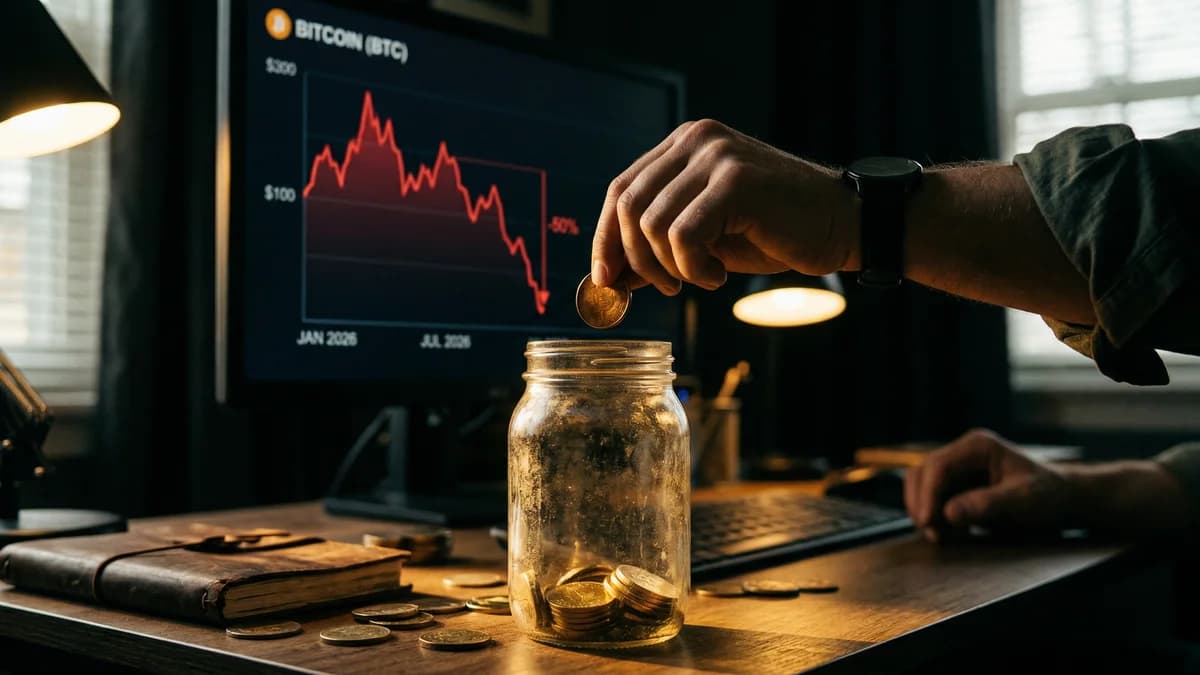
Bitcoin dropped approximately 48% from its October 2025 all-time high of around $126,000 to about $66,000 by February 2026. During the same period, Google searches for "Bitcoin going to zero" reached an all-time high. Meanwhile, Bitcoin ETFs recorded $257.7 million in net inflows in a single day on February 24, 2026. Dollar cost averaging investors kept buying throughout the decline.
Open your phone right now and Google "Bitcoin." You'll see red. Lots of red.
Bitcoin hit an all-time high of roughly $126,000 in October 2025. By February 2026, it dropped to about $66,000. That's a 48% decline in four months. Headlines are screaming. Your coworker who bought at the top is panicking. Social media is full of people declaring Bitcoin dead. Again.
Google searches for "Bitcoin going to zero" just hit their highest level ever recorded, according to TheCryptoBasic. Higher than the 2022 FTX collapse. Higher than any previous crash.
So what are the people who actually understand this doing?
They're buying.
Bitcoin dropped from ~$126K to ~$66K between October 2025 and February 2026. Google searches for "Bitcoin going to zero" hit an all-time high. But Bitcoin ETFs recorded $257.7 million in net inflows on a single day in late February (CryptoTicker, 2026). DCA investors aren't panicking. They've seen this before. Every previous crash that felt like the end turned out to be a sale.
Read more: What Is Dollar Cost Averaging? | Is It Too Late to Buy Bitcoin?
Two Groups of People Are Looking at the Same Chart Right Now
Here's what's actually happening in February 2026. Two very different groups of people are staring at the same price chart and making opposite decisions.
Group 1: The panickers. They bought Bitcoin when it was going up. Maybe at $100K. Maybe at $110K. They watched it climb and felt smart. Now it's at $66K and they feel sick. They're Googling "Bitcoin going to zero." They're thinking about selling. Some already have.
Group 2: The DCA investors. They set up a $20 weekly buy months or years ago. Their app buys automatically, every week, no matter what the price does. This week, their $20 bought more Bitcoin than it did last month. And way more than it did last July. They didn't even check the chart. Their system just kept running.
On February 24, 2026, Bitcoin ETFs recorded a net inflow of $257.7 million in a single day, according to CryptoTicker. That's institutional money flowing in, not out. The biggest funds in the world looked at a 44% crash and said: "Yes, we'll take more."
The people Googling "is Bitcoin dead" and the people managing billions of dollars are making opposite choices. Which group do you want to be in?
This Has Happened Before. Every Single Time.
If this is your first Bitcoin crash, it feels like the world is ending. If it's your third or fourth, it feels like Tuesday.
Here's what Bitcoin has done before:
Crash #1: 2014. Bitcoin peaked above $1,100 in late 2013. By January 2015, it was at $217. An 81% crash. Media declared it dead. People who kept DCA-ing $20/week through that crash? They're sitting on massive returns today.
Crash #2: 2018. Bitcoin hit nearly $20,000 in December 2017. By December 2018, it was around $3,700. An 81% crash. "Bitcoin is finished" was the consensus. People who kept their $20/week going? They caught the $3,000 and $4,000 prices that later looked like the deal of a lifetime.
Crash #3: 2022. Bitcoin topped $69,000 in November 2021. By December 2022, it was around $16,500. A 76% crash. FTX collapsed. Confidence was destroyed. DCA investors were buying at $16,000 and $17,000. Those coins are now worth four times what they paid.
Crash #4: Right now. Bitcoin hit ~$126,000 in October 2025. As of February 2026, it's around $66,000. A 48% drop. And Google searches for "Bitcoin going to zero" just hit a record.
Notice the pattern. Every crash felt permanent. Every crash produced headlines declaring Bitcoin dead. And every crash turned out to be the best buying opportunity for people who kept going. We don't know if this time follows the same pattern. But we do know what panic-selling has produced historically: locked-in losses at the worst possible moment.
What $20 a Week Actually Looks Like Through a Crash
Let's make this concrete. Say you started DCA-ing $20 per week in January 2025, right when Bitcoin was above $100,000. The worst possible timing. You bought at the top.
By February 2026, you've invested about $1,200. Bitcoin dropped 44% from its peak. Your portfolio is down. That feels bad.
But here's what most people miss: you didn't buy everything at the top. You bought some at $102K. Some at $84K. Some at $82K. Some at $94K. Some at $108K on the way up. And some at $66K on the way down. Your average cost is much lower than the peak price.
Now zoom out. What about someone who started DCA-ing $20/week in January 2022, right before the last big crash?
They invested through the entire 2022 bear market. They bought at $45,000. Then $31,000. Then $19,000. Then $16,500. Those gut-wrenching months when Bitcoin kept falling? That's when they accumulated the most coins for their money.
Their total invested: about $4,400 over two years. Their portfolio value in February 2026 at $66,000 per Bitcoin: well into profit. The crash didn't destroy them. The crash is what made their returns possible.
Try the math yourself: Use our DCA Calculator to see what any weekly amount would be worth today.
Why the Panic Is the Point
Here's something nobody tells you. The crashes are not a bug in Bitcoin. They're a feature. Not because losing money is good, but because of what crashes do to human behavior.
Crashes shake out the short-term speculators. The people who bought because the price was going up, who had no plan, who were just chasing quick gains. When the price drops 40%, they sell. They lock in their losses and leave.
That selling creates the low prices that long-term DCA investors buy at. It's a transfer of coins from the impatient to the patient. From the panickers to the planners.
This is exactly what happened in every previous crash:
- Retail traders panic-sold at $170 in 2015. Long-term buyers accumulated.
- Retail traders panic-sold at $3,200 in 2018. Long-term buyers accumulated.
- Retail traders panic-sold at $16,500 in 2022. Long-term buyers accumulated.
The people who are Googling "Bitcoin going to zero" right now are doing exactly what people did at every previous bottom. And the institutions buying $257 million worth of Bitcoin ETFs in a single day are doing exactly what smart money has always done during fear: they're shopping.
$257.7M
Net Bitcoin ETF inflows on a single day (Feb 24, 2026), during the 'crash'
CryptoTicker, Feb 2026
What Should You Actually Do Right Now?
If you already have a DCA plan running, the answer is simple: nothing. Don't change anything. Don't check the price every hour. Don't sell. Your system is doing exactly what it's supposed to do. It's buying more Bitcoin at lower prices. That's the entire point.
If you don't have a DCA plan, this is genuinely one of the better times to start one. Not because we can predict the bottom. Nobody can. But because starting during a period of fear means your first purchases are at lower prices than they would have been six months ago.
Here's what NOT to do:
- Don't try to time the bottom. You won't get it right. Nobody does. The people who waited for $10K in 2023 missed the entire recovery.
- Don't invest money you need. This is not your rent money. This is not your emergency fund. This is the $20 you'd spend on lottery tickets or impulse buys.
- Don't watch the chart every day. Checking the price constantly will make you emotional. Emotional investors make terrible decisions. Set up your weekly buy and check once a month at most.
This is not a guarantee that Bitcoin will recover from this crash. It has recovered from every previous crash of this magnitude, but past performance does not guarantee future results. Bitcoin could go lower. It could go to zero. Only invest money you can genuinely afford to lose. If a 50% drop in your investment would cause real financial hardship, you're investing too much.
The System Wants You to Panic
Think about who benefits when you sell your Bitcoin at a loss during a crash.
Not you. You locked in a loss.
The person who bought your coins at the discounted price? They benefit. The exchange that charged you a fee to sell? They benefit. The media company whose ad revenue depends on you clicking "BITCOIN CRASH" headlines? They benefit.
The entire financial system is built around getting you to react emotionally. Nobody taught you how markets work. Nobody explained that volatility is normal. Nobody told you that crashes are where long-term wealth is actually built. That wasn't an accident.
The system profits when you're scared. When you panic-sell at the bottom and buy back at the top. When you do the exact opposite of what actually works.
DCA is the antidote. It removes you from the cycle of fear and greed. It replaces emotion with a system. $20 a week, every week, regardless of what the headlines say. That's it.
Stop watching. Start stacking.
Join thousands who are learning what the system never wanted you to know about building wealth.
"But What If It Really Does Go to Zero?"
Maybe it will. We can't promise it won't. Any investment can fail.
But let's look at what "going to zero" has meant historically. Bitcoin has been declared dead nearly 500 times since its creation. After the 2014 crash. After the 2018 crash. After the 2022 crash. After every single significant decline.
It hasn't gone to zero yet. Instead, it went from $13 in January 2013 to over $126,000 at its 2025 peak. That's a 900,000% increase over 12 years, with massive crashes along the way.
Does that mean it can't go to zero? No. It means the people who predicted its death at every crash have been wrong every single time so far. And the people who ignored those predictions and kept buying $20 a week have done very, very well.
You don't need to bet your life savings on Bitcoin surviving. You just need to ask yourself: is $20 a week worth the chance that the pattern continues? That's less than most people spend on coffee in a week.

How to Start (or Keep Going)
If you're already DCA-ing: Don't stop. Don't reduce your amount. Don't sell. This crash is your plan working as designed. You're accumulating coins at prices you couldn't get six months ago.
If you've been waiting to start: Here's your 5-minute plan:
- Download Strike or Cash App
- Set up a recurring buy: $5, $10, or $20 per week
- Turn off price notifications on your phone
- Come back in a year
That's it. No charts to read. No timing to figure out. No signals to follow. Just a small, automatic purchase that runs whether Bitcoin is at $120K or $60K.
The people who started during the 2022 crash felt exactly how you feel right now. Scared. Uncertain. Wondering if they were making a mistake. Their $20/week at $16,000 is now worth more than triple what they paid.
We don't know if this crash will play out the same way. But we know what doing nothing produces: your dollars slowly losing value to inflation, year after year, while you watch from the sidelines.
Open Strike or Cash App right now. Set up a $20 weekly Bitcoin buy. The crash is not a reason to stop. For DCA investors, it's a reason to start. Every previous "Bitcoin is dead" moment turned out to be a buying opportunity. You won't know if this one is too until you look back years from now.
The hardest part of this whole game is sitting still when everyone around you is screaming. Every cycle produces the same headlines, the same panicked tweets, the same "I told you so" from people who never owned any. The DCA plan was designed for exactly this moment. Trust it and let the automation do the work.
Frequently Asked Questions
Next steps: Use our DCA Calculator to see what your specific numbers look like. If you're brand new, start with Bitcoin for Beginners. And if you're wondering whether you've missed the boat, read Is It Too Late to Buy Bitcoin?. Spoiler: people have asked that question at every price point.
This article is part of the Small Steps, Real Results series on Untaught.
This article is for educational purposes only and does not constitute financial advice. Untaught does not hold, move, or custody any funds. Past performance does not guarantee future results. Always do your own research before making investment decisions.
Quick calculator
Your coffee money could have become
$16,301
from $9,900 invested