What Would Happen If You Invested Your Lottery Money Instead?
The average lottery player spends $50-100 per month. What if that money went into something that actually grows? Here are three scenarios with real math.
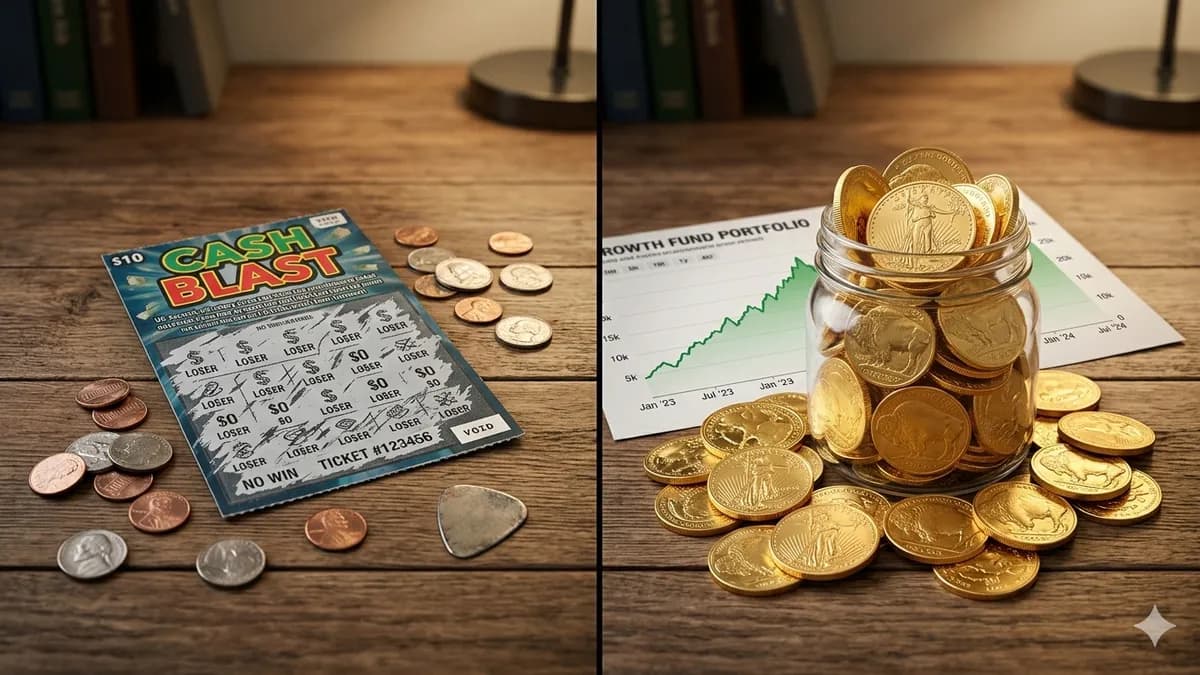
Redirecting lottery spending into investments produces dramatically better outcomes. The average lottery player spends $50 to $100 per month on tickets that return only about 53 cents per dollar. That same $50 per week in an S&P 500 index fund at the historical 10% average return becomes roughly $163,750 in 20 years. Every realistic alternative, including a basic savings account, beats the lottery.
The average lottery player spends $50 to $100 per month on tickets with an expected return of about 53 cents per dollar. That same $50/week in an S&P 500 index fund becomes roughly $163,750 in 20 years at the historical 10% average return. Over 10 years, $20/week in lottery tickets loses you $4,900. The same amount in an index fund gains $7,100. Every alternative beats the lottery.
The numbers tell the whole story:
You Already Have the Money
Here is the part nobody tells you: you do not need to "find" extra money to start building wealth. You are already spending it. You are just spending it on the wrong thing.
If you buy lottery tickets, you are making a weekly investment. You are just investing in a system designed to take your money and give almost nothing back. The lottery is not a game. It is a tax on hope. And the math proves it.
So what happens if you take that same money, the exact same amount you are already comfortable spending, and put it somewhere that actually works in your favor?
Let's run the numbers.
The Baseline: What You Are Already Spending
The average American lottery player spends between $50 and $100 per month on tickets. Some spend far more. But let's keep this conservative and use two scenarios:
- $20 per week = $1,040 per year
- $50 per week = $2,600 per year
That is money you are already parting with. You have already decided you can live without it. The only question is where it goes next.
Scenario 1: High-Yield Savings Account (4.5% APY)
This is the safest, most boring option. You open a high-yield savings account and deposit your lottery money every week. No risk. FDIC insured. Your money just sits there and grows.
At 4.5% annual percentage yield, here is what your lottery money becomes:
At $20/week ($1,040/year):
| Timeframe | Total Deposited | Account Value |
|---|---|---|
| 5 years | $5,200 | $5,740 |
| 10 years | $10,400 | $12,640 |
| 20 years | $20,800 | $32,040 |
At $50/week ($2,600/year):
| Timeframe | Total Deposited | Account Value |
|---|---|---|
| 5 years | $13,000 | $14,350 |
| 10 years | $26,000 | $31,600 |
| 20 years | $52,000 | $80,100 |

Nothing flashy. No excitement. Just your money, growing quietly while you sleep.
Compare that to the lottery, where your expected return on every dollar spent is about 53 cents. Over 20 years of $20/week lottery spending, you would put in $20,800 and get back roughly $11,000 in winnings. You lost almost ten thousand dollars. The savings account gained over eleven thousand. The gap between those two outcomes is over $20,000.
And this is the boring option.
Scenario 2: S&P 500 Index Fund (~10% Historical Average)
Now let's put that money to work. The S&P 500 has returned roughly 10% per year on average over the last several decades. Some years it drops. Some years it surges. But over long stretches, the trend is clear.
You do not need to pick stocks. You do not need to watch CNBC. You just buy an index fund and keep adding to it. That is dollar cost averaging, and it works.
At $20/week ($1,040/year):
| Timeframe | Total Deposited | Portfolio Value |
|---|---|---|
| 5 years | $5,200 | $6,700 |
| 10 years | $10,400 | $17,500 |
| 20 years | $20,800 | $65,500 |
At $50/week ($2,600/year):
| Timeframe | Total Deposited | Portfolio Value |
|---|---|---|
| 5 years | $13,000 | $16,750 |
| 10 years | $26,000 | $43,750 |
| 20 years | $52,000 | $163,750 |
Read that last line again. $52,000 in total contributions becomes over $163,000. That is the power of compound growth over time. The same money. The same weekly habit. Just a different destination.
And you did not need to get lucky. Not once.
Scenario 3: Bitcoin DCA (~50%+ Annualized Over the Last Decade)
Bitcoin is the most volatile option on this list. It is also the one that has dramatically outperformed everything else over the past decade.
From 2014 to 2024, Bitcoin's compound annual growth rate exceeded 50%. That number comes with massive swings. There have been years where Bitcoin dropped 70% or more. If you bought at a peak and panicked, you got crushed. But if you dollar cost averaged, buying a fixed amount every single week regardless of price, the volatility worked in your favor. You bought more when it was cheap, less when it was expensive.
For these projections, we will use a more conservative 30% annualized return to account for the likelihood that growth rates moderate as Bitcoin matures. Even at this reduced rate, the numbers are striking.
At $20/week ($1,040/year) at 30% annualized:
| Timeframe | Total Deposited | Portfolio Value |
|---|---|---|
| 5 years | $5,200 | $10,800 |
| 10 years | $10,400 | $49,200 |
| 20 years | $20,800 | $631,000 |
At $50/week ($2,600/year) at 30% annualized:
| Timeframe | Total Deposited | Portfolio Value |
|---|---|---|
| 5 years | $13,000 | $27,000 |
| 10 years | $26,000 | $123,000 |
| 20 years | $52,000 | $1,577,500 |
Important disclaimers: Past performance does not guarantee future results. Bitcoin is volatile. There will be periods where your portfolio is down 30%, 50%, even 70% from its highs. These projections use a rate well below Bitcoin's historical average, but future returns could be lower still. This is not financial advice. Do your own research.
That said, the underlying trend is worth understanding. Bitcoin has a fixed supply. Only 21 million will ever exist. As demand increases and supply remains capped, the math favors long-term holders. Starting with as little as $20 a week removes the pressure of trying to time the market.
The Comparison: All Three vs. The Lottery
Here is every option side by side. Twenty dollars a week for 10 years. Same money. Different choices.
| Where Your $20/Week Goes | 10-Year Total In | 10-Year Value | Net Gain/Loss |
|---|---|---|---|
| Lottery tickets | $10,400 | ~$5,500* | -$4,900 |
| High-yield savings (4.5%) | $10,400 | $12,640 | +$2,240 |
| S&P 500 index fund (10%) | $10,400 | $17,500 | +$7,100 |
| Bitcoin DCA (30%) | $10,400 | $49,200 | +$38,800 |
*Lottery expected return calculated at ~53 cents per dollar spent, the average across U.S. state lotteries.
Every single alternative beats the lottery. The high-yield savings account, the most conservative option imaginable, still puts you nearly $7,000 ahead of lottery tickets over a decade. The S&P 500 puts you $12,000 ahead. Bitcoin, even at a conservative estimate, puts you over $43,000 ahead.
-$4,900
Net loss from $20/week in lottery tickets over 10 years (vs. +$7,100 in the S&P 500)
Multi-State Lottery Association, NYU Stern historical data
That negative number is the part the billboards never show. A decade of $20 weekly tickets is not just "breaking even while you wait for the big one." It is actively losing $4,900 of your own money to a system that prints tickets faster than it prints winners. The state has already decided, on average, that it is keeping about half of what you hand over.
If any private company offered a product with a guaranteed negative expected return and advertised it on highway billboards, regulators would shut it down within a week. Because the state runs the lottery, the same math gets called "entertainment." Same outcome. Different branding.
Now compare that same $20 a week to the boring end of the spectrum. Not Bitcoin. Not day trading. Just a plain index fund. The chart below shows what happens when you stop paying the lottery tax and start letting time do the work instead.
$20/Week for 10 Years: Lottery vs. Real Investments
Net gain or loss on $10,400 total invested over 10 years
Sources: Multi-State Lottery Association, NYU Stern, FDIC, BTC historical data
The lottery is not an investment. It is a leak.
That is the blunt version, and it is the version nobody wants on the evening news. The lottery has been sold to generations of working people as "a harmless shot at a better life." The math says it is a $450 weekly drip feed out of the poorest zip codes in America, dressed up as entertainment.
The same twenty dollars, redirected, is the difference between a retirement and no retirement. That is not an exaggeration. Run the thirty-year numbers yourself and see.
Ready to redirect your lottery money?
Join thousands learning how to turn small weekly amounts into real wealth.
"But I Might Win!"
You might. And you might get struck by lightning on the way to cash the check.
The odds of winning a major lottery jackpot are roughly 1 in 292 million for Powerball. To put that in perspective, you are about 20,000 times more likely to be hit by lightning in your lifetime than to win Powerball.
Here is what the math actually says: if you spend $20 a week on Powerball for your entire adult life, roughly 50 years, your expected total winnings (including the small prizes) are around $27,500. Your total spend? $52,000. You lose more than half.
Meanwhile, the S&P 500 at that same $20/week for 50 years? Over $1.4 million.
The lottery sells you a fantasy to keep you from doing the one thing that would actually change your life: consistently putting small amounts into things that grow.
Nobody who got wealthy did it by winning the lottery. They did it by showing up, week after week, and letting time and compounding do the work. That is not exciting. It is not a dream. It is just math. And the math is on your side if you let it be.
How to Actually Make the Switch
Knowing the math is step one. Acting on it is everything. Here is how to redirect your lottery money starting this week:
1. Pick your amount. Whatever you currently spend on lottery tickets, that is your number. If you are not sure, start with $20 a week. You will not miss it. You were already spending it.
2. Set up automatic transfers. Remove willpower from the equation. Set up a recurring weekly buy or transfer so the money moves without you thinking about it. This is dollar cost averaging, and automation is the key to making it stick.
3. Choose where to put it. You do not have to pick just one:
- High-yield savings: Open an account at an online bank. Ally, Marcus, or Wealthfront all work. Link your checking account and set up weekly transfers.
- S&P 500 index fund: Open a brokerage account (Fidelity, Vanguard, Schwab). Buy a total market index fund. Set up automatic investing.
- Bitcoin: Use a reputable exchange or app (Strike, Cash App, River, Swan Bitcoin). Set up a recurring weekly purchase. Learn about self-custody when you are ready.
4. Stop buying lottery tickets. This is the hard part, not because you need the money, but because the habit is comfortable. Replace the ritual. Every time you would have bought a ticket, check your investment balance instead. Watch it grow. That is your new dopamine hit.
5. Track your progress. Write down your starting date and amount. Check in monthly. In three months, you will have more than most lottery players win in a year. In a year, you will wonder why you ever played.
The money is already in your budget. The habit is already formed. You are just pointing it somewhere that actually works.
The Bottom Line
You do not need to earn more money to start building wealth. You need to stop handing it to a system that is designed to take it from you.
The lottery preys on the hope that one big moment will change everything. But real financial change does not come from one moment. It comes from a thousand small ones. A twenty dollar bill, redirected every week, quietly compounding in the background while you live your life.
The system was never going to teach you this. That is why you are here.
Pick your amount. Pick your vehicle. Set up a recurring weekly buy today. The math will take care of the rest.
Pick your number. Pick your vehicle. Start this week. The math will take care of the rest.
Frequently Asked Questions
This article is for educational purposes only and does not constitute financial advice. Untaught does not hold, move, or custody any funds. Past performance does not guarantee future results. Always do your own research before making investment decisions.
Quick calculator
Your coffee money could have become
$16,301
from $9,900 invested