What Is Compound Interest? The Most Powerful Force Nobody Explained to You
Compound interest turns $20/week into $105,000+ over 30 years at 7% returns. Here's exactly how it works, with real math and zero jargon.
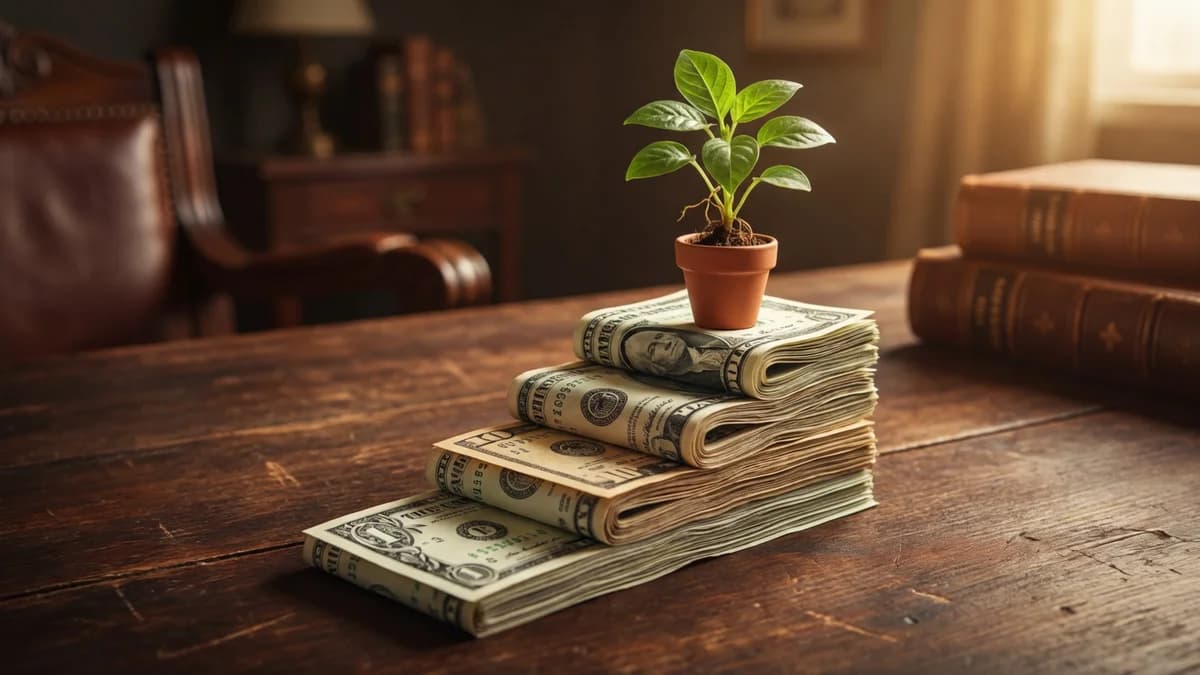
Compound interest is interest earned on both your original principal and the interest you have already accumulated. A $1,000 investment earning 10% annually becomes $1,100 after year one. In year two, you earn 10% on $1,100, not $1,000. This compounding effect accelerates over time, which is why starting early matters far more than starting with a large amount.
Albert Einstein probably never called compound interest "the eighth wonder of the world." That quote gets passed around the internet like gospel, but nobody can actually source it. You know what the real irony is, though? It doesn't matter who said it. The math speaks for itself.
Compound interest is the single most important concept in personal finance. It's the reason a 22-year-old investing $20 a week can retire comfortably, while a 42-year-old investing $50 a week might struggle to catch up. It's the force behind every retirement fund, every student loan that spirals out of control, and every savings account that doesn't grow fast enough to matter.
And nobody taught you how it works. Not in middle school. Not in high school. Not ever. That wasn't a scheduling conflict. That was a choice.
Compound interest means your money earns returns, and then those returns earn their own returns. $20/week at 7% average annual returns grows to $105,700 over 30 years (NYU Stern). You put in $31,200. Compounding added $74,500. It works against you too: a $5,000 credit card balance at 24.6% APR costs over $7,700 in interest if you only make minimum payments. Same force, different direction.
Let's fix it right now. In plain English. With real numbers.
What Is Compound Interest, Actually?
Here's the simplest explanation you'll ever get.
Your money makes money. Then that money makes money too.
That's it. That's compound interest.
Let's make it concrete. Say you put $1,000 into an account that earns 7% per year.
After year one, you've earned $70. Your balance is $1,070.
After year two, you don't earn another $70. You earn 7% on $1,070, which is $74.90. Now you have $1,144.90.
After year three, you earn 7% on $1,144.90. That's $80.14. Balance: $1,225.04.
See what happened? Each year, you earned more than the year before. Not because the rate changed. Because the pile of money getting multiplied kept growing.
That's the "compounding" part. Your earnings generate their own earnings. And those earnings generate earnings. It's a snowball rolling downhill, getting bigger with every rotation.
In 10 years, that $1,000 becomes $1,967. You nearly doubled your money without doing a single thing after the initial deposit. In 30 years? $7,612. Your money made more than six times itself.
Why Didn't Anyone Teach You This?
This is the part that should make you angry.
Compound interest is not advanced finance. It's multiplication. A middle schooler could understand it with 15 minutes of explanation and a calculator.
The National Financial Educators Council found that Americans lost an average of $1,819 per person in 2022 due to financial illiteracy (NFEC, 2022). Multiply that by 250 million adults. That's over $450 billion in avoidable losses, every year.
And yet, as of 2025, only 26 states require a personal finance course for high school graduation (Council for Economic Education, 2024). That means roughly half the country graduates without a single lesson on how their money grows, or how debt devours them.
Who benefits from that ignorance? Credit card companies. Payday lenders. The entire $14 billion tax preparation industry. Everyone who profits when you don't understand the rules.
When I first learned about compounding in my late twenties, I didn't feel enlightened. I felt robbed. All those years of earning interest on nothing, while my student loans were compounding against me. Nobody warned me. Nobody warned you either.
The $20-a-Week Breakdown
Let's stop talking in theory. Let's talk about $20 a week. That's the cost of a decent lunch and a coffee. That's a single impulse buy on Amazon. That's the money you won't remember spending next Tuesday.
Here's what happens if you invest $20 a week at a 7% average annual return, which is roughly the historical average of the U.S. stock market adjusted for inflation (NYU Stern, 2024).
| Time Period | Total You Invested | What It's Worth | Growth from Compounding |
|---|---|---|---|
| 10 years | $10,400 | ~$15,000 | ~$4,600 |
| 20 years | $20,800 | ~$45,100 | ~$24,300 |
| 30 years | $31,200 | ~$105,700 | ~$74,500 |
Read that last row again. You put in $31,200 of your own money. Compounding added $74,500. More than double what you contributed. You didn't work for that money. Your money worked for it.
The Hockey Stick: How $20/Week Compounds Over 40 Years
$20/week invested at 7% average return (S&P 500 inflation-adjusted)
Source: NYU Stern, historical S&P 500 data (7% inflation-adjusted)
And that's at 7%. At 10% (the S&P 500's historical nominal average), $20 a week for 30 years grows to roughly $180,000.
Want to see the full breakdown? Read: $20 a week for 10 years.

Your Daily Coffee, Measured in Decades
Here's an exercise that might ruin your morning routine. Or save your retirement. Maybe both.
A $6 daily coffee habit costs $2,190 per year. That's not a typo. Six dollars, every day, 365 days. If you invested that same amount at 7% average returns:
- After 10 years: ~$31,500
- After 20 years: ~$94,700
- After 30 years: ~$222,600
Nobody is telling you to give up coffee. (Seriously, don't come for me.) But look at the 30-year number. $222,600. That's a house down payment in most of the country. That's a decade of retirement income. That's what compounding does with a daily habit that most people never think twice about.
Now do the same math with eating out for lunch. The average American restaurant lunch costs about $15 (U.S. Bureau of Labor Statistics, 2024). If you packed lunch three days a week instead and invested the $45 savings weekly at 7%:
- After 10 years: ~$33,800
- After 20 years: ~$101,700
- After 30 years: ~$238,200
These aren't fantasy numbers. This is basic math. The same math nobody taught you in school.
How Does Compound Interest Differ from Simple Interest?
Simple interest only pays you on your original deposit. Compound interest pays you on your deposit plus everything it's already earned.
Here's the difference in action. $10,000 at 7% for 30 years:
- Simple interest: $10,000 + ($700 x 30) = $31,000
- Compound interest: $10,000 growing at 7% compounded annually = $76,123
Same starting amount. Same rate. Same time period. Compound interest produced $45,123 more. That's the gap between "your money sits there" and "your money works for you."
This is why a savings account paying 0.01% is quietly devastating. Your balance barely moves while inflation, which has averaged about 3.3% annually since 1914 (U.S. Bureau of Labor Statistics, 2024), eats your purchasing power alive. Your money isn't safe in that account. It's shrinking. Your money is losing value.
Why Does Time Matter More Than Amount?
Here's the most counterintuitive lesson in personal finance: when you start matters more than how much you invest.
Consider two people. Person A invests $100 per month starting at age 22 and stops at 32. Ten years of contributions. $12,000 total invested. Then they never invest another cent.
Person B waits until 32 and invests $100 per month until 62. Thirty years of contributions. $36,000 total invested. Three times more money put in.
At 7% average returns:
- Person A (started at 22, invested for 10 years, then stopped): ~$220,000 at age 62
- Person B (started at 32, invested for 30 years): ~$122,000 at age 62
$220K vs. $122K
Person A (started at 22, invested 10 years) vs. Person B (started at 32, invested 30 years)
Standard compound interest at 7% annual returns
Person A invested one-third the money and ended up with nearly double the result. That sounds impossible. It's not. It's compounding. Those first 10 years gave Person A's money 40 years to compound. Person B's earliest contributions only had 30 years. The late start cost $98,000 in growth, even with three times the contributions.
Every year you wait is the most expensive year of your life. Not because you're losing money, but because you're losing time. And time is the only ingredient compound interest truly needs.
This is the math teachers skip over in high school and advisors fail to impress on new clients. You can out-save a late start, but you cannot out-save time. A twenty-two-year-old contributing pocket change beats a forty-year-old contributing real money if the gap is long enough. The universe doesn't care that the older one earns more. It only cares how many compounding cycles have already run.
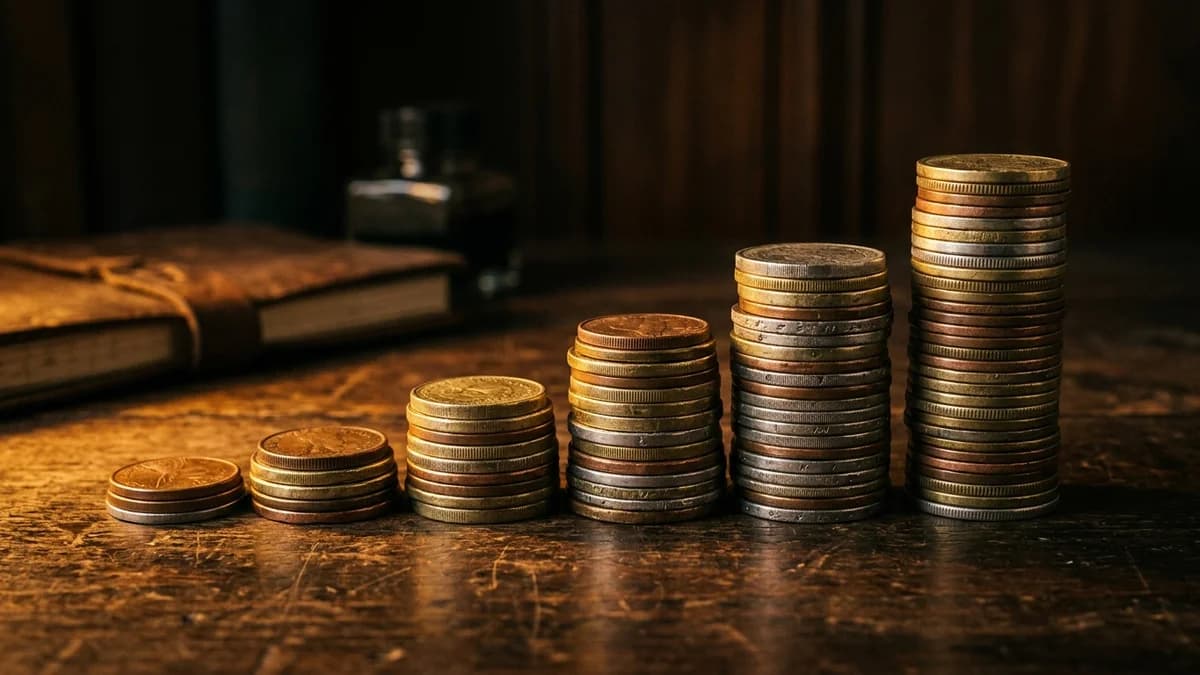
The image above looks like a simple stack of coins. Each step is worth more than the one below it, and the bottom step is the reason the top one exists. That's compounding in physical form. Remove the first coin and the entire stack collapses. Add it and wait long enough and the stack grows past the table.
Which is the case for you? The answer isn't "someday." The answer is this pay period or never.
The coins on a table metaphor breaks down eventually, because a real balance doesn't grow in neat even stacks. It grows in irregular bursts that feel disappointing right up until they don't. Markets dip. Balances stagnate. Then a year later you look up and the curve has lifted past what it had any right to be.
Time is the one thing you can't get back.
Join thousands learning to put compound interest on their side before another year slips away.
Compounding Works Against You Too
Everything we've covered so far is the upside. But compound interest has a dark side, and it's the side most people encounter first.
Credit card debt compounds. The average credit card interest rate hit 24.6% in 2024 (Federal Reserve, 2024). If you carry a $5,000 balance and make only minimum payments, you'll pay over $7,700 in interest. It will take more than 20 years to pay off. A $10,000 balance? Over 34 years and $34,600 total.
Student loans compound. Auto loans compound. Payday loans, with their average 400% APR (CFPB, 2024), compound so aggressively they should be classified as financial weapons.
When you're the investor, compounding builds your wealth quietly. When you're the borrower, compounding destroys it quietly. Same force. Different direction. And the system is designed to put you on the wrong side of it before anyone explains how it works.
That $5,000 credit card balance at 24.6% is compounding against you every single day you carry it. Meanwhile, the credit card company is collecting that compound interest as revenue. You paying interest is their investment return. Think about that. If you want to see the exact daily math, read how credit card interest is calculated.
How Do You Put Compounding to Work?
The formula is embarrassingly simple. Three steps.
Step 1: Start now. Not next month. Not when you get a raise. The math we just covered proves that timing beats amount every single time. Even $5 a week is enough to begin.
Step 2: Automate it. Set up a recurring investment so the decision is made once. If you have to manually remember every week, you'll stop. Automation removes willpower from the equation. Read: How to invest $20 a week.
Step 3: Don't touch it. Every time you withdraw early, you're not just losing the money you took out. You're losing all the future compounding that money would have generated. The snowball doesn't work if you keep breaking pieces off.
That's it. Start. Automate. Leave it alone. The math does the rest.
Compound interest is the single most important concept in personal finance. It builds wealth when it works for you and destroys it when it works against you. The difference between the two comes down to one thing: whether someone explained it to you before you signed your first credit card application.
You now have the concept. The next step is applying it. That means picking an account, picking an amount, and setting up an automatic transfer that runs without you having to think about it. Whether that's a Roth IRA, a brokerage account, a weekly Bitcoin buy, or some mix of the three, the form matters less than the fact that something is running in the background while the rest of your life happens in the foreground.
Compounding rewards people who start. It punishes people who wait. It does not care which category you're in. It only responds to whether contributions are showing up or not.
Frequently Asked Questions
What to Read Next
Compound interest is the engine. But it needs fuel. The fuel is consistent, small contributions over time, a strategy called dollar cost averaging. If you understand compounding but don't have a plan for how to actually invest on a regular schedule, start there.
And if you want to see the exact numbers for a realistic weekly amount, check out $20 a week for 10 years. The table will make the abstract feel very, very concrete.
This article is part of the Nobody Taught You This series, exploring the financial concepts the education system skipped. That wasn't an accident. But now that you know, what you do next is entirely up to you.
This article is for educational purposes only and does not constitute financial advice. Untaught does not hold, move, or custody any funds. Past performance does not guarantee future results. Always do your own research before making investment decisions.
Quick calculator
Your coffee money could have become
$16,301
from $9,900 invested