$20 a Week for 10 Years: What Your Money Could Become
$20/week is $10,400 over 10 years. At the S&P 500's historical 10% average return, it grows to over $17,000. Here's the math for three paths.
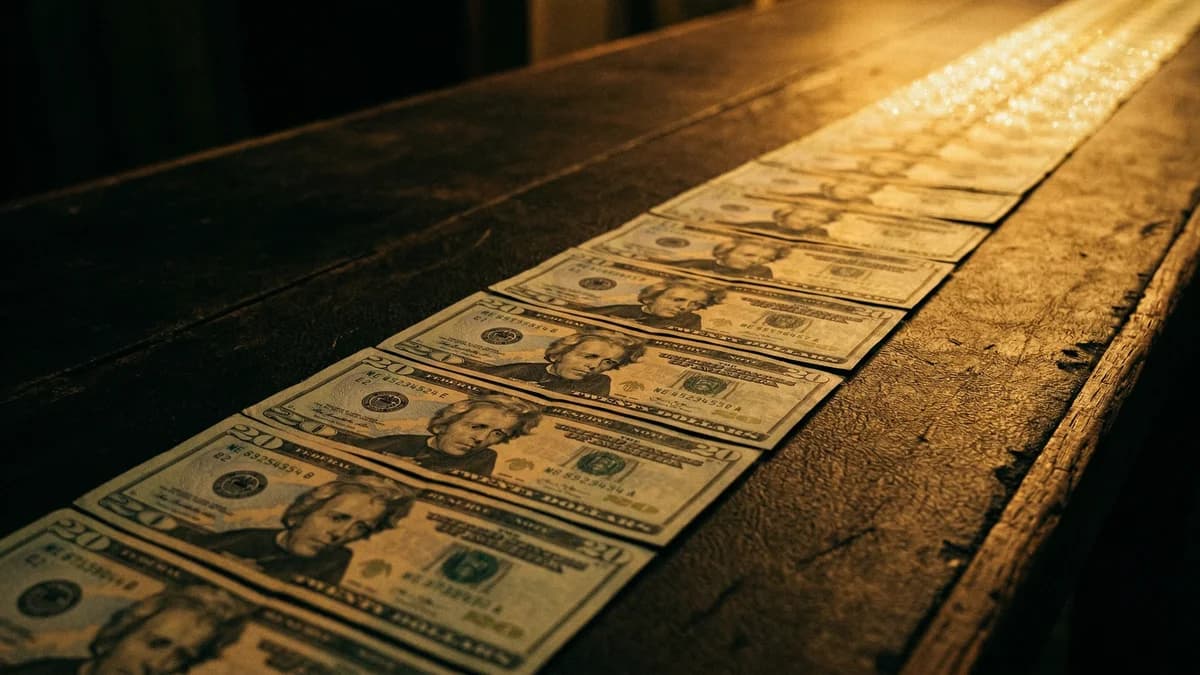
Investing $20 a week for 10 years means contributing $10,400 total. Where that money goes determines the outcome. In a standard savings account at 0.5%, it grows to roughly $10,700. In an S&P 500 index fund at the historical 10% average annual return, it reaches approximately $17,400. The gap between those two numbers, about $6,700, represents the cost of not knowing where to put your money.
Most people think $20 is not enough to matter. Grab lunch. Buy a coffee and a snack. Toss it at a scratch ticket. Gone by Tuesday.
But $20 a week, put somewhere it can grow, turns into real money. Not theoretical. Not "if you win the lottery" money. Real, sitting-in-your-account, watch-it-compound money.
Over 10 years, $20 a week adds up to $10,400 in contributions. That is the baseline. The floor. What happens next depends entirely on where you put it. A basic savings account? An index fund? Bitcoin? Each path leads somewhere different.
Let's look at all three. No hype. Just the math.
$20 a week adds up to $10,400 over 10 years. In a savings account at 0.5%, that becomes roughly $10,700. In an S&P 500 index fund at the historical 10% average, it grows to about $17,400 (NYU Stern). The biggest risk is not picking the wrong option. It is doing nothing.
Every projection in this article uses one model, so the rows are comparable: you contribute the same amount every period, and the balance grows at the stated annual rate. Written out, that is FV = C × ((1 + r)^n - 1) / ((1 + r)^(1/52) - 1) for weekly contributions, with 1/12 in place of 1/52 for the monthly version. All figures are rounded to the nearest $100.
Read more: What Is Dollar Cost Averaging? | You're Already Wasting Money
Where Does $20 a Week Even Come From?
You are probably already spending $20 a week on stuff that vanishes. According to the Bureau of Labor Statistics Consumer Expenditure Survey, the average American household spent $3,945 on food away from home in 2024. That works out to roughly $76 per week on takeout and restaurants alone.
$20 a week is skipping the drive-thru lunch three times. Or making coffee at home instead of buying it. Or canceling one streaming service you have not opened in two months.
You are not adding a new bill. You are redirecting money that was already leaving your pocket. The dollars are the same. The destination changes.
Some common places that $20 a week is already hiding: coffee runs at $5 a day, forgotten subscriptions (a C+R Research survey found consumers were actually spending $219 a month on subscriptions while estimating they spent $86, a gap of $133 a month they did not know they had), impulse Amazon purchases, lunch out three times a week, and lottery tickets (state lottery ticket sales hit $104.7 billion in fiscal 2024, per the U.S. Census Bureau's Annual Survey of State Government Finances). You do not need to earn more. You need to catch the money already slipping away.
Read more: You're Already Wasting Money
What If You Think in Monthly Terms? ($100 a Month)
A lot of people budget by the month, not the week. If that is you, the same idea scales cleanly: $20 a week is about $87 a month, and $100 a month is roughly $23 a week. The number changes, the math does not.
One hundred dollars a month is a phone bill. A gym membership you barely use. A couple of takeout dinners. Over 10 years, that is $12,000 in contributions. Here is where each path lands on $100 a month:
| Vehicle | Assumed Return | Total In (10 yrs) | Value After 10 Years | Net Gain |
|---|---|---|---|---|
| Savings account | 0.5% | $12,000 | $12,300 | +$300 |
| S&P 500 index fund | 10% | $12,000 | $20,000 | +$8,000 |
| Bitcoin (high-growth scenario) | 15% | $12,000 | $26,000 | +$14,000 |
After a decade of saving $100 every month in a basic savings account, you earned about $300 in interest. That is roughly $2.50 a month, less than a gas station coffee. Adjusted for inflation at 3% a year, the things that cost $12,000 when you started cost closer to $16,100 ten years later, so you are about $3,800 behind in real purchasing power. The index fund nearly doubled your money. The Bitcoin row is the same 15% high-growth column used later in this article, not a forecast, and it comes with the volatility described below: drops of 75% to 80% from the peak, more than once.
Whether you frame it as $20 a week or $100 a month, the lesson is identical: a savings account preserves, an index fund grows, and where you put the money matters far more than the exact amount.
There is one more reason the monthly framing is worth understanding. Compounding rewards time more than size. If you start a $100 a month habit at age 25, by 35 you have a real head start. If you wait until 35 to begin, you have not just lost 10 years of contributions, you have lost 10 years of compounding on top of those contributions. That second loss is the expensive one, and it is the part you can never buy back. A smaller amount started today almost always beats a larger amount started "once things settle down." The rest of this article uses the $20 a week numbers, but every chart and table scales the same way if you prefer to think in monthly terms. Multiply the weekly figures by roughly 4.3 and you are looking at the monthly version of the same story.
What Happens If You Put $20 a Week in a Savings Account?
A regular savings account pays almost nothing. The FDIC national rate, which averages every insured bank and credit union reporting data, sits at 0.38% for savings. The tables below use 0.5%, rounding up in the savings account's favor, and it still loses.
At 0.5%, your money barely moves. Here is what $20 a week becomes:
| Time Period | Total Deposited | Account Value | Growth |
|---|---|---|---|
| 10 years | $10,400 | $10,700 | +$300 |
| 20 years | $20,800 | $21,900 | +$1,100 |
| 30 years | $31,200 | $33,700 | +$2,500 |
After 10 years, you have gained about $300. That is roughly $2.50 a month. Your money sat there and did almost nothing.
Here is the worse news. Inflation in the U.S. has averaged about 3% per year over the long run, according to the Bureau of Labor Statistics Consumer Price Index. At 0.5% interest and 3% inflation, your money is actually losing purchasing power every single year. That $10,700 in your account buys less than the $10,400 you put in.
A savings account feels safe. But it is quietly working against you.
The FDIC national average savings rate is 0.38% (FDIC), while inflation has averaged roughly 3% a year over the long run (BLS Consumer Price Index). At those rates, $20 a week in a savings account loses purchasing power every year, even as the dollar amount slowly rises.
What About an S&P 500 Index Fund?
The S&P 500, a collection of the 500 largest U.S. companies, has returned an average of about 10% per year since 1928, according to data from NYU Stern School of Business. In that dataset, $100 invested at the start of 1928 with dividends reinvested was worth $1,157,598.95 at the end of 2025, a 10.02% geometric return across 98 years. That is the number before adjusting for inflation. After inflation, it drops to roughly 7%.
We will use the 10% nominal figure here so you can compare apples to apples with the savings account numbers above.
| Time Period | Total Deposited | Portfolio Value | Growth |
|---|---|---|---|
| 10 years | $10,400 | $17,400 | +$7,000 |
| 20 years | $20,800 | $62,400 | +$41,600 |
| 30 years | $31,200 | $179,300 | +$148,100 |
Look at that 30-year row. You put in $31,200. You walk away with $179,300. The extra $148,100 came from compound growth. Your money made money. Then that money made money. Then that money made money. That is how compound interest works, and it is the most powerful force in personal finance.
The hardest part is not the investing itself. It is sitting still during the bad years. In the same NYU Stern series, the S&P 500 returned negative 36.55% in 2008 and negative 18.04% in 2022, dividends included. If you sold during those dips, you locked in losses. If you kept buying your $20 a week through the worst of it, you picked up shares at a discount. Every crash in history, so far, has been followed by a recovery.
That does not mean it is guaranteed. But a century of data is a strong track record.
Why Does It Grow So Much More?
The difference between 0.5% and 10% sounds small. It is not. Compound growth is not a straight line. It is a curve that gets steeper the longer you wait.
At 0.5%, your money doubles roughly every 139 years. At 10%, it doubles about every 7 years. That is why the 30-year numbers look like a typo compared to the savings account. They are not a typo. They are just math.
The S&P 500 has returned an average of roughly 10% annually since 1928 (NYU Stern). At that rate, $20 a week grows to approximately $179,300 over 30 years, with $148,100 of that coming from compound growth alone.
What If You Put $20 a Week Into Bitcoin?
Bitcoin is harder to project than an index fund. It has only existed since 2009, and its price history is wildly volatile. But the data we do have is worth examining.
One documented run of the numbers: Bitcoin Magazine found that putting $10 a week into Bitcoin over a five-year stretch turned $2,620 of contributions into $7,913.20, a 202% return. Over the same five years and the same $10 a week, gold returned 34.47%, Apple stock 79.13%, and the Dow Jones Industrial Average 23.43%. Scale that Bitcoin result to $20 a week and you are looking at roughly $15,800 from $5,240 contributed.
But here is the honest part, and it is the part that decides whether you actually keep the money. Bitcoin fell about 81% from its December 2017 peak near $20,000 to roughly $3,700 in December 2018. It fell about 76% from its November 2021 peak near $69,000 to roughly $16,500 in December 2022. If you started buying right before one of those crashes, your portfolio was deep in the red for months, sometimes years. The people who came out ahead were the ones who kept buying through the pain. Note too that any five-year window is a choice: pick a different start date and the same strategy produces a very different number.
Bitcoin's historical returns are real, but they come from a period when adoption was growing from nearly zero. Nobody credible expects 50%+ annual returns going forward. As the asset matures and market cap increases, most analysts expect growth rates to moderate. What matters is not the exact number. What matters is that Bitcoin offers something no other asset on this list does: a hard cap of 21 million coins that no government can change. In a world where the dollar is being printed into oblivion, that scarcity has value.
A Conservative Bitcoin Projection
Rather than project Bitcoin's past returns into the future, here is a range of scenarios:
| Assumed Annual Return | $20/week After 10 Years | After 20 Years | After 30 Years |
|---|---|---|---|
| 15% | $22,600 | $114,200 | $484,600 |
| 25% | $38,700 | $398,700 | $3,752,100 |
| 40% | $86,000 | $2,574,700 | $74,559,200 |
These numbers get wild fast, and the bottom-right corner should tell you something. The 40% row is arithmetic, not a projection. No asset in history has sustained a 40% annual return for 30 years, and if one did, $74 million from $31,200 of contributions would mean the rest of the economy had come apart. Treat that row as a demonstration of how violently compounding scales, not as a number anybody should plan around.
The 15% row is the only one worth taking seriously as a long-horizon planning figure, and even that is optimistic. Higher potential reward comes with higher risk. Bitcoin is not a savings account and it is not a guarantee.
There is a second reason to distrust the right-hand columns specifically. A 30-year projection on a volatile asset assumes you hold it for 30 years, and almost nobody does. The table quietly prices in a level of stomach that very few people actually have. Between you and the 30-year cell sit two or three drawdowns of 70% or more, each lasting a year or longer, each accompanied by confident public arguments that this time the thing is finished for good. The number in the corner is not a prediction about Bitcoin. It is a prediction about you.
So use these rows the way you would use a weather forecast ten days out: for the shape, not the specifics. The shape is that a high-growth asset held through a long stretch produces outcomes that a savings account cannot reach, and that the same asset can cut your balance by three quarters on the way there.
A $10 per week Bitcoin DCA strategy turned $2,620 of contributions into $7,913.20 over five years, a 202% return, versus 34.47% for gold and 23.43% for the Dow over the same window (Bitcoin Magazine). The same asset fell about 81% from its 2017 peak and about 76% from its 2021 peak, so the return and the drawdown are the same package.
How Do All Three Compare Side by Side?
Here is the full picture. Same $20 per week. Same starting point. Three different destinations.
| Vehicle | Assumed Return | After 10 Years | After 20 Years | After 30 Years |
|---|---|---|---|---|
| You contributed | n/a | $10,400 | $20,800 | $31,200 |
| Savings account | 0.5% | $10,700 | $21,900 | $33,700 |
| S&P 500 index fund | 10% | $17,400 | $62,400 | $179,300 |
| Bitcoin (high-growth scenario) | 15% | $22,600 | $114,200 | $484,600 |
The savings account preserved your money. The index fund built real wealth. Bitcoin, at a rate it has cleared in some stretches and missed badly in others, created a different category of outcome entirely.
But here is what matters most: even the "boring" index fund turned $31,200 into $179,300 over 30 years. You do not need to take big risks to get meaningful results. You just need to start.
$145,600
30-year gap between a savings account and an index fund on $20/week
NYU Stern, FDIC data
The gap between the savings account and the index fund after 30 years is $145,600. That gap represents the cost of not knowing where to put your money. Nobody taught you this in school. That was not an accident.
Think about what $145,600 means in real life. That is a paid-off car, a down payment on a house, or years of breathing room in retirement. That is the difference between a system that quietly drains your paycheck and a system that actually compounds in your favor. Same $20. Same person. The only thing that changed was where the money went.
And the number keeps widening the longer you stay in. Compound growth does not care about your stress level or the news cycle. It only cares that you keep showing up.
One more thing worth noticing in that table: the savings account row is the only one where the ending value stays close to what you put in. After 30 years you contributed $31,200 and finished with $33,700. Everything you gained came from your own paycheck. In the index fund row, $148,100 of the ending balance was never yours to begin with. It was created by time. That is the actual difference between saving and investing, and it is not a difference of degree.
Ready to see what your $20 could become?
Join thousands learning how small, consistent action builds real wealth over time.
Which One Should You Pick?
There is no single right answer. But your situation narrows it down fast.
| Where you are right now | What to do with the $20 | Why |
|---|---|---|
| No emergency fund yet | All of it into a high-yield savings account | Build a $1,000 to $2,000 cushion first. Online banks like Ally and Marcus were paying in the high 3% to low 4% range as of August 2026, against a 0.38% national average. Then start investing. |
| Cushion in place, want proven growth | All of it into an S&P 500 index fund | The most battle-tested path for regular people. Warren Buffett has recommended exactly this approach for non-professionals repeatedly over decades. |
| Want some Bitcoin exposure | $5 or $10 of it into Bitcoin, the rest into the index fund | Participate in the upside without betting everything on one asset. |
| Want a bit of everything | $10 index fund, $5 Bitcoin, $5 high-yield savings | Growth, upside, and liquidity in one split. Adjust as your comfort level grows. |
Whichever row you land on, the split is a detail you can revise later. The account you open this week is the part you cannot go back and get.
The worst option? Doing nothing. Leaving your $20 in a checking account earning 0.01%. Or spending it on something that is gone by the end of the day.
How Do You Actually Start?
Knowing the math is not the same as doing it. The good news: the barriers that used to keep regular people out of investing, the $3,000 account minimums, the $50 trade commissions, the advisors who would not call you back without six figures, are gone. You can set any of these up on your phone in about 10 minutes, with no minimum balance. Every option below runs on the same engine: dollar cost averaging, which simply means buying the same dollar amount on a fixed schedule no matter what the price is doing. (Need to free up the $20 first? Start with how to find the money.)
High-yield savings account (HYSA). This is the training wheels option, best if you want zero risk and instant access to your cash. Pick an online bank like Ally, Marcus, or SoFi, which pay in the high 3% to low 4% range as of August 2026 instead of the big-bank 0.01%. Rates move, so check before you open. Open the account (you need your Social Security number, an ID, and a funding source), then set a recurring $20 weekly transfer. FDIC insured, fully liquid, but after inflation your real return hovers near zero. This is where an emergency fund lives, not where wealth gets built.

Index funds via fractional shares. Best for proven long-term growth you can leave alone for 5+ years. Open a free brokerage account at Fidelity, Charles Schwab, or Robinhood, all of which support fractional shares. Search for a broad index fund: common tickers are VTI (Vanguard Total Stock Market), VOO (Vanguard S&P 500), or FXAIX (Fidelity 500 Index). Set up a recurring $20 weekly buy and walk away. Fees are usually under 0.1% a year, and you own a slice of hundreds of companies in a single purchase.
Bitcoin via Strike or Cash App. Best if you want exposure to a fixed-supply asset and can stomach the swings. You do not need to buy a whole coin. You buy a fraction, measured in satoshis, and there are 100 million of them in one Bitcoin. Download Strike or Cash App, verify your identity, then set a recurring buy. In Strike, use "Recurring Buy" and set $20 a week. In Cash App, tap the Bitcoin tab, hit "Buy," then "Recurring." For the full walkthrough, see how to buy Bitcoin on Strike.
I-Bonds (Series I Savings Bonds). Best for money that absolutely cannot lose to inflation. These are U.S. Treasury bonds whose rate resets every six months to track inflation, so your purchasing power is guaranteed to hold. Buy them at TreasuryDirect.gov (the only place), in amounts from $25 up to $10,000 per year. The catch: you cannot touch the money for 12 months, and TreasuryDirect has no automatic recurring purchase, so you set a reminder and buy manually. A hedge, not a growth engine.
You do not have to pick just one. Split your $20: maybe $10 into an index fund and $10 into Bitcoin, or $15 and $5. The exact split matters far less than starting. Imperfect action beats perfect inaction every single time.
What Is the Biggest Risk Here?
It is not a market crash. It is not Bitcoin volatility. It is not picking the "wrong" fund.
The biggest risk is waiting.
You can prove that with the tables on this page, no outside study required. Take the 30-year row. Chasing a better return, moving from 7% to 10%, takes $20 a week from $101,600 to $179,300, a gain of $77,700. Now leave the return alone at 7% and simply save twice as much: $40 a week for 30 years reaches $203,100, a gain of $101,500. Doubling what you set aside beat a three-point improvement in returns, and it is the only one of the two you actually control.

Every week you wait is a week of compound growth you never get back. The math does not care about your reasons for delaying. It just runs the numbers, and the numbers always favor the person who started sooner.
Read more: The "Start Tomorrow" Trap
On this article's own model, raising a $20 a week habit to $40 a week adds $101,500 over 30 years at a 7% return, while keeping $20 a week and lifting the return from 7% to 10% adds $77,700. How much you set aside moves the number more than which asset you pick, and it is the variable you control.
Frequently Asked Questions
The Math Is Clear. The Choice Is Yours.
$20 a week is not life-changing money in the short term. It is lunch money. Coffee money. Money you would not even notice if it disappeared.
Here is every rate in this article on one set of axes, so you can see the whole argument at a glance. The dashed line is what you actually contributed. Everything above it is growth.
$20/Week: How Return Rates Change Everything
Same $20/week, different vehicles, dramatically different outcomes
$20 contributed weekly, balance growing at the stated annual rate. 10% is the S&P 500's long-run average, 1928 to 2025 (NYU Stern). 15% is a high-growth scenario, not a forecast.
But over 10, 20, or 30 years, that same $20 turns into something that could genuinely change your financial future. The savings account preserves it. The index fund multiplies it. Bitcoin, for those willing to ride the volatility, offers a different kind of potential entirely.
None of this was taught in school. Nobody sat you down and showed you a compound growth chart. Nobody explained that the biggest advantage in investing is not money, it is time. And every week you wait, you lose a little more of that advantage.
You do not need a financial advisor. You do not need a big salary. You just need $20, a plan, and the willingness to start before you feel ready.
You do not need to pick the perfect option. You just need to pick one and start. Open an account today. Set up a $20 weekly recurring buy. Come back in a year and look at the number.
Ready for the next step? Scroll back up to how do you actually start, where the four options are broken down step by step. And if you want to understand the engine behind all of these numbers, read What Is Compound Interest?.
This article is part of the Small Steps, Real Results series, which breaks down how ordinary people can build real wealth with small, consistent actions. No jargon. No gatekeeping. Just the math and the method.
This article is for educational purposes only and does not constitute financial advice. Untaught does not hold, move, or custody any funds. Past performance does not guarantee future results. Always do your own research before making investment decisions.
Quick calculator
Your coffee money could have become
$16,301
from $9,900 invested