What to Actually Do With Your $3,000 Tax Refund
The average 2026 tax refund was $3,276 (IRS), the biggest check in six years, and it still buys less than 2021's. Here is what to actually do with yours.
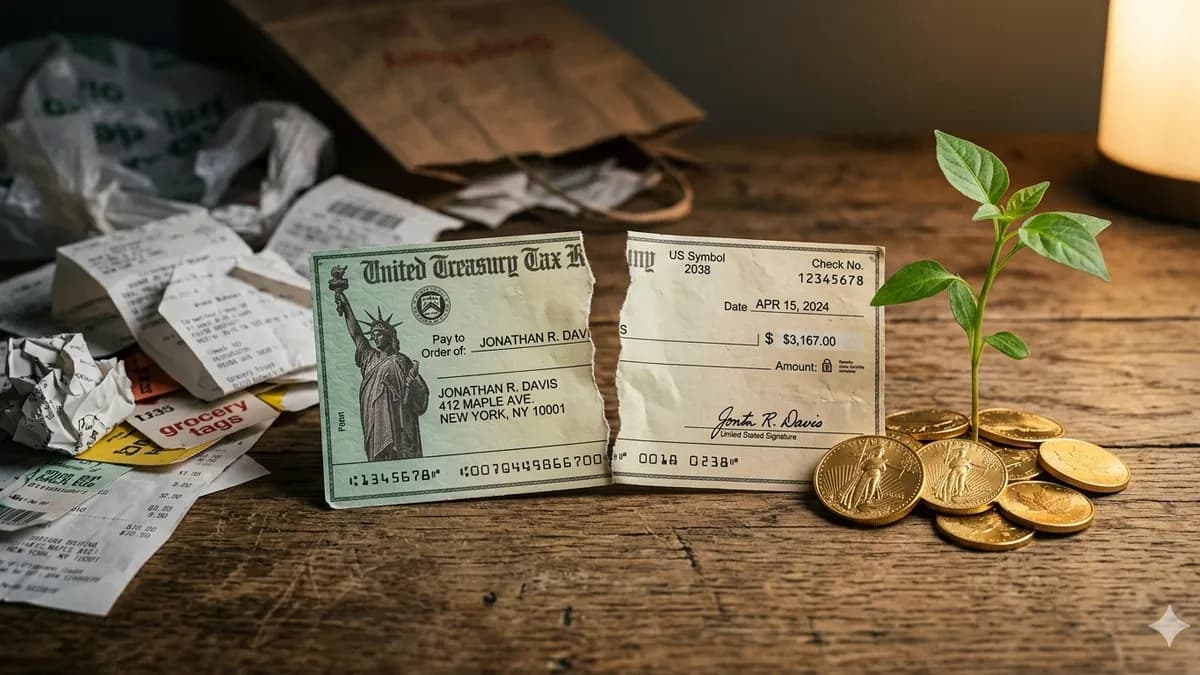
The average U.S. tax refund in the 2026 filing season was $3,276, and the IRS issued 99.1 million of them worth $324.8 billion. Measured at the same point in the season, that is the biggest average refund since at least 2021 in dollar terms, and after inflation it still buys less than the refund people got in 2021. Most of it will be spent within weeks. Put in the right place instead, one refund does more for your future than a year of budgeting.
You're about to get a check from the government. Or maybe you already did.
Through May 8, 2026, the IRS had issued 99,138,000 refunds totalling $324.76 billion, an average of $3,276 each, per its own filing season statistics. A year earlier, at the same point in the season, the average was $2,939. Refunds got 11.5% bigger.
And most of that money will vanish within weeks. Not stolen. Not lost. Just... spent. On stuff that won't matter by summer.
Here's the thing nobody tells you: your tax refund is the single best chance most people get each year to change their financial future. And almost everyone blows it.
The average 2026 refund was $3,276 across 99.1 million refunds (IRS, filing season through May 8, 2026). It is the biggest check in six years in nominal dollars, and in constant dollars it still buys less than the 2021 refund. Put $3,000 of it to work across 2023, 2024 and 2025 and it would have become $3,384 in a savings account, $5,562 in an S&P 500 index fund, or $16,029 in Bitcoin. Spent, it became $0. Your refund is either a shopping spree that fades by April, or the start of something that compounds for decades. You choose.
Read more: Your Money Is Losing Value | What Is Dollar Cost Averaging?
Your Refund Got Bigger. It Also Got Smaller.
Here is the part the "bigger refunds this year" headlines leave out. Measured through early May, the 2026 average refund of $3,276 is the largest since at least 2021 in the dollars printed on the check. Restate every year's refund in today's money using the BLS Consumer Price Index, and the 2021 refund was worth $3,564 in today's terms. The 2022 refund was worth $3,468.
Your Bigger Refund Buys Less Than the Smaller One Did
Average IRS refund, filing season through early May, in that year's dollars and in May 2026 dollars
Sources: IRS filing season statistics (2009 to current year), BLS CPI series CPIAUCNS. Untaught calculation.
So the record-looking check in your account this spring buys about 8% less than the smaller check did five years ago. That is not a complaint about the IRS, which just returns your own overwithheld money. It is the whole Untaught thesis showing up in a single line item: the number went up, the value went down, and nothing on the check tells you that happened.
Which is also why where the money lands matters more than how big it is. You cannot control the size of the refund. You can control whether it gets to keep up.
Where Does the Money Actually Go?
Most of it goes straight back out. The National Retail Federation's 2026 tax returns survey, conducted with Prosper Insights & Analytics among 7,901 adults from January 30 to February 5, 2026, found 56% of consumers expected a refund this year. What they planned to do with it splits along predictable lines.
An Experian survey of 1,000 consumers, fielded March 4 and 5, 2026, found about 40% planned to save or invest their refund and about 20% planned to pay off debt. The rest goes to spending. The income split inside that number is the interesting part: households under $50,000 a year were most likely to put the refund toward everyday expenses, households between $50,000 and $100,000 leaned toward paying down debt, and only above $100,000 did investing become a common answer.

That pattern is not a character flaw. It is arithmetic. If your refund is the only month of the year you are not short, it goes to the shortfall. But there is a large middle group whose refund is genuinely optional money, and who still route it into a checking account where it quietly evaporates.
"Saving" sounds responsible, and for the emergency bucket it is. But for most people "savings" means an account earning the national average of 0.38% APY (FDIC, August 17, 2026). Your $3,000 earns about $11 in a year there while 3.4% inflation takes about $102 of what it can buy (BLS, twelve months through August 2026). That is not saving. That is a slow leak.
The IRS issued 99.1 million refunds worth $324.8 billion in the 2026 filing season, an average of $3,276 each. Roughly 40% of consumers plan to save or invest that money, and the share who invest rises sharply with income, which means the households with the least room to grow their money are also the least likely to try.
What Does $3,000 Actually Become?
This is the part that should make you uncomfortable. Because the gap between spending your refund and investing it isn't small. It's massive.
Take one clean, fully documented window: the three calendar years 2023, 2024 and 2025. Here's what $3,000 did depending on what you chose.
Option 1: You spent it. New TV, weekend trip, some clothes. Value at the end of 2025: $0. You might not even remember what you bought.
Option 2: Savings account. At 4.10% APY, the best rate on the market today (Bankrate, September 21, 2026), your $3,000 grew to $3,384 after three years. Better than nothing. But consumer prices rose 9.18% over those same three years, so in constant dollars you ended with about $3,100. The real gain was roughly $100, not $384.
Option 3: S&P 500 index fund. The index returned 26.06% in 2023, 24.88% in 2024 and 17.78% in 2025, per the annual series kept at NYU Stern. Your $3,000 became $5,562. That is an 85% gain in three years.
Option 4: Bitcoin. Bitcoin ended 2022 at $16,547 and 2025 at $88,414 in Untaught's bundled monthly price dataset. Your $3,000 became $16,029. Two things have to be said about that number. It is a 434% gain, and the window starts within weeks of a cycle bottom, which flatters it enormously. It also ends about 30% below Bitcoin's October 2025 peak, so this is not a top-tick figure either.
Your $3,000 Tax Refund: What It Becomes
Outcome of a $3,000 refund across 2023, 2024 and 2025, by where you put it
Sources: FDIC rates, SlickCharts S&P 500 returns, BTC monthly prices (2023-2026). Past performance does not guarantee future results.
Look at the spread between the "spent" bar and the rest. The difference is not skill. It is not timing. It is just the choice of where the money went for three years. Every other outcome beats a closet full of impulse purchases, even the boring ones.
The point is not that any of these repeats. Bitcoin will not reliably hand anyone 434% again, and a three-year window that starts at a peak instead of a bottom tells a much uglier story. The point is that all three non-spending options beat spending, and the worst of them still finished ahead.
$16,029
What $3,000 in Bitcoin at the end of 2022 was worth at the end of 2025, still 30% below the October 2025 peak
Untaught calculation, bundled BTC monthly price dataset
Try the math yourself: Use our DCA Calculator to see what your specific refund amount could become.
That tool is useful not because it predicts the future, but because it forces you to run the arithmetic instead of guessing. Most refund decisions happen on vibes. Run the numbers once and the vibes lose a lot of their power.
Should You Pay Off Debt First?
Here's where it gets honest. If you're carrying high-interest debt, your refund might need to go there first.
The average credit card rate on accounts assessed interest was 22.15% in the second quarter of 2026, per the Federal Reserve's G.19 consumer credit release published September 8, 2026. Across all accounts, including those paid in full each month, the average was 20.94%. Americans owed $1.263 trillion on credit cards as of the second quarter of 2026, per the New York Fed's Household Debt and Credit Report.
Paying that down is the one move on this page with a guaranteed return. Here is how the options stack up on the same $3,000:
| What you do with $3,000 | Return | Guaranteed? |
|---|---|---|
| Pay off a card at 22.15% | 22.15% saved, about $665 a year | Yes |
| Best high-yield savings, 4.10% | About $123 a year before tax | Yes |
| Index fund at the long-run average | About 10% a year, wildly variable | No |
| Leave it in checking at 0.07% | About $2 a year | Yes, unfortunately |
At minimum payments, that $3,000 card balance becomes over $6,000. Paying it off with your refund is the closest thing to a risk-free 22% return you will ever be offered.
Here's a simple decision tree:
- Credit card debt above 15% APR? Pay it off first. That's the highest guaranteed return you'll find anywhere.
- No emergency fund? 53% of Americans could not cover an unexpected $1,000 expense from savings, and 24% have no emergency savings at all (Bankrate, February 2026). Put $1,000 into an emergency fund before investing the rest.
- Debt under control and emergency fund exists? Now invest. That's where the magic happens.
This isn't complicated. Kill the expensive debt. Build a small safety net. Then put the rest somewhere it grows.
Paying off a credit card at 22.15% APR gives you a guaranteed 22.15% return. No stock, fund, or Bitcoin investment can promise that. If you have high-interest debt, your refund's highest and best use is eliminating it. Once the debt is gone, redirect those freed-up monthly payments into a DCA plan.
Read more: The 50/30/20 Budget Rule | How to Build an Emergency Fund
Why Most People Waste It (and How to Stop)
The problem isn't that people are stupid with their refunds. The problem is that the refund feels like found money. And found money gets treated differently than earned money.
Behavioral economists call this "mental accounting." When you get your regular paycheck, you budget it. When you get a $3,000 check you weren't thinking about, your brain categorizes it as a bonus. Windfall money. And windfalls get spent on wants, not needs.
The intention gap is measurable. A TaxSlayer survey conducted by Talker Research among 2,000 taxpayers found 72% of those who had not yet spent their refund planned to use it exclusively for necessities. Among those who had already spent theirs, housing (58%) and groceries (48%) led, but the pattern of intention running ahead of behavior is the part worth noticing.
What the money actually covered, for those who had already spent it:
| Where the spent refund went | Share who used it there |
|---|---|
| Housing | 58% |
| Groceries | 48% |
| Credit card debt | 29% |
| Home repairs | 13% |
Notice what is missing from that list. Investing does not appear at all, and the two largest categories are the two bills that arrive whether or not a refund does. A refund absorbed by rent and groceries is not wasted, but it also leaves nothing behind once the month turns over.
Here's how to beat the pattern:
Move the money before you think about it. The day your refund hits your account, transfer a set amount to your investment account. Don't wait until you've "figured out what to do with it." That's how it disappears. Move $2,000 into an investment and give yourself $1,000 to spend guilt-free.
Automate the investment. Set up a DCA plan with your refund. Instead of investing $3,000 as a lump sum, spread it over 6 months at $500/month or 12 months at $250/month. This way the money works automatically, and you stop thinking about timing.
Do the "future self" exercise. Before you spend a dollar of your refund, ask: will this matter in 5 years? The vacation will be a memory. The new gadget will be in a drawer. But $100 a month invested consistently? That compounds into something real.
Your refund won't last. What you do with it will.
Join thousands learning how to redirect everyday money into real wealth.
The Cushion Problem Nobody Fixes
Here's the number that should keep you up at night. Only 46% of U.S. adults have set aside enough money to cover three months of expenses, down from 53% in 2021, according to the sixth wave of the FINRA Foundation's National Financial Capability Study, a survey of more than 25,500 adults fielded from June through October 2024.
Read that trend line again. After twelve years of steady improvement, American financial resilience went backward. More than half the country cannot absorb three months without income, and the share who can is shrinking, not growing.
| Cushion check | Share of U.S. adults |
|---|---|
| Have three months of expenses saved | 46% |
| Could cover a surprise $1,000 expense | 47% |
| Have no emergency savings at all | 24% |
The refund is the one predictable moment each year when that gap is closable without cutting anything. A single average refund of $3,276 is more than three times the $1,000 emergency that 53% of Americans say they could not currently cover (Bankrate, February 2026). One check, one transfer, and a household moves from the wrong side of that statistic to the right side.
Nobody does it, because the refund arrives at the exact moment retailers spend the most money advertising to it. That is not a coincidence. That is a marketing budget aimed at your windfall.
A Simple Plan for Your Refund
Stop overthinking this. Here's exactly what to do, in order:
Step 1: Pay off high-interest debt. Any credit card balance over 15% APR. Every dollar here saves you real money in interest. If this eats your whole refund, that's fine. You just gave yourself a raise by eliminating those monthly payments.
Step 2: Build a $1,000 emergency cushion. If you don't already have one, set aside $1,000 in a high-yield savings account paying around 4% APY. That's your buffer against life's surprises, and it is the single move that keeps the next flat tire off a credit card.
Step 3: Invest the rest. Open a DCA plan on Strike or Cash App. Set up a recurring weekly buy of $25, $50, or whatever makes sense. Let the money work automatically. If you have $2,000 left after steps 1 and 2, that's $38/week for a year of consistent investing.
Step 4: Forget about it. Seriously. Don't check the price every day. Don't second-guess yourself in a down week. The whole point of dollar cost averaging is that it removes timing from the equation. Set it and let it run.
You don't need to become a trader. You don't need to read charts or follow crypto Twitter. You just need to redirect money you were going to waste anyway into something that has a chance to grow. That's the entire Untaught thesis.
Beating the marketing is not complicated. The money has to go somewhere before your brain finds a reason to "treat yourself" with it. Schedule the transfer the same week the refund hits. Once it is inside a brokerage account or a DCA plan, it stops being "fun money" and starts being future money.
Your tax refund is sitting in your account right now. Before you spend any of it, move at least half into an investment. Set up a recurring buy for $25 or $50 a week. The same $3,000 left in a checking account for three years earns about six dollars. In the index it earned $2,562.
Give yourself one small reward out of the refund and lock the rest away. That small reward is not a failure. It is the thing that makes the discipline sustainable. Deprivation breaks habits. A controlled treat protects them.
Half is a good default because it preserves optionality. You still get to enjoy a chunk of the refund guilt free, which keeps the habit sustainable next year. The other half, the invested half, is the one you will thank yourself for in three, five, and ten years. Next year's refund will show up whether or not you have a plan. Make the plan now so you do not have to negotiate with yourself in April.
Frequently Asked Questions
Next steps: Run your own numbers with our DCA Calculator. New to Bitcoin? Start with Bitcoin for Beginners. And if you're wondering whether impulse spending is quietly draining the rest of your money year-round, you're probably right.
This article is part of the Your Money Is Losing Value series on Untaught. Your bank won't explain why your savings are shrinking. Your school never taught you where to put your money. We will.
This article is for educational purposes only and does not constitute financial advice. Untaught does not hold, move, or custody any funds. Past performance does not guarantee future results. Always do your own research before making investment decisions.
Quick calculator
Your coffee money could have become
$16,301
from $9,900 invested