Bitcoin vs Gold: Which One Actually Protects Your Money?
Gold has been the inflation hedge for centuries. Bitcoin has been around for 15 years. Here's an honest comparison for people who just want to protect their purchasing power.
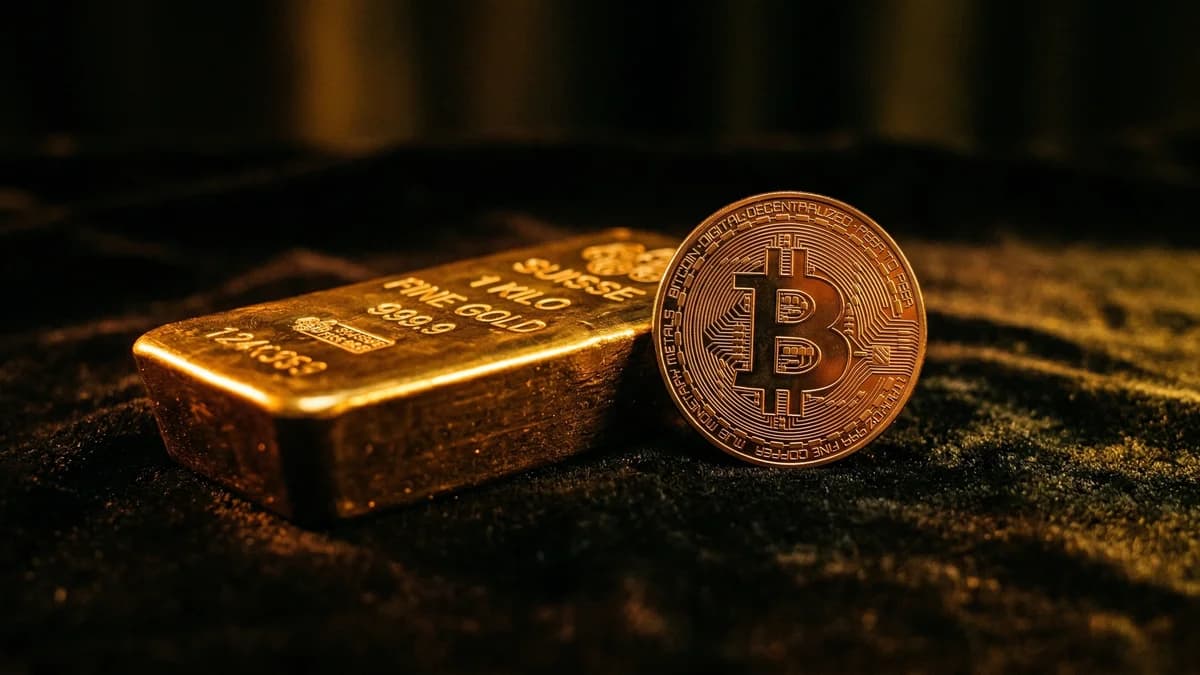
Gold and Bitcoin both serve as inflation hedges and stores of value outside government control. Gold has a 5,000-year track record and lower volatility, while Bitcoin has delivered far higher returns over its 15-year existence. For regular people investing $20 a week, Bitcoin's zero-minimum entry, low fees, and 24/7 markets make it significantly more accessible than physical gold.
Your savings account is paying you 0.01% interest. Inflation is running at 3% or higher. Every dollar you hold is slowly losing purchasing power. You know you need to do something. But what?
For thousands of years, the answer was gold. Kings hoarded it. Empires fought wars over it. Your grandparents might have stashed a few coins in a safe deposit box. Gold has always been the thing people reached for when they stopped trusting paper money.
Then Bitcoin showed up in 2009. Fifteen years old. No physical form. No government backing. And yet it has outperformed every other asset class in history over its lifetime.
So which one actually protects your money? Let's be honest about both.
Gold is a proven store of value with a 5,000-year track record and lower volatility. Bitcoin has delivered far higher returns over its 15-year existence but with bigger swings. The key difference for regular people: you can start a $20/week Bitcoin DCA habit with three taps on your phone. Doing the same with gold is expensive and complicated.
Read more: Your money is losing value | What Is Fiat Currency?
Why Gold Has Worked for 5,000 Years
Gold is scarce. You can't print it. You can't create it in a lab (not economically, anyway). The total amount of gold ever mined in human history would fit inside a single Olympic swimming pool, according to the World Gold Council.
That scarcity is why gold holds value. When governments print too much paper money, gold tends to go up. When inflation spikes, gold tends to go up. When people get nervous about the economy, gold tends to go up.
In 2025, gold had a monster year. It surged roughly 65%, its best performance in decades, according to Morningstar data. The price broke through $2,800 per ounce for the first time ever. Central banks around the world were buying gold at record pace, signaling they didn't fully trust their own paper currencies either.
Gold's track record is undeniable. It survived the fall of Rome, two World Wars, the Great Depression, and every financial crisis since. When cash loses value during recessions, gold has historically held its ground or gone up.
But gold has real problems that nobody talks about when they're selling you gold coins on late-night TV.
The Problems with Gold
Storage costs money. You need a safe, a vault, or a safe deposit box. Annual storage fees at a professional vault typically run 0.5% to 1% of your gold's value. That eats into your returns every single year.
Dealer premiums are brutal. When you buy a gold coin from a dealer, you don't pay the spot price. You pay 5% to 15% above spot, sometimes more for smaller coins. When you sell, you get below spot. That spread can wipe out years of gains.
It's not divisible for small investors. The smallest common gold coin (a 1/10 oz American Eagle) costs around $280 at current prices. And the dealer premium on small coins is even higher percentage-wise. You can't invest $20 a week in physical gold without getting crushed on fees.
Gold ETFs exist, but they're not gold. You can buy shares of a gold ETF like GLD. But then you own a piece of paper that represents gold, not actual gold. You're trusting a custodian again. That defeats part of the purpose.
It pays no yield. Gold just sits there. It doesn't pay dividends. It doesn't earn interest. Your only return is the price going up.
Gold has served as a store of value for over 5,000 years. In 2025, gold prices surged approximately 65%, breaking $2,800/oz for the first time, per Morningstar data. However, dealer premiums (5-15%), storage fees (0.5-1% annually), and low divisibility make small, consistent gold investing expensive for regular people.
What Bitcoin Brings to the Table
Bitcoin was designed from the start to solve the same problem gold solves: protect wealth from governments that print too much money.
There will only ever be 21 million Bitcoin. That number is locked in the code. No government, no company, no person can change it. The Federal Reserve added $4.8 trillion to the money supply after the 2020 recession. Nobody can do that to Bitcoin.
But Bitcoin does things gold can't.
You can buy $1 worth. A single Bitcoin costs tens of thousands of dollars. But you don't need to buy a whole one. Bitcoin is divisible to eight decimal places. The smallest unit, called a satoshi, is worth a fraction of a penny. You can invest $5, $10, or $20 at a time. Try that with gold.
No storage costs. Your Bitcoin lives on a phone app, a hardware wallet, or even a piece of paper with a code on it. No vault fees. No insurance premiums. No safe deposit box rental.
24/7 markets. Gold markets close on weekends and holidays. Bitcoin trades around the clock, every day of the year. You can buy or sell at 3 AM on Christmas if you want.
No dealer premiums. When you buy Bitcoin on an exchange or through an app like Strike or Cash App, you pay the market price plus a small fee (typically 0.5-1.5%). Compare that to the 5-15% premium on gold coins.
It's easy to move. Sending $1,000 worth of gold across the country requires armored transport and insurance. Sending $1,000 in Bitcoin takes about 10 minutes and costs a few dollars.
21 million
The total number of Bitcoin that will ever exist, locked in the code forever
Bitcoin protocol, 2009
Bitcoin's fixed supply of 21 million coins is encoded in its protocol and cannot be altered. Unlike gold, Bitcoin is divisible to eight decimal places (0.00000001 BTC = 1 satoshi), enabling investment amounts as small as a few dollars, per the Bitcoin whitepaper and Bitcoin.org protocol documentation.
That cap is the entire point. Gold is scarce, but new gold gets mined every year. Companies drill deeper, explore new regions, and every so often a major discovery expands supply. Bitcoin does not have that option. The code stops at 21 million. No CEO can override it. No central bank can vote to print more. That is a different category of scarcity, and it is the reason people are paying attention.
Read more: Bitcoin for beginners
The Honest Comparison
Let's put them side by side. No spin. Just facts.
| Feature | Gold | Bitcoin |
|---|---|---|
| Track record | 5,000+ years | 15 years |
| Supply | Limited (grows ~1.5%/year from mining) | Fixed at 21 million, ever |
| Minimum investment | ~$280 (1/10 oz coin + premium) | $1 or less |
| Storage costs | 0.5-1% per year (vault) | Free (self-custody) |
| Purchase premium | 5-15% over spot (coins) | 0.5-1.5% (exchanges/apps) |
| Volatility | Low to moderate | High |
| Best 5-year return | ~65% (2020-2025) | ~1,100%+ (2020-2025) |
| Worst drawdown | ~45% (1980-1999) | ~77% (2021-2022) |
| Divisibility | Poor (smallest coin ~$280) | Excellent (buy fractions of a penny) |
| Portability | Heavy, requires security | Digital, instant transfer |
| Market hours | Weekdays, business hours | 24/7/365 |
| Yield | None | None (similar to gold) |
| Government seizure risk | Historical precedent (1933 Executive Order 6102) | Harder to seize if self-custodied |
Neither one is perfect. Both have real strengths. The question is which one fits your situation.
Gold and Bitcoin solve the same core problem: protecting your wealth from currency devaluation. Gold has a longer track record and less volatility. Bitcoin has better returns, better accessibility, and lower costs for small investors. They're not enemies. Some people hold both.
What $20 a Week Looks Like in Each
This is where the rubber meets the road for the Untaught audience. Most people reading this aren't sitting on $50,000 to drop into gold bars. They're looking to redirect $20 a week from lottery tickets, impulse buys, or subscriptions they forgot about.
So what does $20 a week actually do in each asset?
$20/Week DCA: Bitcoin vs Gold Over 5 Years
Approximate cumulative portfolio value, $5,200 total invested
Sources: World Gold Council, BTC historical price data. Approximate figures, past performance does not guarantee future results.
These are approximate figures based on historical performance over the past five years. Past results don't guarantee future returns. But the pattern is clear: even in a strong period for gold (including that massive 2025 rally), Bitcoin's DCA returns have been significantly higher.
The bigger point isn't just returns. It's friction.
To invest $20/week in gold, you'd need to use a gold ETF (which isn't really gold), accumulate cash and buy coins periodically (getting crushed on premiums), or use a gold savings app (adding another layer of trust and fees).
To invest $20/week in Bitcoin, you open Strike or Cash App, set up a recurring buy, and forget about it. Three taps. Done. That's it.
A $20/week DCA strategy invested over five years (approximately $5,200 total) has historically produced significantly different outcomes in gold versus Bitcoin, with Bitcoin delivering higher cumulative returns despite greater short-term volatility. Gold's strong 2025 rally narrowed the gap but did not close it, per World Gold Council and BTC historical price data.
Read more: How to invest $20 a week
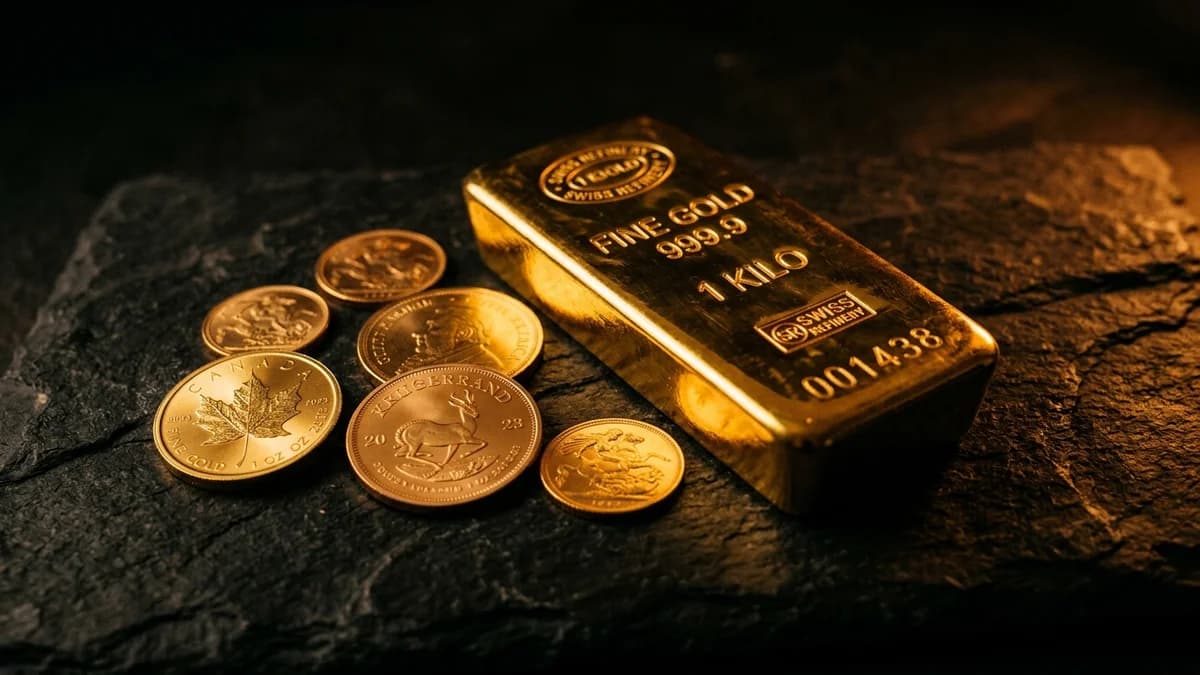
The Volatility Question
Let's not pretend Bitcoin is a smooth ride. It's not. That's the honest part of this comparison.
Gold dropped about 45% from its 1980 peak and took 28 years to recover in inflation-adjusted terms. That's bad. But Bitcoin dropped 77% from its November 2021 high to its January 2023 low. In dollar terms, it went from about $69,000 to about $16,000. That's brutal.
If you had $10,000 in Bitcoin in November 2021, it was worth about $2,300 by January 2023. That kind of drop can make you physically sick.
But here's what DCA does: it turns volatility from your enemy into your ally. When prices crash, your $20 buys more Bitcoin. When you're dollar-cost averaging, you actually want prices to dip. You're accumulating more at lower prices.
Someone who started a $20/week Bitcoin DCA in January 2022 (right after the crash started) would have been buying all the way down and all the way back up. By early 2025, their total investment of about $3,120 would have been worth significantly more than that, even though Bitcoin spent most of 2022 in a brutal downturn.
Gold doesn't swing as hard. If you can't stomach a 50% or 70% drop, even temporarily, gold might let you sleep better. That's a legitimate reason to choose it.
Bitcoin's volatility is real. It has dropped 50% or more multiple times in its history. If you invest money you might need next month, a crash could force you to sell at the worst possible time. Only invest money you can leave alone for years. This is true for gold too, but especially true for Bitcoin.
What About Both?
Some people split the difference. They put some money in gold and some in Bitcoin. This isn't a bad idea.
Gold gives you the 5,000-year track record, lower volatility, and the comfort of a physical asset that has never gone to zero. Bitcoin gives you the higher growth potential, better accessibility for small amounts, and a fixed supply that can't be inflated.
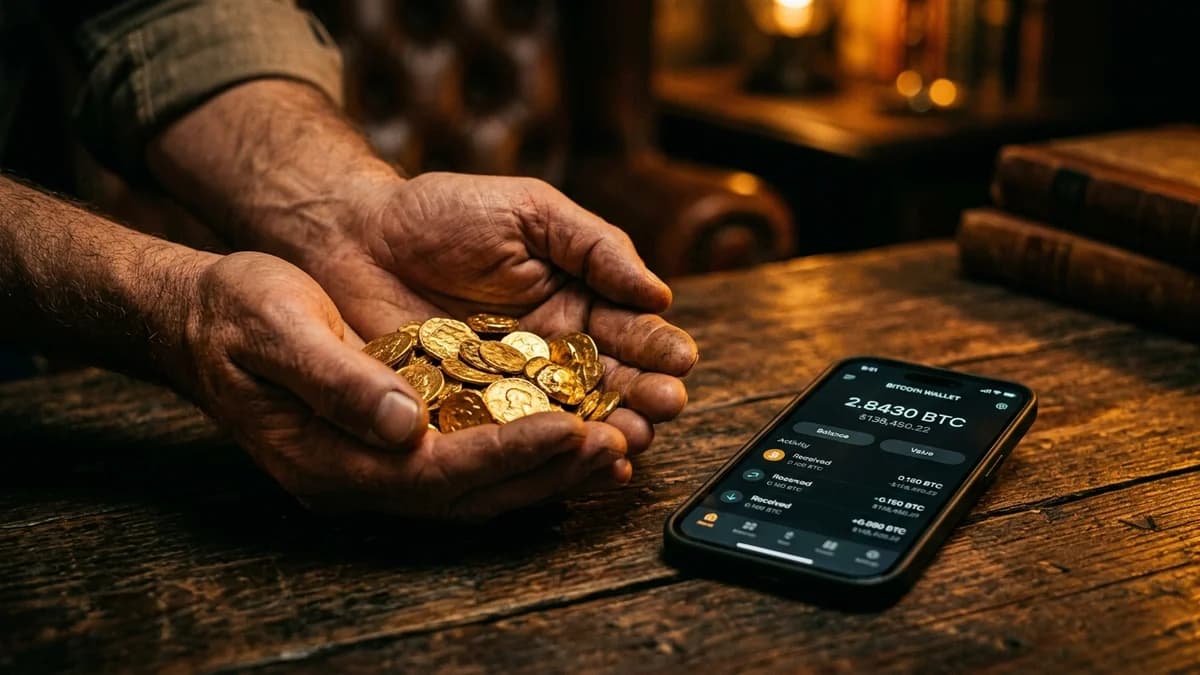
A simple approach: start with Bitcoin DCA because the minimum investment is lower, the fees are smaller, and it's easier to automate. If you build up enough to buy physical gold without getting killed on premiums, add some later.
The worst option? Doing nothing. Keeping all your money in a savings account earning 0.01% while inflation eats it alive. Both gold and Bitcoin have historically beaten cash over any meaningful time period.
Both assets exist for the same reason: the people in charge of the dollar will never stop printing. That is not a political statement, it is a historical pattern. Gold survived that pattern for five thousand years. Bitcoin was built to do the same thing, with better math and better plumbing. You do not have to pick a side in that debate to benefit from it. You just have to own some of one or the other, and stop parking every dollar in a savings account that cannot keep up.
Want to protect your purchasing power?
Join thousands learning what the system never wanted you to know about money.
The decision does not have to be final. Start with one, see how it fits your temperament, and layer in the other later if it makes sense. The goal is not perfection. The goal is to stop losing ground to inflation every single year while you wait for the perfect plan that is never coming.
The questions below are the ones people actually ask when they compare these two. Short answers, no spin.
Frequently Asked Questions
Gold works. It has always worked. If you're wealthy enough to buy gold bars and store them properly, it's a solid hedge against inflation and economic chaos. Rich people have known this for centuries.
But most people reading this aren't buying gold bars. They're trying to figure out what to do with $20 a week. And for that, Bitcoin is simply more practical. Lower minimums, lower fees, easier to automate, and historically higher returns.
The system never taught you about either option. That was the point. They wanted you spending your money on lottery tickets and subscription services, not building wealth. Now you know better.
Pick one and start this week. $20. That's it. If Bitcoin's volatility scares you, start with a gold ETF and learn as you go. If you want the simplest path with the lowest barriers, open Strike or Cash App and set up a $20/week recurring Bitcoin buy. The worst move is leaving all your money in cash and watching it lose value year after year.
The real competition isn't Bitcoin vs. gold. It's either of them vs. doing nothing. And doing nothing is the only guaranteed way to lose.
This article is part of the Your Money Is Losing Value series on Untaught.
This article is for educational purposes only and does not constitute financial advice. Untaught does not hold, move, or custody any funds. Past performance does not guarantee future results. Always do your own research before making investment decisions.
Quick calculator
Your coffee money could have become
$16,301
from $9,900 invested