What Is Fiat Currency? (And Why It Matters for Your Money)
Fiat currency is money backed by government decree, not gold. The U.S. dollar has lost 97% of its value since 1913. Here's what that means for your money.
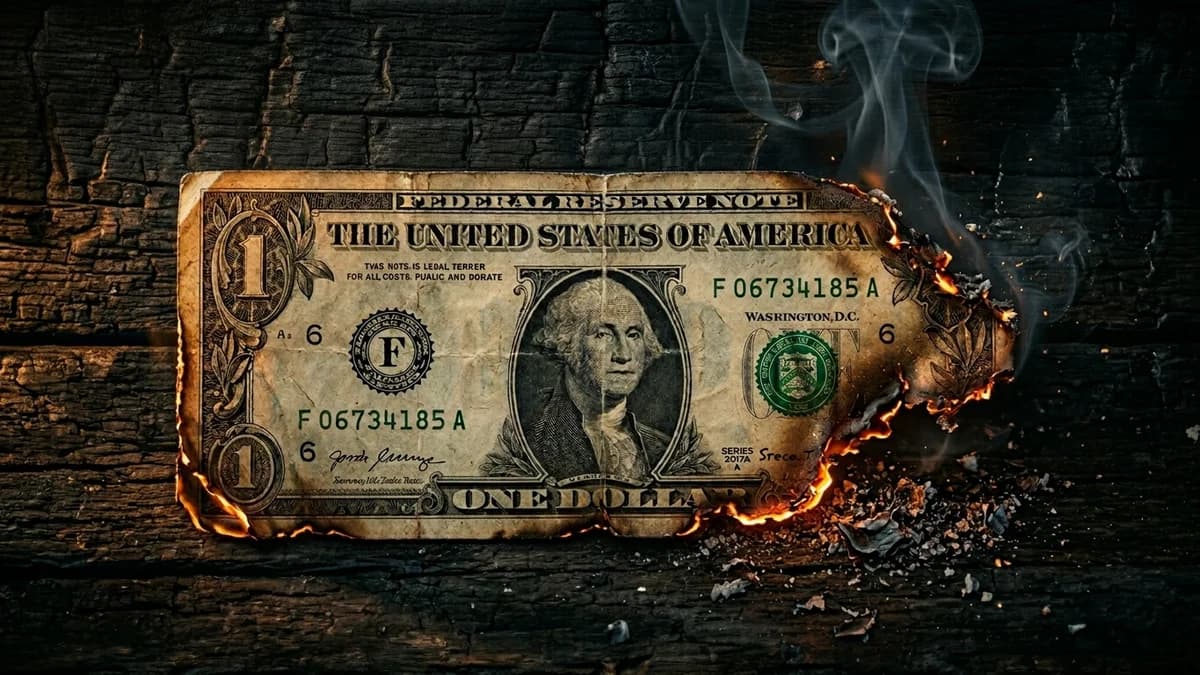
Pull a dollar bill out of your wallet. Look at it. The paper itself is worth maybe 5 cents. The ink, the cotton, the green dye. It is worth a dollar because the federal government says it is. That is fiat currency, in one sentence.
You have heard the word "fiat" a hundred times by now. In news clips, on podcasts, on Reddit threads, in every Bitcoin conversation. Nobody ever actually told you what it means, why it matters, or what it has done to the money sitting in your account. So the word just floats past, one more piece of financial jargon that feels too technical to bother with.
It is not technical. It is the most important thing you were never taught about your paycheck.
This article gives you the plain-English definition, the three dates that rigged the system, the math of what 110 years of fiat did to your purchasing power, and the one thing regular people can actually do about it.
Fiat currency is money that has value because a government says it does, not because it is backed by gold or another physical commodity. The U.S. dollar has been fully fiat since August 15, 1971, when Nixon ended dollar-gold convertibility. Since then, the dollar has lost roughly 88% of its purchasing power, per BLS Consumer Price Index data. A 1913 dollar now buys about 3 cents of what a dollar bought then. That is not a glitch. It is the feature.
Read more: Your Money Is Losing Value | How the Government Prints Money | Is the Dollar Losing Value? 50+ Years of Data
The answer to "what is fiat currency" is simple. What fiat currency has done to regular working Americans is not. We'll walk both in order.
What Is Fiat Currency in Plain English?
Fiat currency is money backed by government decree, not by any physical commodity like gold or silver. The word "fiat" comes from Latin. It means "let it be done." That is the whole trick. The money is valuable because an authority says so. The U.S. dollar, the euro, the yen, the pound, and every other major currency on earth today are fiat currencies. None of them are convertible to a fixed weight of gold, silver, or anything else with physical scarcity.
Your dollar has value for three reasons, and three reasons only. First, the government accepts it for taxes. Second, retailers accept it because they owe those same taxes. Third, everyone else accepts it because the first two do. That's it. Collective agreement, backed by law, not by any asset sitting in a vault somewhere.
Compare that to what money used to be. Before 1933, a U.S. "gold certificate" dollar could be walked into a bank and exchanged for an actual coin of gold. Before 1965, a silver certificate could be exchanged for silver. That's commodity money. You held a paper receipt for a physical thing. The thing had independent value. The paper was just a claim check.
The difference is easiest to see side by side.
| Gold or silver certificate (before 1933) | Federal Reserve note (today) | |
|---|---|---|
| What the paper is | A claim check on metal held for you | The asset itself |
| What stands behind it | A fixed weight of gold or silver | Government decree and legal tender law |
| Who can redeem it | Any holder, at a bank window | Nobody. There is nothing to redeem |
| How the supply grows | Only as fast as metal is mined | By central bank decision |
| What limits the supply | Physical scarcity | Policy restraint |
Fiat is different. There is nothing to claim. The paper is the asset. Its value depends entirely on whether you and everyone around you keep agreeing it has value. That sounds unstable, and historically it is. But for now, everyone agrees, so the system runs.
This matters because your purchasing power, which is what your money can actually buy, depends on how much of this agreement-based money exists relative to the goods it's chasing. Fiat systems allow the supply to be expanded at will. Every dollar created makes the ones you already hold worth slightly less. That is not a theory. That is the math.
Is the U.S. Dollar a Fiat Currency?
Yes. The U.S. dollar has been a pure fiat currency since August 15, 1971. On that date, President Richard Nixon ended the dollar's convertibility to gold in a Sunday night TV announcement. Before that, foreign governments could exchange dollars at the U.S. Treasury for gold at $35 per ounce under the Bretton Woods system. After Nixon's "temporary" suspension, the dollar was backed only by "the full faith and credit of the U.S. government." The suspension was never reversed. Source: Federal Reserve History.
Four dates made the modern dollar what it is. Knowing them in order will make everything else easier.
| Year | What changed | Gold reference price | Who could redeem paper for gold |
|---|---|---|---|
| 1913 | The Federal Reserve Act creates the Fed | $20.67 per ounce | Any U.S. holder, at a bank window |
| 1933 | Executive Order 6102 ends domestic convertibility | Collected at $20.67, then repriced to $35 | Foreign governments only |
| 1944 | Bretton Woods pegs the dollar to gold and other currencies to the dollar | $35 per ounce | Foreign governments only |
| 1971 | Nixon closes the gold window | $35 peg abandoned | Nobody |
| Today | Nothing in the Treasury backs the dollar | About $4,190 per ounce (October 9, 2026), set by the market | Nobody |
1913. President Wilson signed the Federal Reserve Act on December 23, 1913. The United States got its third central bank, after the first two had been allowed to expire in the 1800s. The Fed's job, as originally described, was to stabilize the banking system. What it became, over the next century, was the institution that manages the money supply. Inflation was rare before 1913. It became routine after.
1933. President Franklin Roosevelt signed Executive Order 6102 on April 5, 1933. The order made it illegal for U.S. citizens to own gold coins, gold bullion, or gold certificates. Americans had 30 days to turn their gold in to the government at $20.67 per ounce. Then the government repriced gold at $35 per ounce. Overnight, anyone who had complied with the order had lost roughly 40% of their gold's value. The domestic gold standard, the thing that had let ordinary Americans exchange paper for coin, was dead.
1944. The Bretton Woods Conference in New Hampshire set up the post-war monetary system. The dollar got pegged to gold at $35 per ounce. Every other major currency got pegged to the dollar. The dollar became the world's reserve currency. Foreign governments could still redeem their dollars for gold. American citizens could not.
1971. By the summer of 1971, the U.S. had printed so many dollars, largely to pay for the Vietnam War and Great Society programs, that foreign governments holding dollars started demanding more gold than Fort Knox had in reserve. The U.S. monetary gold stock had fallen to about $11 billion at the official $35 price by the end of 1970, and kept falling, far less than the dollar claims foreign governments could present. As the Federal Reserve puts it, "eventually, there were more foreign-held dollars than the United States had gold." France was already transferring gold home. Nixon's options were austerity (contract the money supply) or default (tell foreign holders "sorry, out of gold"). He chose a third. He changed the rules. On Sunday, August 15, 1971, at 9 p.m. Eastern, broadcast television interrupted its programming. Nixon announced the dollar was no longer convertible to gold. He called it "temporary." Fifty-five years later, it still is.
Today, nothing in the U.S. Treasury backs your dollar. Not gold. Not silver. Not oil. Just trust, and the government's ability to enforce its use through law and taxes.
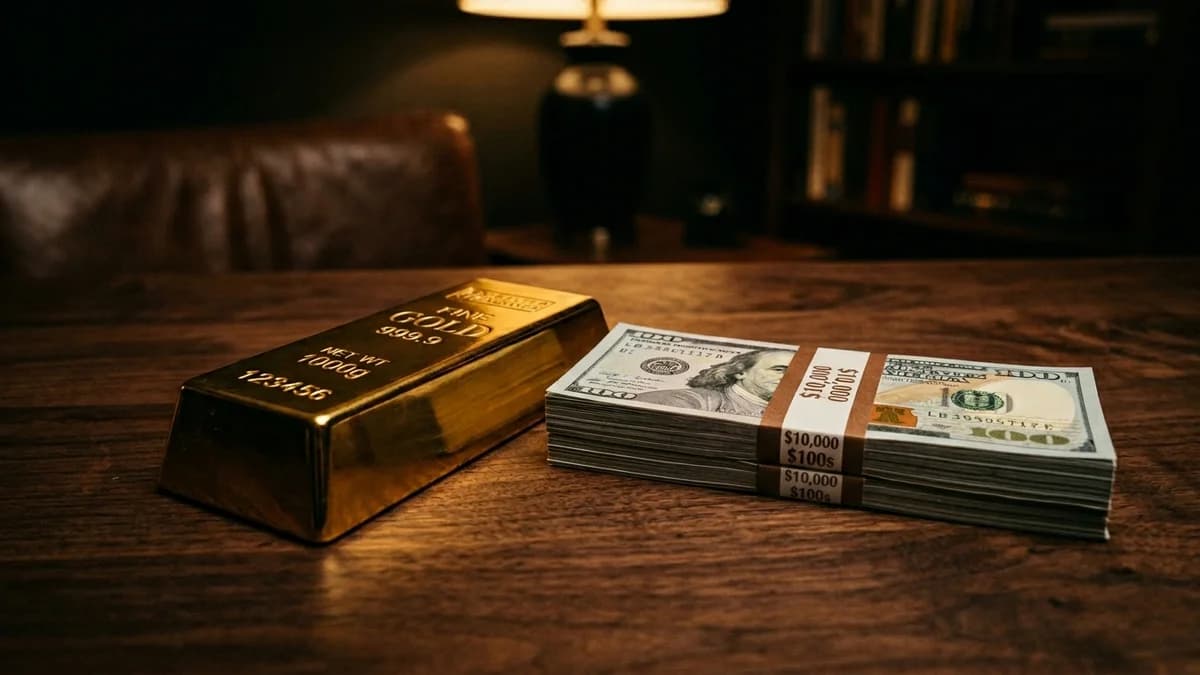
An ordinary American could walk paper dollars into a bank and walk out with gold coin until 1933. Foreign governments could until 1971. Nobody can today. The "normal" economy you grew up in is 55 years old, and it is the anomaly, not the rule.
Why Did the U.S. Switch to Fiat Currency?
The U.S. switched to fiat in stages, and every stage was driven by the same motive: the government wanted to spend more than its gold reserves would allow. In 1933, FDR needed flexibility to fund New Deal programs during the Depression. In 1971, Nixon faced a run on the dollar because the U.S. had printed far more dollars than Fort Knox could back. Closing the gold window let the government keep spending without the physical constraint. That was the point. Source: Federal Reserve History.
Here is the honest answer nobody in a textbook will write down for you. Gold limits spending. Fiat doesn't. Every government that has adopted fiat has done so because the existing system was blocking something it wanted to do. Fight a war. Expand a social program. Bail out banks. Run a deficit in peacetime. Pick any of these, and fiat is what unlocks it.
The bill for unlocking it does not arrive as a tax. It arrives as the slow loss of what your money buys, and it has been arriving every year of the last decade.
What $100 Is Actually Worth Over Time
What $100 of 2015 spending power buys at later prices: $70.76 by August 2026, a loss of about 29%.
Source: BLS Consumer Price Index (CPI-U, all items, not seasonally adjusted). Yearly averages 2015 to 2025, then August 2026.
Think about the incentive. Under a gold standard, if the government wants to spend more, it has to either tax the population (unpopular), borrow from them (visible on the balance sheet), or mine more gold (slow, physical, hard). Under fiat, the central bank can create new money by buying government bonds, and the cost gets distributed across everyone holding dollars through inflation. No vote. No line item. No receipt.
The Nixon Shock is the cleanest example. By the end of 1970, the U.S. monetary gold stock was worth about $11.1 billion at the official price, down from $22.9 billion at the end of 1950, per NBER data on FRED, while the dollars held abroad that could be presented for that gold were worth multiples of it. The arithmetic was obvious. There was not enough gold. France knew it. Switzerland knew it. Nixon's choice was to default on the gold promise or change the rules. He changed the rules, on national television, over the weekend, without a congressional vote. Most Americans went to work Monday morning with no idea the monetary system they used had just been rewritten.
Here is what that weekend cost anyone who held dollars afterward. Measured against the Consumer Price Index, a dollar from the summer Nixon spoke buys about 12 cents of what it bought then. The steepest part of the slide came first, in the 1970s, when the constraint had just been removed and the Fed had not yet been forced to defend the currency by pushing the federal funds rate to a record 20% in late 1980.
Purchasing Power of $1 (1971-2026)
$1.00 in 1971 dollars buys about $0.12 of equivalent goods in 2026
Source: BLS Consumer Price Index (CPIAUCNS) via FRED, annual averages against the August 2026 reading
The rest of the world followed, because the dollar had been the last link to gold and that link was now cut. The euro launched as a fiat currency in 1999. Today, not one country on earth lets you exchange its currency for a fixed weight of gold at a government window. The entire global economy runs on mutual agreement and central bank discretion.
That's the "why." Fiat made unlimited spending possible. How the government actually prints money is the mechanism. What it does to your savings is the next section.
What Happens to Your Money Under a Fiat System?
Your dollars lose value every year. The U.S. dollar has lost about 97% of its purchasing power since the Federal Reserve was created in 1913. The BLS Consumer Price Index stood at 9.9 in 1913 and at 334.980 in August 2026, which means a 1913 dollar now buys about 3 cents of what it bought then. Since 1971 alone, when the last gold link was cut, the index went from 40.5 to 334.980, a loss of roughly 88%. That didn't happen to your parents. That is happening to you.
97%
Purchasing power lost by the U.S. dollar since 1913
Bureau of Labor Statistics, Consumer Price Index (CPI-U), 1913 annual average to August 2026
The loss was not spread evenly. It came in waves, and every wave followed a stretch of heavy money creation.
How Much the Dollar Lost, Decade by Decade
Cumulative purchasing-power loss in each decade since 1971 (BLS CPI)
Source: Bureau of Labor Statistics, CPI-U (CPIAUCNS) annual averages, 1971 to August 2026. *The 2020s bar is a partial decade: the 2020 average to the August 2026 reading.
Here is the machinery. The U.S. M2 money supply, which is the total amount of cash, checking accounts, and easily accessible savings in the country, was $4.67 trillion in January 2000. By August 2026, it was $23.34 trillion, per the Federal Reserve's H.6 release. That is exactly a 5x increase in 26 years. Most of it came after 2008 (quantitative easing in response to the financial crisis) and 2020 (pandemic stimulus). Between February 2020 and its March 2022 peak, M2 grew from $15.49 trillion to $21.79 trillion, about $6.3 trillion or 40.6% in 25 months.
More dollars chasing the same amount of goods means every dollar buys less. It is supply and demand applied to money itself. When the supply of dollars grows 10% in a year and the supply of goods grows 2%, prices rise about 8% just from the arithmetic. The Consumer Price Index might report 3%. Your grocery bill might say 15%. Both can be true, depending on what's in the basket, but the direction is always the same.
Your savings account is on the losing side of this trade. The FDIC national average savings rate was 0.37% as of the September 21, 2026 release, while consumer prices rose 3.4% in the twelve months through August 2026. Inflation peaked at 9.1% in June 2022. Run $10,000 through both numbers and the gap compounds.
| After | Balance at 0.37% | What the same basket costs | Balance in today's buying power | Real change |
|---|---|---|---|---|
| 1 year | $10,037 | $10,340 | $9,707 | -$293 |
| 5 years | $10,186 | $11,820 | $8,618 | -$1,382 |
| 10 years | $10,376 | $13,970 | $7,427 | -$2,573 |
The bank statement shows a green number in every row. The real return is -2.93% a year, so a decade of "saving" costs you about a quarter of the money. That's the savings account trap in one line.
Zoom out further. An ounce of gold cost $35 in 1971. At the October 9, 2026 close it traded around $4,190, per Kitco. The gold did not get 120 times more valuable. The dollar collapsed against it. Same metal. Same weight. The measuring stick changed.
This is also why the real inflation rate that people actually feel at the grocery store and the gas pump often runs higher than the government's official number. The Consumer Price Index gets adjusted periodically through "hedonic" tweaks and substitution assumptions. The direction of every one of those adjustments, over the decades, has been to push the reported number lower.
Can Fiat Currency Collapse? (Has It Before?)
Yes. Fiat currencies have collapsed dozens of times. Economist Steve Hanke and Nicholas Krus have catalogued 57 verified hyperinflations, and the worst of them are not close calls.
Economists use a hard line for this, not a feeling. The standard test, set out by Phillip Cagan in 1956 and still the one researchers apply, is a monthly inflation rate above 50% sustained for 30 consecutive days. Fifty percent a month is not 50% a year. Compounded, it is prices roughly 130 times higher twelve months later. That is the threshold each currency below crossed, and in two cases obliterated.
| Currency | Worst point | Inflation at that point | Measure |
|---|---|---|---|
| German mark | October 1923 | 29,500% | Per month |
| Zimbabwe dollar | November 2008 | 79.6 billion % | Per month |
| Venezuelan bolivar | February 2019 | 344,510% | Year over year |
| Argentine peso | August 2026 | 33.5% | Year over year |
| Turkish lira | August 2026 | 31.5% | Year over year |
Zimbabwe's November 2008 peak was the second most severe episode in recorded history, with prices doubling roughly every 24.7 hours, per Hanke's published account of how that rate was measured. Venezuela's episode ran 26 months, from December 2017 to January 2020, and its year-over-year rate peaked at 344,509.5% in February 2019 on the central bank's own index, per a descriptive analysis of the BCV-INE data. None of these countries started with "crazy" money. They all started with "temporary" money printing to fund government spending.
Weimar Germany is the one most people have heard of. The famous photos of people hauling wheelbarrows of cash to buy bread are from 1923. What those photos do not show is that the crisis had been building since 1914. Germany had financed World War I by printing money rather than taxing. By the time the Allies demanded reparations in 1921, the mark had already been softening for years. The hyperinflation was not the disease. It was the fever that finally broke.
These are not ancient episodes, and the last two rows of that table are not history. Argentina's annual inflation was running at 33.5% in the twelve months through August 2026, and Turkey's eased to 31.5% in August 2026 from 31.75% the month before. Both have spent years above 30%. These are active fiat crises in real time. An Argentinian who kept savings in pesos lost about a quarter of their buying power in a single year, and has done so repeatedly. Many stopped trying, which is why gold, dollar accounts, and Bitcoin ownership in both countries have climbed.
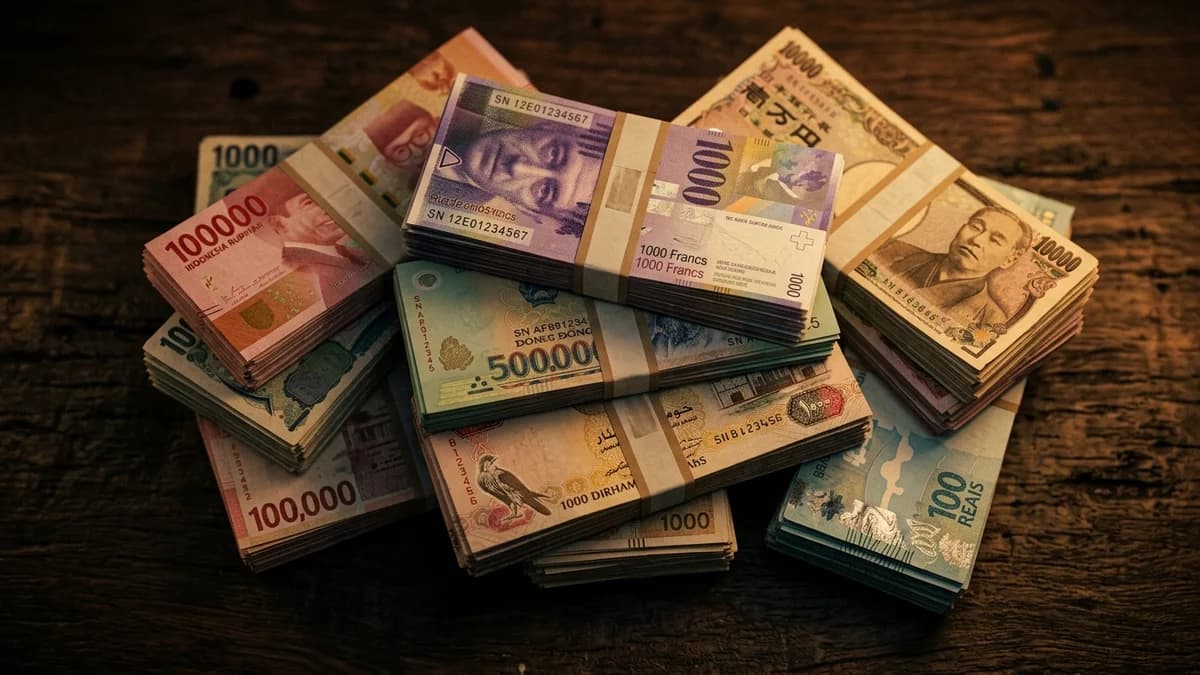
Every fiat currency before the U.S. dollar has eventually failed. Some took centuries. Some took decades. All of them looked stable until they didn't. That does not mean the dollar fails tomorrow. It means "stable forever" is not how any fiat system has ever ended.
The U.S. is not Weimar Germany. The U.S. has the world's deepest capital markets, the global reserve currency, and a military that backs up dollar demand. But "not Weimar" is not a financial plan. Total federal debt stood at $40.24 trillion on October 2, 2026, per the Treasury's own Debt to the Penny record, up $2.36 trillion from $37.88 trillion a year earlier. It crossed $40 trillion for the first time in August 2026. Debt-to-GDP is about 123%, per FRED (first quarter of 2026). Every warning sign that preceded historical fiat failures, unpayable debt, central bank financing of government deficits, loss of reserve-currency share, public trust in the currency eroding, is currently flashing in the U.S.
Central Banks Are Quietly Exiting the Fiat System
The institutions that run the fiat system don't trust it either. Central banks have spent four years buying physical gold at roughly double their old pace. They added 1,082 tonnes in 2022, 1,051 tonnes in 2023 and 1,092 tonnes in 2024, then eased to 863 tonnes in 2025, per World Gold Council data. Every one of those years beat the 473-tonne annual average the same source reports for 2010 to 2021.
Central Banks Have Been Buying Gold at Roughly Double Their Old Pace
Net gold purchases by central banks, in tonnes per year
Source: World Gold Council, Gold Demand Trends, full-year 2023 to 2025 reports (latest revision of each year). Dashed line is the 473-tonne annual average for 2010 to 2021.
The other half of the move is what they are selling. The U.S. dollar's share of allocated global central-bank reserves was 56.70% in the second quarter of 2026, down from 57.18% the quarter before, per the IMF's COFER release. That is down from a peak near 72% in 2001. The dollar is still the reserve currency by a wide margin. It is just a smaller margin every few years.
This is the story nobody at Investopedia tells you when you search "what is fiat currency." The people running the fiat system are quietly diversifying out of it. They are not buying more dollars. They are buying gold, yuan, euros, and spreading their reserves across a wider basket of assets.
56.7%
U.S. dollar share of allocated global central-bank reserves, Q2 2026. Down from a peak near 72% in 2001.
IMF Currency Composition of Official Foreign Exchange Reserves (COFER), released September 30, 2026
Why? A few reasons, and none of them are flattering to the dollar. First, the sanctions on Russia after the invasion of Ukraine froze roughly $300 billion of Russia's foreign reserves. Every central bank on earth watched that happen. Many concluded that dollar reserves are only "safe" if the U.S. approves of your foreign policy. Second, the accumulating U.S. debt is now so large that default, either explicit or through inflation, is no longer a tail risk. It is a base case. Third, the Chinese yuan and other currencies are slowly becoming more viable for trade settlement, reducing the structural need to hold dollars.
Put the four together and the pattern is hard to read as anything else.
| Why central banks are diversifying | The evidence on the record |
|---|---|
| Reserve assets can be frozen | Roughly $300 billion of Russia's reserves frozen in 2022 |
| U.S. debt is no longer a tail risk | $40.24 trillion on October 2, 2026, about 123% of GDP, up $2.36 trillion in a year |
| Gold is the preferred alternative | 473 tonnes a year from 2010 to 2021, then 1,082t, 1,051t, 1,092t and 863t |
| The dollar's share keeps slipping | 56.70% of allocated reserves in Q2 2026, down from a peak near 72% in 2001 |
The practical implication for you is simple. Central banks have access to the same menu of stores of value you do. Physical gold. Other currencies. Increasingly, Bitcoin (through spot ETFs that several national funds have now disclosed positions in). When the institutions with the best information and the deepest research budgets are moving out of dollars, that is signal, not noise.
You can compare Bitcoin and gold as stores of value if you want the longer answer on where the smart money is going.
How Bitcoin Differs From Fiat (And Why People Care)
Bitcoin is not a fiat currency. It has a hard-coded supply cap of 21 million coins, enforced by open-source software that thousands of computers around the world run independently. Fiat currencies have no supply cap. Whoever controls the central bank can create more dollars, euros, or yen by adjusting a number in a spreadsheet. The difference is structural, not rhetorical. A fiat system assumes the humans in charge will exercise restraint on money creation. A hard-capped system does not need them to.
The issuance schedule is the part that tends to land. New bitcoin enters circulation at a rate that is published years in advance and cuts in half roughly every four years, with no meeting, no vote, and no discretion. There is no equivalent on the dollar side. The Federal Open Market Committee meets eight times a year and decides, and the only record of what it decided that reaches you is the price of everything you buy.
U.S. Money Supply (M2): 60 Years of Growth, Then an Explosion
Total dollars in circulation, in trillions. December readings 1960 to 2025, plus February 2020, the March 2022 peak and August 2026.
Source: Federal Reserve, M2 Money Stock, seasonally adjusted (FRED series M2SL), through August 2026.
That is the whole trade. Fiat supply expands by decree. Bitcoin's supply is capped by code. If you think the people running the fiat system will create dollars responsibly over your entire lifetime, stick with cash. If you think 110 years of monetary history suggests otherwise, you need an alternative.
Bitcoin is volatile. Bitcoin is early. Bitcoin has regulatory uncertainty. None of that is in dispute, and this article is not telling anyone to sell all their dollars. What it is saying is that "what is fiat currency" is actually the most important financial question you can ask. Knowing the answer forces a follow-up: what do you do with the knowledge?
Know the trade-offs before you buy any. Bitcoin held in an app is not insured like a bank deposit. The FDIC lists crypto assets among the things deposit insurance does not cover, and SIPC does not protect crypto that does not qualify as a registered security. For taxes, the IRS treats digital assets as property, so selling Bitcoin for more than you paid is a taxable capital gain.
For most people, the answer is not "bet the farm." It is "redirect a small, consistent amount out of the leak." That is the logic behind dollar-cost averaging, and it's why even $20 a week matters more than most people think. Bitcoin for beginners covers the practical mechanics if you want to go deeper.
Now you know what fiat currency actually is.
Learn what school never taught about money. No spam, no selling.
Frequently Asked Questions
Six of the questions readers most often ask about fiat currency, answered in one place.
Fiat currency has value for two reasons: government decree and collective trust. The government requires you to pay taxes in its currency and makes it legal tender for all debts, so everyone needs it. On top of that, value rests on confidence that others will keep accepting it tomorrow. Nothing physical backs it, no gold, no silver. When that confidence breaks, as in Weimar Germany or Zimbabwe, the currency can collapse.
Yes. The U.S. dollar has been purely fiat since August 15, 1971, when President Richard Nixon ended dollar-gold convertibility in a Sunday night TV announcement. Before 1933, the dollar was commodity money redeemable for gold coins. Between 1944 and 1971 under Bretton Woods, foreign governments (but not U.S. citizens) could still redeem dollars for gold at $35 per ounce. Since 1971, nothing has backed the dollar except the government's ability to enforce its use through taxation and law. Source: Federal Reserve History.
Fiat is issued by governments, has unlimited supply, and derives value from government decree. Most cryptocurrencies (like Bitcoin) have fixed supplies enforced by open-source code and are not issued by any single authority. The deepest structural difference is supply. The U.S. dollar's M2 supply grew from $4.67 trillion in January 2000 to $23.34 trillion in August 2026, per FRED M2SL. Bitcoin's supply is mathematically capped at 21 million coins forever.
"The full faith and credit of the United States government," which in practice means the government's ability to tax its citizens, enforce the use of its currency through legal tender laws, and pay its debts. There are no physical reserves of gold, silver, oil, or any other commodity held against the dollar's value. The U.S. Treasury's gold holdings (about 8,133 tonnes) are not tied to the money supply in any functional way.
Yes. Dozens of examples across modern history. Weimar Germany hit 29,500% monthly inflation in October 1923. Zimbabwe hit 79.6 billion percent monthly in November 2008, with prices doubling about every 24.7 hours. Venezuela's year-over-year rate peaked at 344,510% in February 2019 during a 26-month episode that ran to January 2020. Argentina and Turkey were both still above 30% annual inflation in August 2026. Every prior world-reserve currency has eventually been replaced.
Because fiat lets governments spend without the physical constraint of gold reserves. That is the feature for governments and the cost for citizens, whose savings lose value when the money supply grows faster than the economy. Under the gold standard, the U.S. money supply could only expand as fast as gold was mined. Under fiat, it can expand by any amount the central bank chooses. Between February 2020 and March 2022, M2 grew 40.6%, from $15.49 trillion to $21.79 trillion, something a gold-backed system physically could not do.
The Point
You now know what most people don't. The money in your wallet, your checking account, your paycheck, and your retirement account is backed by nothing except a collective agreement that it has value. That agreement has been honored so far. It has also been diluted by roughly 97% since 1913 through continuous money creation that nobody voted on and very few Americans understand.
This was kept out of school on purpose. The system runs smoother when the people inside it don't ask what their money actually is. You just asked. That changes the trajectory by itself.
You can't reverse 55 years of fiat expansion. You can't out-vote the Federal Reserve. What you can do is stop keeping all of your savings in the currency that is losing value the fastest. The institutions that run this system are already diversifying out of it. You have the same option they do, at roughly the same prices. Start with the DCA calculator and run your own numbers. Redirect even $20 a week out of the leak. A decade from now, the version of you that did will be glad the version of you reading this took the first step.
Related reading:
- Your Money Is Losing Value (Pillar Hub)
- How the Government Prints Money
- What Is Purchasing Power?
- The Real Inflation Rate
- Your Savings Account Is Losing Money
- What $100 Used to Buy
- Bitcoin vs Gold
- Cash During a Recession
- Bitcoin for Beginners
- What Is Dollar-Cost Averaging?
- Nobody Taught You This. That Was on Purpose.
This article is for educational purposes only and does not constitute financial advice. Untaught does not hold, move, or custody any funds. Past performance does not guarantee future results. Always do your own research before making investment decisions.
Quick calculator
Your coffee money could have become
$19,233
from $9,900 invested
Monthly buys, Oct 2021 to Sep 2026, at Coin Metrics month-end closes. Past results, not a forecast.