The Real Inflation Rate: What the Official Numbers Don't Tell You
The official CPI says inflation is around 4%, but real costs for energy, insurance, food, and rent often rise far faster. Here's what the government's formula leaves out.
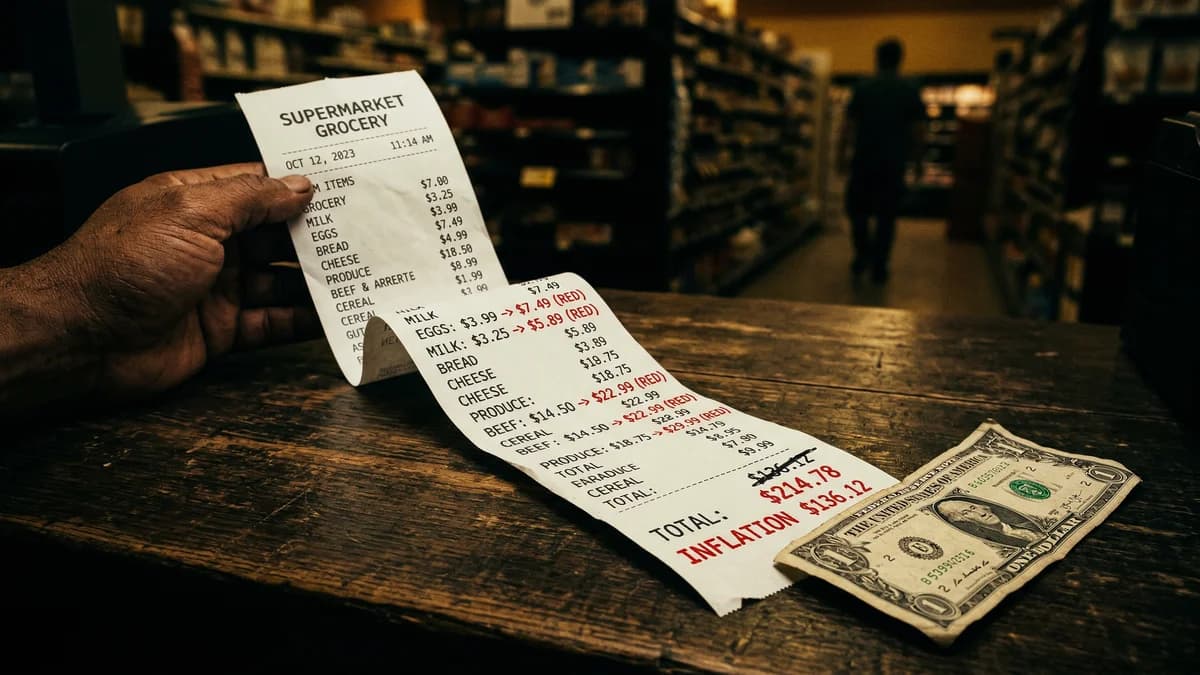
The real inflation rate is the actual loss of purchasing power you experience, which is often higher than the official Consumer Price Index (CPI) figure. The CPI measures a government-selected basket of goods and has been adjusted multiple times since the 1980s. Shadow Stats and other independent economists estimate true inflation runs 2 to 5 percentage points above the official CPI number.
The government says inflation is about 4%. Your gas pump and grocery bill say otherwise.
According to the Bureau of Labor Statistics (BLS), the Consumer Price Index rose 4.2% over the 12 months through May 2026, the highest annual rate since 2023. But that headline average hides what you actually feel: over the same year, energy prices climbed 23.5% and gasoline jumped 40.5%. If you're wondering why the "official" number never seems to match your wallet, you're not wrong. And there's a reason for that gap.
The formula they use to calculate inflation was designed to produce a lower number. Not on accident. By design.
The government measures inflation using the Consumer Price Index, but its formula uses tricks like "substitution" and "hedonic adjustments" that push the number lower. Real costs for essentials like housing, food, and healthcare often rise 2-4 percentage points faster than the CPI reports, according to economists at the American Institute for Economic Research (AIER). The official number isn't your number.
Before we get into the methodology, keep one number in mind. Every tenth of a percent shaved off the official inflation figure translates into billions of dollars the federal government does not have to pay in cost of living adjustments on Social Security, federal pensions, and tax bracket indexing. The incentive to report a lower number is not subtle. It is baked into the budget math.
That pressure shows up in the methodology. Anytime a choice could be made about how to measure a price change, the choice that lowered the headline number tended to win. That happened over decades, under administrations from both parties, because the incentive does not care about politics. A lower reported inflation rate is cheaper for the Treasury and easier for the Federal Reserve to defend.
You, on the other hand, have the opposite incentive. Your paycheck, your benefits, and your savings all need to be measured against real prices at a real checkout counter. If your yardstick is the government's number and the government's number is designed to run small, every long term plan you make starts with a built in shortfall. The fix is to understand how the number gets built so you can replace it with something that matches your life.
$340B
Government savings from using a lower inflation formula over a decade
Congressional Budget Office
Read more: What Is Purchasing Power?
What Is the Consumer Price Index?
The CPI tracks price changes across about 80,000 goods and services each month, according to the Bureau of Labor Statistics (BLS). It's the government's main tool for measuring inflation, and it affects everything from your Social Security check to your tax brackets.
Here's the basic idea. Every month, BLS data collectors visit stores, gas stations, doctor's offices, and apartments across the country. They record prices. Then they compare those prices to last month and last year. The percentage change is the inflation rate you hear on the news.
Sounds straightforward, right?
It used to be. The problem is what happens between the data collection and the final number. The BLS doesn't just report the raw price changes. They run the data through a series of adjustments that, conveniently, almost always push the reported number lower.
Those adjustments have names. We'll get to them. But the effect is simple: the number you hear on the news is smaller than the price increases you're actually paying.
Think of it this way. If someone asked you "how much did your cost of living go up this year?" you'd think about your rent, your groceries, your gas, your insurance. You'd estimate based on what you actually spend. The CPI does something different. It estimates what a theoretical consumer might spend after swapping to cheaper products and adjusting for "quality improvements." Those are two very different questions.
What Is Hedonic Adjustment?
One of the biggest tricks in the CPI formula is something called "hedonic quality adjustment." The BLS has used this method since the early 1990s, and it can significantly change the reported price of everyday goods.
Here's how it works. Say a laptop costs $1,000 this year. Last year, a similar laptop also cost $1,000. No price change, right?
Not according to the BLS. If this year's laptop has a faster processor, more storage, or a better screen, the BLS says you're getting "more value" for the same price. So they adjust the price downward in their index. They might record that laptop as only costing $850 in "quality-adjusted" terms, even though you paid $1,000 at the register.
According to a Brookings Institution analysis of CPI methodology, hedonic adjustments have a particularly large effect on technology, housing, and vehicles. These are categories where manufacturers regularly change features.
Your receipt says $1,000. The CPI says $850. Guess which number goes into the inflation calculation.
The BLS argues this makes the data more accurate. And in narrow technical terms, they have a point. If you're getting a better product for the same money, that's a form of deflation. But here's the problem: you can't pay rent with your laptop's extra RAM. You still paid $1,000. The number that left your bank account didn't get a "quality adjustment."
The BLS uses hedonic quality adjustments to reduce reported price increases when products gain new features. According to Brookings Institution research, this practice significantly affects CPI calculations in technology, housing, and vehicle categories, often producing a lower inflation figure than the actual prices consumers pay at the point of sale.

What Is Substitution Bias?
The second major adjustment is called "substitution bias," and it might be even more frustrating than hedonic adjustment.
Here's the concept. If the price of beef goes up 15%, the BLS assumes you'll switch to chicken. If chicken goes up, they assume you'll switch to pork. The CPI formula accounts for this "substitution" and lowers the reported inflation number accordingly.
The BLS adopted this approach formally in 1999 when it began using a "chained" CPI formula, per Congressional Budget Office (CBO) documentation. The logic is that a fixed basket of goods overstates inflation because people adjust their buying habits when prices rise.
And sure, some people do switch. But think about what that really means. The government's inflation measure is literally saying: "Prices didn't go up that much because we assumed you'd accept something cheaper."
That's not measuring your cost of living. That's measuring your cost of settling.
Substitution adjustment has a hidden philosophical problem. It assumes that your quality of life stays the same when you downgrade. But eating chicken every night because you can't afford beef anymore is not "equivalent." It's a decline in your standard of living that the CPI conveniently doesn't count.
You've probably done this yourself without thinking about it. Switched from name brand to store brand. Bought the smaller package. Skipped the organic option. Every time you downgrade because of price, the CPI formula nods approvingly and says inflation is "under control."
How Does the CPI Measure Housing Costs?
Housing is the biggest monthly expense for most Americans. It makes up roughly 36% of the CPI, according to the BLS CPI weights. So you'd think the government would measure it carefully.
They do measure it. Just not the way you'd expect.
The CPI doesn't use actual home prices. It doesn't track what homes sell for or what new mortgages cost. Instead, it uses something called "Owner's Equivalent Rent" (OER). This is the BLS asking homeowners: "How much do you think your house would rent for?"
Read that again. It's a survey question. An estimate. Not an actual price.
According to the Federal Reserve Bank of Cleveland, OER tends to move more slowly than actual home prices and real rent increases. Between 2020 and 2023, the Case-Shiller Home Price Index showed home prices jumping over 40% nationally. The OER component of CPI? It rose about 18% over the same period, per BLS data. The gap between that official housing number and what tenants actually pay is exactly why rent feels so high.
That's a massive gap. If you bought a house, refinanced, or signed a new lease during that period, you felt the 40%. The CPI recorded roughly half of it.
40% vs. 18%
Real home price growth vs. CPI housing measure (2020-2023)
Case-Shiller Index / BLS
The CPI measures housing costs using Owner's Equivalent Rent, a survey-based estimate, rather than actual home prices. While the Case-Shiller Home Price Index showed a 40%+ increase from 2020 to 2023, the CPI's OER component rose only about 18% over the same period, according to BLS and Federal Reserve Bank of Cleveland data, significantly understating the real cost of housing for Americans.
How Far Off Is the Official Number?
So if the CPI understates things, what's the real inflation rate?
Economists at ShadowStats, an alternative economic data site run by economist John Williams, have tracked what CPI would look like using the methodology from 1980, before many of these adjustments were introduced. Their estimates consistently place real inflation 3 to 5 percentage points above the official CPI figure.
The American Institute for Economic Research (AIER) publishes an "Everyday Price Index" that tracks the goods and services people buy frequently: food, gas, utilities, prescription drugs, childcare. Their index regularly outpaces the official CPI by 1 to 3 percentage points.
And the Federal Reserve Bank of New York conducts its own Survey of Consumer Expectations. In 2023, consumers expected inflation of 5.2% over the next year. The official CPI came in at 3.2%. Regular people consistently "feel" more inflation than the government reports. The data confirms they're right.
Here's what that gap looks like in practice:
| Measure | Reported Rate | Source |
|---|---|---|
| Official CPI (2023) | 3.2% | BLS |
| AIER Everyday Price Index | ~4-6% | AIER |
| ShadowStats (1980 methodology) | ~7-10% | ShadowStats |
| Consumer expectations | 5.2% | NY Fed |
The official number tells you one story. Your bank account tells you another.
Official Inflation vs. What You Actually Pay
Cumulative price growth from 2014 baseline (100 = starting value)
Sources: BLS CPI, AIER Everyday Price Index, NY Fed Consumer Expectations, ShadowStats
Look at the spread between the headline CPI and every independent measure. This is not one outlier source being contrarian for clicks. It is four different groups, using four different methods, all landing in the same range. When private economists, consumer surveys, and alternative indexes all cluster two to four points above the government number, the government number is the outlier.
And the gap is not academic. It compounds. Three extra points of inflation over a decade is the difference between retiring on schedule and retiring with a part time job. That is why this matters for you even if you never read another economics paper.
The consequence shows up in everything that gets indexed to CPI. Your Social Security cost of living adjustment. The federal tax brackets that determine how much of your paycheck gets taxed. The inflation protected Treasury bonds that are supposed to keep pace with prices. All of them get anchored to a number that is designed to run smaller than real life. So even the "inflation adjusted" parts of your financial life are not adjusted to the inflation you actually experience.
The official numbers don't add up. You already knew that.
Join thousands learning the real math behind inflation, purchasing power, and your money.
What Does This Gap Cost You in Real Life?
Let's stop talking percentages and start talking dollars. The difference between 3% inflation and 6% inflation might sound small. It isn't.
According to the BLS inflation calculator, at 3% annual inflation, $100 today will buy $74 worth of stuff in ten years. At 6%, that same $100 buys just $56 worth. That's the difference between losing a quarter of your purchasing power and losing nearly half.
Now put that against everyday spending.
If you spend $6 on a coffee every morning, that's about $2,190 per year. At 3% inflation, you're paying $2,256 next year. At 6%, you're paying $2,321. The gap is $65 in just one year, on coffee alone.
Scale it up across your actual budget:
| Monthly Expense | Current Cost | After 5 Years (3% CPI) | After 5 Years (6% Real) |
|---|---|---|---|
| Rent | $1,400 | $1,623 | $1,874 |
| Groceries | $600 | $695 | $803 |
| Gas | $200 | $232 | $268 |
| Health insurance | $450 | $522 | $602 |
| Eating out | $300 | $348 | $401 |
| Monthly total | $2,950 | $3,420 | $3,948 |
At the official CPI rate, your monthly costs go up by $470 over five years. At a more realistic 6%, they go up by nearly $1,000. That's an extra $6,000 per year that nobody warned you about.
How do you feel about that? Because that $6,000 gap is coming straight out of your pocket, and the official inflation number is pretending it doesn't exist.
The difference between 3% official CPI and a more realistic 6% inflation rate means $100 buys $74 versus $56 worth of goods after a decade, per BLS inflation calculator data. For a household spending $2,950 per month on essentials, that gap amounts to roughly $6,000 per year in additional costs the official numbers don't account for.

Why Would the Government Understate Inflation?
This isn't a conspiracy. It's incentives. The government has very real financial reasons to keep the official inflation number low.
Social Security benefits are adjusted annually based on the CPI. According to the Social Security Administration, the 2024 cost-of-living adjustment was 3.2%. If real inflation was closer to 5 or 6%, then every Social Security recipient effectively got a pay cut.
The same goes for federal tax brackets, military pay, government pensions, and Treasury Inflation-Protected Securities (TIPS). All of these are tied to the CPI. A lower CPI means smaller adjustments. Smaller adjustments mean the government pays less.
According to a Congressional Budget Office report, switching from the traditional CPI to the chained CPI (the one with substitution adjustments) saves the federal government roughly $340 billion over a decade in reduced benefit payouts.
Nobody's sitting in a back room plotting to lie about inflation. They don't have to. The methodology does the work. A few technical adjustments here, a survey question instead of a market price there, and the number quietly drifts below what people actually experience.
Read more: How the Government Prints Money | What Is Fiat Currency? | Is the Dollar Losing Value? 50+ Years of Data
What Can You Do About It?
You can't change how the BLS calculates the CPI. But you can stop planning your finances around a number that doesn't reflect your reality.
Start by tracking your own inflation rate. Look at your actual spending over the past year compared to the year before. Your rent increase. Your grocery receipts. Your insurance premiums. That number is your real inflation rate, and it matters more than any government statistic.
Once you know what you're actually losing, the next step becomes obvious. Money sitting in a savings account paying 0.01% isn't just failing to keep up with the official CPI. It's getting crushed by the real rate.
The system wasn't built to protect your purchasing power. It was built to manage a number on a report. Your money is losing value faster than anyone in charge is going to admit. The question isn't whether inflation is higher than they say. It's what you're going to do now that you know.
Track your own inflation rate. Compare what you spent on rent, groceries, gas, and insurance this year versus last year. That number is your real inflation rate. Plan around it, not the government's version.
Once you have your personal number, use it the same way the Treasury uses CPI. Your raises need to clear it. Your savings need to outrun it. Your investments need to beat it over the long haul or you are going backwards in slow motion. That one habit, measuring your own cost of living, puts you ahead of most households that just accept whatever number makes the evening news.
Nobody is going to hand you a better yardstick. You have to build it, then use it.
Frequently Asked Questions
This is just one piece of the puzzle. The inflation number is rigged in your favor, at least if you're the government. But the bigger question is why nobody taught you any of this in the first place. That answer might bother you even more.
This article is part of the Your Money Is Losing Value series. The official inflation rate doesn't measure what you actually pay. It measures what the government wants to report. Your purchasing power is shrinking faster than the headlines suggest, and your savings account isn't keeping up. The first step is seeing the real numbers. You just did.
This article is for educational purposes only and does not constitute financial advice. Untaught does not hold, move, or custody any funds. Past performance does not guarantee future results. Always do your own research before making investment decisions.
Quick calculator
Your coffee money could have become
$16,301
from $9,900 invested