Your Money Is Losing Value (and Nobody Is Going to Tell You)
The U.S. dollar has lost over 25% of its purchasing power in the last decade. Your savings account is bleeding money. Here's what's really happening.
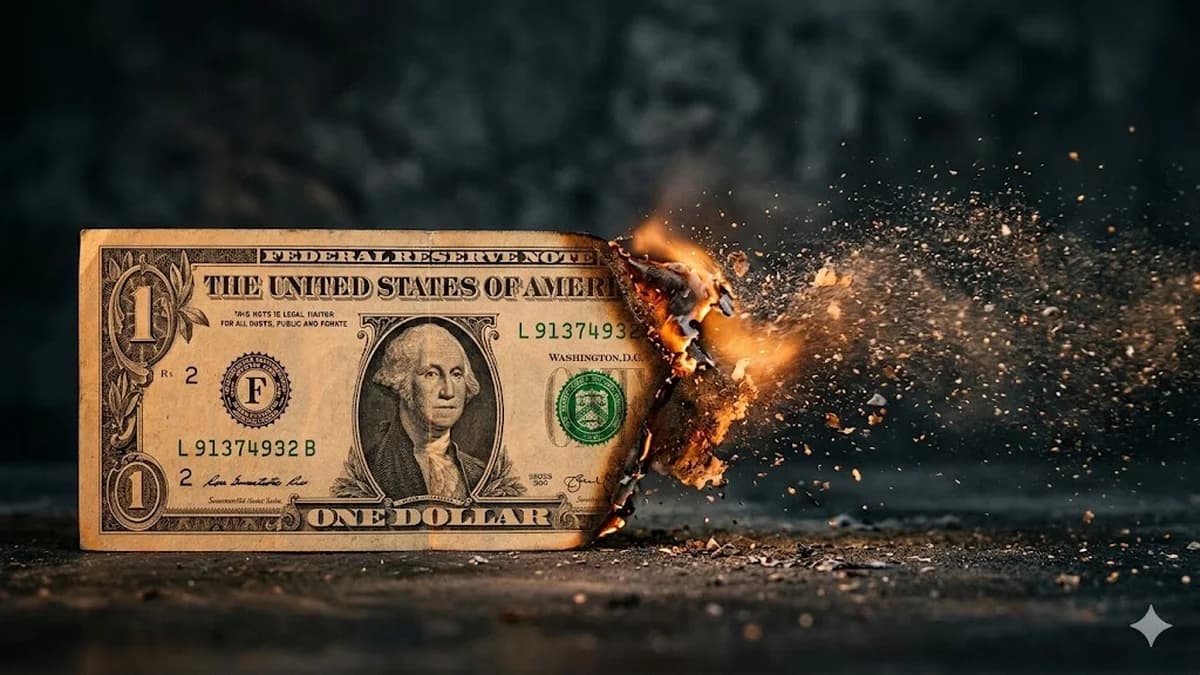
Your money is losing value every year. This is not an opinion or a theory. The U.S. dollar has lost over 97% of its purchasing power since 1913, when the Federal Reserve was created. A basket of goods that cost $100 in 1913 costs over $3,000 today. The mechanism is inflation, and it runs on purpose.
In 2015, a hundred dollar bill could fill your gas tank twice, cover a week of groceries for two, or pay for a decent dinner out with drinks. That same hundred dollar bill is still sitting in your wallet. Same serial number. Same dead president staring back at you.
But it doesn't do what it used to.
Today, that $100 fills your tank once. Maybe. It covers four days of groceries if you're careful. That dinner out? You're splitting an appetizer and skipping dessert.
The bill didn't change. The world around it did. And this isn't some slow, invisible process happening over centuries. This happened in the last ten years. While you were working, saving, doing everything you were told to do.
Your money is losing value. Right now. Every single day. And the system that's causing it has zero incentive to explain it to you.
The U.S. dollar has lost over 25% of its purchasing power in the last decade (Bureau of Labor Statistics). Between 2020 and 2022, the money supply grew by roughly 40% (Federal Reserve). A $10,000 savings account earning 0.5% loses about $250 in real purchasing power every year when inflation runs at 3%. Your savings account isn't saving you. It's a slow leak, and nobody at your bank is going to tell you.
Here's how fast it's happening:
What "Purchasing Power" Actually Means
Let's strip the jargon out of this.
Purchasing power is a simple concept: it's what your money can actually buy. Not the number on the bill. Not the balance in your checking account. What that money gets you in the real world. Food. Rent. Gas. The stuff you need to survive.
When someone says "the dollar is losing purchasing power," they mean this: the same dollar buys less stuff than it used to. The number on your paycheck might stay the same, or even go up a little. But the things you need to buy with that paycheck cost more. So you're falling behind even when it looks like you're keeping up.
Think about it like this. Imagine you have a gift card to your favorite restaurant. Five years ago, that gift card covered dinner for two. Today, same restaurant, same gift card, and you can barely cover one entree and a drink. The card didn't expire. The value just evaporated.
That's what's happening to every dollar you own. Every dollar in your savings. Every dollar in your paycheck. Every dollar stuffed in a shoebox under your bed.
It's all worth less than it was yesterday. And it will be worth less tomorrow.
The Math Your Bank Doesn't Want You to Do
Here's where it gets painful.
The average savings account in the U.S. pays about 0.5% interest. Some of the bigger banks pay even less. That means if you've got $10,000 sitting in savings, you're earning roughly $50 per year for the privilege of letting the bank use your money.
Sounds better than nothing, right?
Now look at the other side. According to the Bureau of Labor Statistics, inflation has averaged between 3% and 5% annually over the last several years. In 2022, it hit 9.1%, the highest in over 40 years. Even in calmer years, it hovers around 3%.
Let's do the math that nobody at your bank is going to do for you.
You put $10,000 in a savings account. Your bank pays you 0.5%. You "earn" $50. Meanwhile, inflation runs at 3%. That means the cost of everything you need went up by $300 relative to your ten grand. Your real return? Negative $250.
You didn't make money. You lost it. You lost $250 in purchasing power in a single year, while your bank statement showed a green number that made you feel like everything was fine.
Your Savings Account vs. Inflation
Annual rates compared. The gap is your real loss.
Sources: FDIC national rate data, Bureau of Labor Statistics
Multiply that across five years. Ten years. A lifetime of "saving."
A person who diligently saved $10,000 in a standard savings account in 2015 has, in real terms, lost over $2,500 in purchasing power by 2025. The account might show $10,500 or so with accumulated interest. But the things that $10,000 could buy in 2015 now cost over $13,000.
Your savings account isn't saving you. It's a slow leak.
How They Print Money (and Why You Pay for It)
So where does inflation come from? Why do prices keep going up?
There are a few reasons, but the biggest one is the simplest: the government creates more money.
Not physically printing bills, necessarily (though they do that too). The Federal Reserve, which is America's central bank, has the ability to create new dollars out of thin air. They do this by buying government bonds and other financial assets, which pumps fresh money into the banking system. Banks then lend that money out, and it multiplies through the economy.
Between 2020 and 2022, the U.S. money supply (measured by M2, which is basically all the cash, checking deposits, and easily accessible savings in the country) increased by roughly 40%. Forty percent. In two years.
That's not a typo.
~40%
Increase in U.S. money supply (M2), 2020-2022
Federal Reserve Economic Data (FRED)
The Federal Reserve created trillions of new dollars. And here's what happens when you flood the system with new money: every dollar that already existed becomes worth less. It's basic supply and demand. More dollars chasing the same amount of goods and services means each dollar buys less.
Think of it like a pizza. You and nine friends are splitting a pizza, ten slices, one each. Now imagine someone invites four more people but doesn't order another pizza. Same ten slices, now fourteen people. Everyone's slice just got smaller.
That's what money printing does to your purchasing power. The government made the pizza smaller for everyone who was already at the table. But they didn't send you a memo about it. Your paycheck still said the same number. Your bank account still showed the same balance. You just started noticing that everything costs more.
And here's the part that should make your blood boil: the people closest to the new money, banks, large corporations, institutional investors, they get to spend it before prices adjust. By the time it trickles down to your paycheck or your savings account, the damage is done. Prices have already moved. You're paying the inflation tax, and you never even got a ballot.
The Dollar Has Lost Over 25% of Its Value in a Decade
Let's put hard numbers on this.
According to the Bureau of Labor Statistics Consumer Price Index (CPI) data, the purchasing power of the U.S. dollar has declined by more than 25% since 2015. That means something that cost $1.00 in 2015 costs roughly $1.27 or more today.
Scale that up. A hundred dollars in 2015 buys about $73 worth of stuff today. You lost $27 out of every hundred, not because you spent it, but because it was taken from you through the slow, quiet erosion of your currency's value.
What $100 Is Actually Worth Over Time
Purchasing power of $100 (2015 dollars), adjusted for inflation
Source: Bureau of Labor Statistics CPI Data
And this isn't some anomaly. It's the pattern. The dollar has lost over 96% of its purchasing power since the Federal Reserve was created in 1913. A dollar from 1913 would need to be about $31 today to have the same buying power. That's not a century of progress. That's a century of dilution.
Zoom out even further and it gets stranger. For most of the country's history before 1913, prices were roughly stable from decade to decade. A loaf of bread cost about the same in 1900 as it did in 1860. The dollar held. Then the chart breaks upward and never comes back down. For the full 50+ year picture since the gold standard ended, see is the dollar losing value.
Something clearly changed. It wasn't technology. It wasn't global trade. It was who controlled the supply of money, and how freely they could expand it.
Here's what that looks like in everyday life:
How Prices Have Changed Since 2019
Percentage increase in common expenses
+1,200% College tuition since 1980 (NCES)
+100% Healthcare (per capita) since 2000 (CMS)
Sources: USDA, Census Bureau, EIA, NCES, CMS
These aren't freak price spikes. This is the cost of a currency that's been systematically devalued over decades. Every year, the dollars you hold buy less. Every year, you need more of them just to stay in place.
That's not saving. That's running on a treadmill that's speeding up.
The "Real" Inflation Rate Is Probably Worse Than You Think
Here's something else worth knowing: the official inflation numbers might be understating the problem.
The Consumer Price Index, which is how the government measures inflation, has been adjusted multiple times over the decades. The way they calculate it today is different from how they calculated it in the 1980s or 1990s. Changes in methodology, like "hedonic adjustments" (where they argue that a product got better, so a price increase doesn't really count) and substitution effects (where they assume you'll switch to cheaper alternatives when prices rise), tend to push the official number lower.
Some economists, including those at ShadowStats and the American Institute for Economic Research, have argued that real inflation, the kind you actually feel at the grocery store and the gas pump, runs significantly higher than the official CPI number. Estimates vary, but many put it 2 to 4 percentage points above the government's reported figure.
That means when the government says inflation is 3%, the actual cost-of-living increase might be closer to 5% or 7%. And that gap compounds. Over a decade, the difference between 3% and 6% annual inflation is enormous. It's the difference between your dollar being worth $0.74 and your dollar being worth $0.54.
You don't need to take anyone's word for it. Just look at your own life. Do the prices you're paying feel like they've only gone up 3% a year? Or does it feel like a lot more?
Trust your gut. It's probably right.
This is just the beginning.
Join thousands of people learning what school never taught about money.
Why Nobody Tells You This
This is the part that matters most.
If this is all real, if the dollar is losing value, if savings accounts are a losing bet, if the government is quietly inflating away your purchasing power, why doesn't anyone tell you?
Because the system benefits from your ignorance.
Banks benefit when you keep money in savings accounts earning 0.5% while they lend it out at 7%. The spread is their profit. Your loss is their business model.
The government benefits because inflation is a hidden tax. They can spend more than they collect in revenue, print the difference, and the cost gets distributed across every dollar holder in the country. No vote required. No line item on your tax return. You just quietly get poorer.
Financial institutions benefit because confused, uneducated consumers are easier to sell products to. Complicated 401(k) plans, high-fee mutual funds, whole life insurance policies. The less you understand about money, the more you need their "help."
And the education system? Financial literacy has been systematically left out of public school curricula for decades. As of 2025, only about half of U.S. states require any personal finance education in high school. Half. And even in states that do, the curriculum rarely covers inflation, purchasing power, or how the monetary system actually works.
This isn't an accident. When people don't understand how money works, they make predictable, profitable mistakes. They keep cash in savings accounts that lose value. They take on debt for things they don't need. They never question why everything keeps getting more expensive while their wages barely move.
You were never taught this. And that was by design.
You're Probably Already Bleeding Money Without Knowing It
Here's where this gets personal.
Most people, when they hear about purchasing power erosion, think: "Okay, but what am I supposed to do? I can't control the Federal Reserve."
True. You can't.
But here's what you can control: where your money goes every week. And chances are, a decent chunk of it is going to things that are making this problem worse.
That $20 a week on lottery tickets? Gone. Zero return. The average American spends over $1,000 a year on lottery tickets, and the expected return is about negative 50%.
The streaming subscriptions you forgot about? The impulse buys on Amazon at midnight? The "treat yourself" coffee runs that add up to $150 a month?
None of this is about judging your spending. It's about seeing it clearly. You're already spending money on things that lose value or vanish entirely. Every one of those dollars is also getting hit by inflation while it sits in your account waiting to be spent.
It's a double loss. The dollar is worth less, and you're spending it on things worth nothing.
Once you see it, you can't unsee it. And once you can't unsee it, you start asking a different question. Not "why is everything so expensive?" but "what do I do about it?"
What You Can Do About It
This isn't a hopeless situation. It feels like it sometimes, because the scale of the problem is massive and the forces behind it are powerful. But the reality is simpler than you think.
You don't need to become a financial expert. You don't need to understand derivatives or options chains or macroeconomic theory. You just need to do one thing: stop leaving all of your money in a system that's designed to drain its value.
That means taking small, consistent steps to redirect some of what you earn away from the leak. Away from the savings account that's losing to inflation. Away from the frivolous spending that evaporates on contact. Toward something that has a chance of holding or growing in value over time.
Small steps, done consistently, produce real results. Not overnight. Not in a way that makes you rich by Friday. But in a way that actually moves the needle over months and years.
You don't need thousands of dollars. Start with $5, $10, or $20 a week. That's the money you're already spending on things that vanish. Redirect it toward something that doesn't.
The trick isn't the amount. It's the habit. A $5-a-week habit that runs for a decade does more than a $500 one-time deposit that never gets repeated. The system counts on you thinking small amounts don't matter, because the moment you realize they do, a lot of the spending that keeps the system running stops flowing.
Five bucks a week is a latte you skipped. Ten bucks a week is two impulse buys you didn't make. Twenty is one mediocre takeout meal. These are not sacrifices. They are course corrections. And the longer they run, the bigger the gap grows between you and the person who never corrected at all.
The first step is understanding the problem. You just did that. The second step is understanding your options. That's coming.
Get the full picture.
We'll send you the next chapter when it's ready. No spam, no selling.
Before you click anywhere else, sit with this for a second. The dollar erosion isn't a future problem. It happened while you were reading. It'll happen again tomorrow. It happens whether you pay attention or not.
The questions below cover the ones people ask most often once they realize what's been going on. Skim them. Pick the one that keeps nagging at you. Then go do something about it.
Frequently Asked Questions
Keep Reading
This article is the starting point. The foundation. You now know something that most people never learn: your money is losing value, and the system is set up to keep you in the dark about it.
But knowing the problem is only the beginning. Here's where to go next:
- What Is Fiat Currency? (And Why It Matters for Your Money) The honest, plain-English answer nobody taught you in school, plus why fiat is the reason your dollar loses value every year.
- What Is Purchasing Power (and Why Should You Care)? A deeper look at the concept that determines whether your money is actually worth anything.
- Your Savings Account Is Losing You Money The real math behind "safe" savings, and why the safest-sounding option might be the most dangerous.
- How the Government Prints Money (in Plain English) No jargon, no economics degree required. Just how it works and why it matters to you.
- What $100 Used to Buy (and What It Gets You Today) A decade-by-decade breakdown that makes the abstract feel very real.
- The Real Inflation Rate: What the Government Isn't Telling You Why the official numbers might be dramatically understating the problem.
- Why Is Rent So High? The standard answer is supply and demand. The deeper one: rent is where you watch your dollar lose value in real time.
- Average American Savings by Age: Where You Stand The "average" is a statistical trick. The typical American has $8,000 in the bank, not the $62,410 you always see quoted, and even that is measured in a shrinking dollar.
- Bitcoin vs Gold: Which One Actually Protects Your Money? An honest comparison of the two most popular inflation hedges, written for people who have never invested.
- What Happens to Cash During a Recession (and What Actually Holds Value) What really holds value when the economy falls apart, and why cash isn't the safe bet you think it is.
- Nobody Taught You This. That Was on Purpose. How financial literacy was systematically kept out of the classroom, and who benefits from your ignorance.
- You're Already Wasting Money (Here's Where It's Going) A look at the invisible spending that's draining your wallet before inflation even gets its turn.
- Small Steps, Real Results What you can actually do about all of this, starting with the money you're already spending.
- The Debt Trap Credit cards, student loans, BNPL. How the system keeps you borrowing and what the math really looks like.
The dollar lost over 25% of its purchasing power in the last decade. Your savings account isn't keeping up. The system that's causing this has no reason to explain it to you. But now you know. The question is: what are you going to do about it?
This article is for educational purposes only and does not constitute financial advice. Untaught does not hold, move, or custody any funds. Past performance does not guarantee future results. Always do your own research before making investment decisions.
Quick calculator
Your coffee money could have become
$16,301
from $9,900 invested