You're Already Wasting Money: The Spending Habits Nobody Questions
Lottery tickets, forgotten subscriptions, impulse buys. Americans waste thousands every year on things that lose value instantly. The money is there. You just need to redirect it.
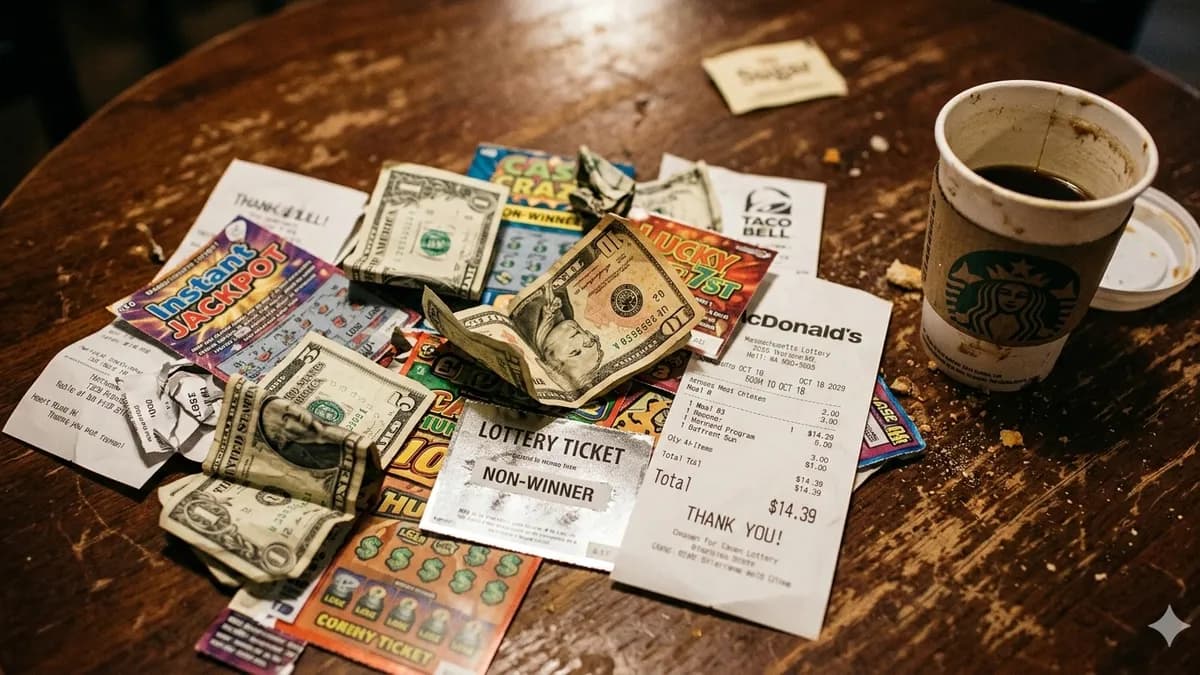
The average American household wastes between $10,000 and $18,000 per year on spending they barely notice, according to a Ladder Life/OnePoll survey. This includes lottery tickets, forgotten subscriptions, impulse buys, and convenience fees. Most people underestimate their subscription spending alone by $133 per month. The money to change your financial future is already in your budget.
Here is a number nobody wants to hear: the average American household wastes somewhere between $10,000 and $18,000 every year on spending they barely notice.
Not rent. Not groceries. Not the stuff that actually keeps you alive. We are talking about the other stuff. The lottery tickets, the forgotten subscriptions, the daily convenience purchases, the impulse buys you cannot even remember a week later.
That is not a budgeting problem. That is a leak. A slow, invisible drain on your future. And nobody talks about it because the entire economy is designed to keep it flowing.
Americans waste between $10,000 and $18,000 per year on spending they barely notice (Ladder Life/OnePoll). Lottery tickets, forgotten subscriptions, impulse buys, delivery markups. The average person underestimates their subscription spending by $133/month (C+R Research). Redirecting just $200/month of that waste into an S&P 500 index fund at 10% average returns grows to over $150,000 in 20 years. The money is already in your budget. You're just setting it on fire.
This is not about shaming anyone for buying a coffee. This is about seeing clearly. Because once you actually add up what "invisible spending" costs over a year, five years, ten years, it changes how you think about money forever.
Let's do the math.
The Invisible Spend: What It Actually Adds Up To
Before we break it down category by category, here is a rough monthly snapshot for an average American:
- Lottery tickets: $50 to $100
- Forgotten or unused subscriptions: $30 to $50
- Daily coffee and convenience drinks: $80 to $150
- Impulse purchases (Amazon, Target runs, app stores): $100 to $200
- Convenience food (delivery fees, fast food upgrades, vending machines): $75 to $150
- "Treat yourself" spending (clothes, gadgets, random stuff): $50 to $150
Add it up and you are looking at $385 to $800 per month. Call it $500 on average. That is $6,000 a year, and that is a conservative estimate.
The Monthly Invisible Drain
Average monthly spending on things that vanish instantly
Sources: Slickdeals, West Monroe, Quicken, NASPL (2023-2024 surveys)
Some studies put the number much higher. A Ladder Life/OnePoll survey (2019) found the average American spends roughly $18,000 per year on nonessential purchases ($1,497/month across categories like dining out, impulse buys, and convenience spending).
Wherever you land on that scale, the point is the same: you have more money than you think. You are just not keeping it.
The Lottery: America's Biggest Voluntary Tax
Let's start with the most obvious one. And the most painful.
Americans spend over $100 billion on lottery tickets every single year. That is more than the country spends on books, movies, video games, concert tickets, and sporting event tickets combined. Read that again.
The average regular lottery player spends between $50 and $100 per month. In some states, the figure is significantly higher. In Massachusetts, the per-capita lottery spend is over $900 per year.
And the odds of winning? Powerball's jackpot odds are roughly 1 in 292 million. You are about 300 times more likely to be struck by lightning. You are more likely to be killed by a vending machine. The lottery is not a financial strategy. It is a tax on hope.
The cruelest part: the people who spend the most on lottery tickets are the people who can least afford it. Households earning under $30,000 per year spend a higher percentage of their income on the lottery than any other income bracket. The system takes from those who have the least and returns almost nothing.
What would happen if you took that lottery money and invested it instead? Even at $50 a month, put into a basic index fund averaging 8% annual returns, you would have over $9,000 in ten years. At $100 a month, that jumps to roughly $18,500. That is real money. That is a down payment. That is an emergency fund. That is freedom.
But nobody tells you that. Because the state makes billions off the current arrangement.
Forgotten Subscriptions: The Silent Monthly Drain
Here is another number that should make you uncomfortable: the average American has 12 or more active subscriptions. And according to a 2022 study by C+R Research, 42% of consumers are still paying for subscriptions they have forgotten about entirely.
Think about that. Nearly half of us are paying for services we do not even use.
Streaming platforms. Fitness apps. Cloud storage upgrades. Free trials that quietly converted to paid plans. That meditation app you used twice in January. That news site you signed up for during an election cycle and never cancelled.
Each one seems small. $9.99 here. $14.99 there. But the subscription trap is designed to work exactly this way. Companies bet on your inertia. They make it easy to sign up and deliberately hard to cancel. Some services bury the cancellation option behind phone calls, multi-step processes, or dark patterns that guilt you into staying.
The average American spends $219 per month on subscriptions, according to a 2022 C+R Research study. But when surveyed, most people estimated they were spending around $86. That gap, roughly $133 a month, is money people do not even realize they are losing.
That is $1,596 a year in spending you literally forgot about. Over a decade, assuming you never even invest it, just stop the bleeding, that is nearly $16,000.

Impulse Buys and "Treat Yourself" Culture
Now let's talk about the spending that feels intentional but really is not.
You know the pattern. You are scrolling your phone. An ad pops up. The product looks good. The reviews say it is amazing. The price is "only" $29.99. You add to cart. You check out. It arrives two days later. You use it once. It sits in a drawer. Repeat.
A Slickdeals survey (2022) found that the average American spends about $314 per month on impulse purchases. Per month. That is $3,768 per year on things you did not plan to buy and, in many cases, did not actually need.
$314/mo
Average American impulse spending
Slickdeals, 2022
The psychology behind impulse buying is well-documented. Retailers and advertisers have spent decades engineering environments that override your rational brain. Limited-time offers create urgency. "Only 3 left in stock" triggers scarcity bias. One-click purchasing removes friction. Social media ads target you based on your browsing history, your mood, even the time of day.
This is not an accident. It is a machine. And it is very, very good at its job.
Then there is the latte factor, a concept financial author David Bach popularized. A $5 coffee every workday is $25 a week. That is $1,300 a year. Is it the end of the world? No. But it is a symptom of a bigger pattern: the belief that small daily spending does not matter.
It does. Not because each individual purchase is a disaster, but because the pattern, repeated daily for years, adds up to a staggering amount of money that simply disappears.
Convenience Spending: The Fee Economy
There is a category of waste that barely existed 15 years ago: convenience fees.
DoorDash charges delivery fees, service fees, and small-order fees. Uber adds surge pricing. Instacart marks up grocery prices 15% or more on top of service fees. You pay $18 for a burrito that costs $9 at the counter.
Then there are the smaller leaks. ATM fees averaging $4.73 per transaction. Late payment fees. Overdraft charges. "Convenience" fees for paying bills online, which is somehow still a thing in 2026.
A Bankrate survey found that among Americans who pay bank fees, the average is $24 per month, or $288 per year. And while many account holders avoid fees entirely, millions still pay them without realizing there are free alternatives.
Add in delivery app premiums and you are easily looking at another $100 to $200 per month in pure convenience costs. That is money you are paying so you do not have to walk two blocks, wait in line, or cook a meal.
Again, no judgment. But awareness matters. Because every one of those dollars had an alternative life.
The 10-Year Gut Punch: Opportunity Cost Is Real
This is the part that hurts.
Let's take a very moderate number. Say you are wasting $400 per month on some combination of lottery tickets, forgotten subscriptions, impulse buys, and convenience fees. That is probably on the low end of average, but let's be conservative.
$400 per month is $4,800 per year.
Over 10 years, that is $48,000. Just gone. Poof. Nothing to show for it.
But that is just the static number. What if you had redirected even half of that into something that grows?
$200 per month invested in an S&P 500 index fund averaging roughly 10% annual returns over the past decade would grow to approximately $41,000 in 10 years. In 20 years, it would be over $150,000. In 30 years, north of $450,000.
Wasted vs. Invested: The 10-Year Gap
$400/month wasted (gone forever) vs. $200/month invested at 10% return
Invested line assumes 10% average annual return (S&P 500 historical average)
$200 per month. That is the cost of your forgotten subscriptions and a few skipped DoorDash orders.
The money was always there. It was just flowing in the wrong direction.
And that is just one scenario. You could put it into I-bonds for inflation-protected savings. Into a Roth IRA for tax-free growth. Into Bitcoin through a basic dollar-cost-averaging strategy. Into a high-yield savings account. The vehicle matters less than the habit. The point is that the money exists and you are currently lighting it on fire.
Why You Don't Notice: The Psychology of Invisible Spending
If the math is this obvious, why do so many people miss it?
Because the system is built to make you miss it.
Small amounts do not trigger pain. Behavioral economists have shown that humans evaluate spending relative to the size of the individual transaction, not the cumulative total. A $5 purchase does not feel significant, even if you make one every single day. Your brain processes each swipe as a standalone event, not as part of a $1,825 annual pattern.
Autopay hides the bleed. When a subscription auto-renews, you do not make an active decision to spend that money. It just leaves your account. Out of sight, out of mind. Companies know this. It is the entire business model of the subscription economy.
Social norms protect the habit. Nobody questions your daily coffee. Nobody raises an eyebrow at a Netflix subscription. These purchases are culturally "normal," which makes them invisible. You would notice if someone stole $200 from your wallet. You do not notice when you spend $200 across 40 micro-transactions over a month.
Marketing reframes waste as self-care. "You deserve it." "Treat yourself." "Life is short." The messaging around consumer spending is designed to make frugality feel like deprivation. If you question the spending, you are the problem. You are no fun. You are cheap.
That framing is not an accident. It exists because your spending is someone else's revenue.
Nobody sat you down in school and taught you about opportunity cost, compound growth, or the cumulative impact of daily spending decisions. Nobody taught you this. And that was by design.
Stop the leak.
Join thousands learning how to redirect wasted spending into real wealth.
This Is Not About Deprivation
Let's be very clear about something: this is not about living like a monk.
You do not need to cancel every subscription. You do not need to stop buying coffee. You do not need to eat rice and beans and feel miserable about it.
This is about awareness. About seeing where your money actually goes, instead of where you assume it goes. Most people, when they actually track their spending for a month, are stunned by what they find. The gap between what you think you spend and what you actually spend is almost always hundreds of dollars.
The goal is not zero fun. The goal is intentional spending. Keep the things that genuinely make your life better. Cut the things you forgot you were paying for. Reduce the things that deliver a momentary hit and nothing lasting.
When people hear "budget," they think restriction. But this is actually the opposite. This is about finding money you already have and putting it somewhere it actually works for you.
You are not broke. You are leaking.
What "Redirecting" Actually Looks Like
So what do you do with this awareness?
You redirect. Not all of it. Not overnight. You start small and build the habit.
Here is what that looks like in practice:
Step 1: Find the leaks. Pull up your bank and credit card statements for the past three months. Highlight every recurring charge you do not actively use. Highlight every purchase you cannot remember making. Add it up. That number is your starting point.
Step 2: Cancel what you forgot about. This is the easiest money you will ever "make." If you have not used a subscription in 30 days, cancel it. You can always re-subscribe later. You will not miss it. Studies show that most people who cancel forgotten subscriptions never re-subscribe because they never noticed the service was gone.
Step 3: Pick one daily habit to modify. Not eliminate. Modify. Buy coffee three days a week instead of five. Cook two meals you would have ordered delivery for. Skip the Amazon impulse buy and put the item on a 48-hour wait list. If you still want it in two days, buy it. Most of the time, you will not.
Step 4: Redirect the savings automatically. This is the critical step. Set up an automatic transfer. Even $25 a week. Move it the same day you get paid, before you have a chance to spend it. Put it into a savings account, a brokerage account, a Roth IRA, whatever makes sense for your situation. The vehicle matters less than the consistency.
The key word is "automatic." If you have to make a conscious decision every week to save, you will eventually stop. But if the money moves before you see it, the habit runs itself.
This is the bridge from awareness to action. And it is exactly what we dig into in the next pillar: Small steps, real results.

The Money Was Always There
Here is the truth that the financial industry does not want you to hear: most people do not have an income problem. They have an awareness problem.
Your money is already losing value to inflation every day it sits in a checking account. And on top of that, you are actively bleeding it out through spending you do not even register.
The money to change your financial future is not locked behind a raise, a promotion, or a side hustle. It is sitting in your existing spending, hiding in plain sight. In the subscriptions you forgot. In the lottery tickets that will never pay off. In the delivery fees and impulse buys and "treat yourself" moments that evaporate the second the dopamine fades.
$200 a month. That is all it takes to start building something real. And you are almost certainly wasting more than that right now.
Pull up your bank statement right now. Highlight every charge you do not remember making. Add it up. That number is your starting point. Cancel what you forgot about, redirect even half of it, and you are already ahead.
The question is not whether you can afford to start. The question is whether you can afford not to.
Frequently Asked Questions
Keep Reading
This article is part of a series on financial literacy and building better money habits. Explore more:
- Pillar 1: Your money is losing value, and it is not an accident
- Pillar 2: Nobody taught you this. That was the plan.
- Pillar 4: Small steps, real results: how redirecting small amounts changes everything
- Pillar 5: The Debt Trap: what nobody told you about borrowing money
Deep Dives From This Pillar
- The real odds of winning the lottery (and what they mean for your wallet)
- What if you invested your lottery money instead?
- Americans spend $100 billion on lottery tickets every year
- The subscription trap: why companies bet on your inertia
- The latte factor: does daily coffee really matter?
- The psychology of impulse buying (and how to beat it)
- How to stop living paycheck to paycheck (when the system is designed to keep you there)
This article is for educational purposes only and does not constitute financial advice. Untaught does not hold, move, or custody any funds. Past performance does not guarantee future results. Always do your own research before making investment decisions.
Quick calculator
Your coffee money could have become
$16,301
from $9,900 invested