Buy Now, Pay Later: The New Debt Trap Dressed Up as a Deal
41% of BNPL users made a late payment last year (Federal Reserve). Buy Now, Pay Later looks like a deal. It's debt in a nicer outfit. Here's how the trap works.
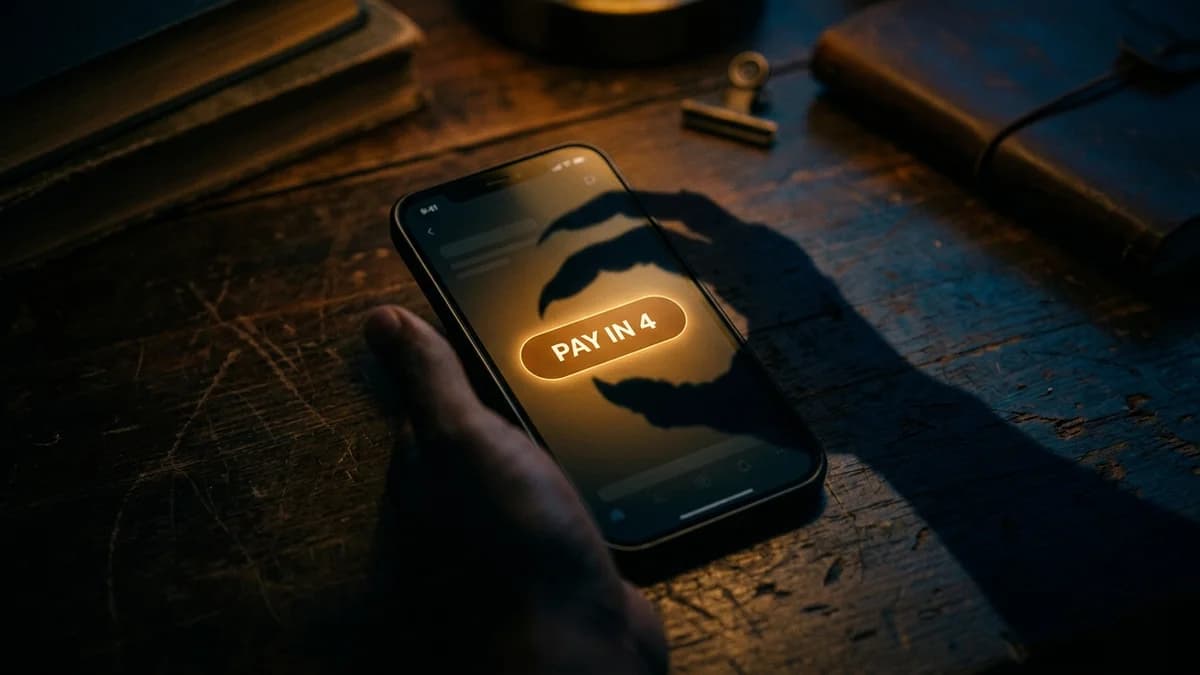
Buy Now, Pay Later (BNPL) is short-term installment debt that splits a purchase into four interest-free payments over six weeks. 41% of BNPL users made at least one late payment in the past year, according to the Federal Reserve. 63% carry multiple BNPL loans at the same time, per the CFPB's January 2025 report. The "Pay in 4" label is a marketing move. The debt is real.
You saw a pair of shoes. $127. More than you wanted to spend. Then a little button appeared: "Or 4 payments of $31.75." You clicked it. The shoes were on your porch two days later. You still don't remember giving anyone any money.
That feeling is the product. Buy Now, Pay Later was engineered to feel weightless. To make $127 feel like $32. To get you to the checkout screen before your brain can ask the question that matters: do I actually have the money for this?
41% of Buy Now, Pay Later users made at least one late payment in the past 12 months (Federal Reserve, 2025). 63% of borrowers carry multiple BNPL loans simultaneously, and 61% are in subprime or deep-subprime credit categories (CFPB, January 2025). Starting in fall 2025, FICO began including BNPL data in two of its credit scoring models. The "Pay in 4" label hides real debt. This article breaks down the math.
This isn't a story about reckless shoppers. It's a story about a product category that regulators, the Federal Reserve, and now FICO have quietly reclassified as debt, while the marketing on checkout buttons still reads like a discount.
Read more: The Debt Trap: What Nobody Told You About Borrowing Money | The Minimum Payment Trap
What Is Buy Now, Pay Later?
Buy Now, Pay Later is short-term installment debt that splits a purchase into four (or more) interest-free payments over six weeks. The global BNPL market was valued at roughly $560 billion in 2025, and the average yearly loan value grew from $745 in 2022 to $848 in 2023, a 14% increase, per the CFPB's January 2025 report.
The major providers are names you've probably seen at checkout: Affirm, Klarna, Afterpay, PayPal Pay Later, Zip, and Sezzle. Click the BNPL button, answer a few questions, and you're approved in seconds. No hard credit pull on most plans. No interest on the four-payment plans. Just a nudge that says "This is easier."
Here's how they actually make money. The consumer pays zero interest on a standard Pay in 4 plan. But the merchant pays the BNPL provider 2% to 6% of every sale. Why would a retailer give up that margin? Because shoppers who see a BNPL option spend 20% to 40% more per order, according to industry data reviewed by PartnerCentric (2025). The provider takes a slice. The merchant takes the bigger basket. You take on a loan.

BNPL also charges late fees. Roughly 4.1% of BNPL loans were assessed a late fee in 2023, per the CFPB. That sounds small until you realize one in twenty-five loans getting dinged is across hundreds of millions of transactions per year. The business model does not need every user to pay late. It just needs enough to do.
Is BNPL Actually Debt?
Yes. BNPL is debt by every definition that matters. The Consumer Financial Protection Bureau treats BNPL as a consumer loan. The Federal Reserve tracks BNPL in its household debt reporting. The Federal Reserve Bank of Richmond's February 2026 brief calls BNPL a "fast-growing form of consumer credit." Every legitimate regulator has been clear: you are borrowing money.
So why does it feel so different from a credit card? Because the language was designed to make it feel different.
BNPL providers don't say "loan." They say "installment plan." They don't say "borrow." They say "split your payment." They don't show an APR, because on a standard Pay in 4 plan there isn't one. The math is hidden inside friendly language.
There's a deeper reason it works. Behavioral economists call it "pain of paying." When you hand over cash, you feel the loss. When you swipe a credit card, you feel it less. When you click a BNPL button and only $32 comes out today, you barely feel anything at all. Research published in the Journal of Retailing (2025) confirms that BNPL reduces payment salience, which in turn increases spending.
The data backs this up. BNPL users spend 6.42% more than non-users on the same product categories, per a 2025 ScienceDirect review of BNPL consumer behavior. That's not a neutral payment method. That's a product engineered to make you spend more. Which is exactly what debt has always done.
+6.42%
Additional spending by BNPL users vs. non-users on the same purchases
ScienceDirect consumer behavior review, 2025
The Phantom Debt Problem
Until 2025, most BNPL loans were not reported to any credit bureau. That means when a lender pulled your credit report to evaluate you for a mortgage or an auto loan, they couldn't see a single one of your BNPL plans. They couldn't see you had four active loans across three providers with $900 in pending payments. Regulators call this "phantom debt."
63% of BNPL borrowers originated multiple simultaneous loans in 2022, and 33% held loans across several providers at once, per the CFPB's January 2025 report. In other words, if you use BNPL at all, the odds say you're probably juggling more than one plan right now. And unless you track them yourself, no one else can see the full picture either.

Why does this matter? Two reasons.
First, on the personal level, phantom debt is how people end up overextended without realizing it. A single BNPL plan feels manageable. Four of them, all charging on different Fridays, is a cash-flow problem. You don't see it coming because the app doesn't show you all four side by side. Your bank account does, but by the time it does, it's too late.
Second, on the macro level, BNPL is now big enough to matter. Affirm announced it would begin reporting BNPL loans to credit bureaus in 2025. But Klarna and Afterpay have pushed back, arguing that traditional credit scoring models may unfairly penalize frequent BNPL users. Translation: they'd rather keep their data off the books than risk spooking customers.
The CFPB also found that 32.7% of BNPL users have a credit score below 620, a rejected credit application on file, or a delinquent loan. Phantom debt isn't a small problem hiding inside a healthy population. It's concentrated in the cohort that can least afford it.
Why BNPL Users Spend More
49% of Americans using BNPL say they make more impulse buys because of it, according to a 2026 Fullstory survey. Nearly half admit they're spending more than they would without the option. This isn't a willpower failure. It's what the product is designed to produce.
The psychology is simple. When a $127 purchase is framed as $31.75 today, your brain compares $31.75 to your bank balance, not $127. The full price never enters the decision. Retailers know this. BNPL providers know this. That's why the installment number is giant on the button, and the total price is printed in small gray text underneath.
If you find yourself choosing Buy Now, Pay Later because the full price felt "too expensive" to pay today, that's the trap working. The label is the trick. If you can't afford the full price, you can't afford the payment plan.
This is the same mechanic that makes impulse buying so expensive across the board. Design makes the decision feel small. The cost stays real. You've done it before with subscriptions, with "only $X per day" ads, with one-click reorders. BNPL is just the newest version.
The numbers show up in merchant reports. Stores that add BNPL options see average order values climb 20% to 40%. That's not because BNPL customers are wealthier. It's because the same customer, given a Pay in 4 button, buys more than they planned. Every time.
What Happens If You Miss a Payment?
Late fees, credit damage, and potentially collections. Starting in fall 2025, FICO launched two new scoring models (FICO Score 10 BNPL and FICO Score 10 T BNPL) that include BNPL repayment behavior in a consumer's credit score. The "it doesn't affect your credit" era is over.
Here's what a single missed payment actually looks like in practice. Your autopay retries on the scheduled date. Your checking account is short. The BNPL provider charges a late fee, typically $7 to $15. The bank charges an overdraft fee, which averages roughly $35 at large banks per CFPB 2024 overdraft research. Your original $127 purchase just became a $177 purchase. A 39% surcharge, on one miss.
One Late Payment, Multiple Losses
What a single missed payment actually costs on a $127 median BNPL purchase
Sources: CFPB BNPL Market Report (Jan 2025), CFPB Overdraft Research (2024)
That's the direct cost. The indirect cost is bigger. Since fall 2025, lenders using FICO Score 10 BNPL see a record of your missed BNPL payments alongside your credit card and loan history. Payment history is 35% of your FICO score, and a single 30-day-late payment can drop a high score by 90 to 110 points, according to myFICO. That kind of drop moves mortgage rates, car loan rates, and even some apartment applications.
What about before 2025, when BNPL didn't affect credit? The costs were still real. Missed BNPL payments still went to collections after 60 to 90 days. Collections agencies still called. Your bank account was still drained by overdraft fees. Credit just didn't know. The damage showed up on your bank statement instead of your credit report.
The late-payment rate is the canary in the coal mine. It was 34% in 2023 and climbed to 41% in 2024, per Federal Reserve tracking. For Gen Z users, the rate is 51%. That isn't occasional oversight. That's a cohort that is consistently coming up short.
Late Payment Rate by Payment Type
Share of users who made at least one late payment in the past 12 months
Sources: Federal Reserve (2025), CFPB BNPL Market Report (Jan 2025), NY Fed Household Debt Q4 2025
Compare that to credit card delinquency, which sits around 9% per New York Fed data for Q4 2025. BNPL users are falling behind at four to five times the rate of credit card holders. And until 2025, that pattern was almost completely invisible to the wider financial system.
Who Is BNPL Designed For?
BNPL is disproportionately used by young consumers and people with thin or subprime credit profiles. 37% of 18-to-24 year-olds have financed a purchase with BNPL, almost twice the national average, per the CFPB January 2025 report. 61% of U.S. BNPL borrowers are in subprime or deep-subprime credit categories. The product is targeted exactly where the late-payment risk is highest.
There's a reason for that. BNPL grew fastest during a period of wage stress, rising rents, and persistent inflation. People needed more time to pay for things they already couldn't afford outright. BNPL offered a workaround that felt less stigmatized than a credit card. No hard inquiry. No interest. No credit score requirement on most plans. Just a friendly button at checkout.
61%
Share of U.S. BNPL borrowers in subprime or deep-subprime credit categories
CFPB, January 2025
Consider who that combines into. Subprime credit, often high credit card utilization, multiple active BNPL plans, and a cash-flow profile that can't absorb a surprise. The CFPB found that BNPL users had average credit card utilization of 60% to 66%, compared to 34% for non-users. BNPL isn't replacing other debt. It's stacking on top of it.
This is why it matters that 41% of users are late at least once a year. The system isn't failing marginally. It's placing significant debt inside exactly the households that can least afford the slip-ups the product is engineered to produce.
How to Stop Feeding the Trap
Three rules. Pick them up in order, and the trap loses its grip.
Rule 1: If you can't afford the full price today, you can't afford the payment plan. The math is simple. A Pay in 4 plan is a four-week commitment to an expense you already couldn't cover. If your budget can't handle $127 this week, stacking a $32 payment into each of the next four weeks doesn't fix the budget. It just delays the hit and creates three new moments where it can fail.
Rule 2: Audit your active BNPL loans right now. Open every BNPL app you've used. Most of them list all active plans in one place. Add up what you owe across all providers. Add up what's due in the next two weeks. If the total surprises you, that's phantom debt. That's the shape of the trap from the inside.
Rule 3: Pay off every active BNPL loan before you open another one. This is the cash-flow discipline the product was designed to bypass. Closing the loop on one plan before starting another is how you keep multiple loans from stacking and becoming invisible to you.
Then the redirect. The $32 you were sending to a BNPL plan every Friday can go somewhere useful. $20 a week invested for 10 years at an 8% average return grows to roughly $16,000. Same rhythm. Same bank account. Completely different outcome. Our DCA Calculator lets you plug in your own number and see what it becomes.
The same $32 that would have been the second payment on a BNPL plan can go into a weekly DCA habit. $32 a week for 5 years at an 8% return grows to roughly $10,500. That's not a trick. That's the math the BNPL button is designed to keep you from running.
Frequently Asked Questions
Buy Now, Pay Later was built to feel weightless. A big number split into four small numbers. A button that feels like a discount. Language that never says "debt." But the Federal Reserve sees it as debt. The CFPB regulates it as debt. FICO now scores it as debt. The only people still pretending otherwise are the providers selling it.
The system isn't broken. It's working exactly as designed. Your job isn't to play along and "be responsible" with it. Your job is to notice when a product has been built to make you spend more, and then spend less.
Start here: This article is part of The Debt Trap, our complete guide to how the system keeps you borrowing and what to do about it.
Next step: Read The Minimum Payment Trap to see the older version of this same mechanic on credit cards. BNPL fails every question on the good-debt test, and the article walks through why. Ready to redirect the money? Dollar-cost averaging and the DCA Calculator show you what $32 a week actually becomes over time.
Don't miss the rest of the story.
Join thousands learning what school never taught.
This article is for educational purposes only and does not constitute financial advice. Untaught does not hold, move, or custody any funds. Past performance does not guarantee future results. Always do your own research before making investment decisions.
Quick calculator
Your coffee money could have become
$16,301
from $9,900 invested