The Minimum Payment Trap: How Banks Keep You in Debt on Purpose
A $5,000 balance at 23% APR costs over $8,900 in interest at minimum payments (CBS News, 2025). Here's how the math is rigged and what to do instead.
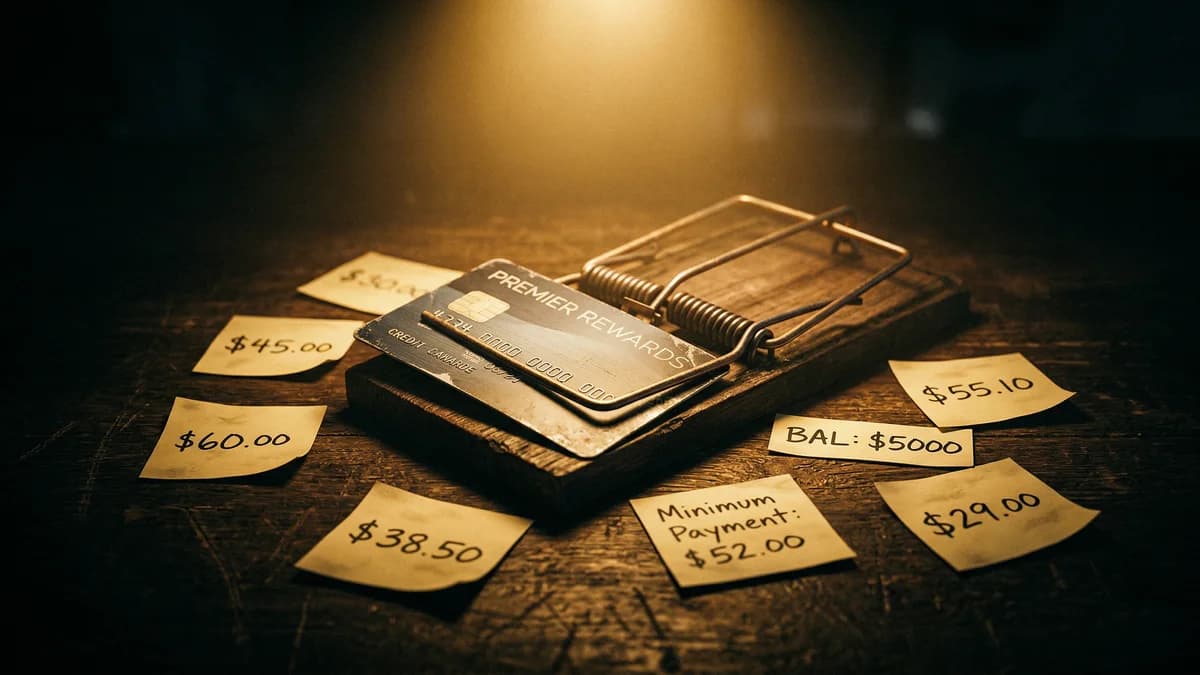
Credit card minimum payments are calculated as 1-2% of your balance plus interest, keeping monthly amounts low while maximizing the total interest you pay. On a $5,000 balance at 23% APR, minimum payments cost over $8,900 in interest and take 23 years to clear. Paying $200 per month instead cuts that to under 3 years.
You owe $5,000 on a credit card. The statement says your minimum payment is $146. You pay it. You feel responsible. You did the right thing.
You just made the bank very happy.
That $146 payment? About $96 of it went straight to interest. Only $50 actually reduced what you owe. At that rate, you'll be making payments for over 23 years and hand over more than $8,900 in interest, according to CBS News (March 2025). The original purchase cost you $5,000. The bank turns it into nearly $14,000.
That's not a glitch. It's the business model. And nobody taught you how it works.
Credit card minimum payments are designed to keep you in debt as long as possible. A $5,000 balance at 23% APR takes over 23 years to pay off at minimum payments, costing $8,900+ in interest (CBS News, 2025). Paying $200/month instead cuts that to under 3 years. The math isn't complicated. It's just hidden on purpose.
Read more: What Is Compound Interest? | How Companies Profit from Financial Ignorance
How Much Does a $5,000 Balance Actually Cost at Minimum Payments?
The average credit card APR on accounts accruing interest hit 22.30% in Q4 2025, according to Federal Reserve G.19 data analyzed by LendingTree (January 2026). Some cards charge even more. The CFPB found that average APRs on general-purpose cards reached 25.2% in 2024, the highest level since at least 2015, per an Orrick analysis of the 2025 CARD Act Report.
Let's use real numbers. You carry $5,000 at 23% APR. Your minimum payment is calculated as 1% of the balance plus interest charges. That comes to about $146 in month one.
Here's what happens to that $146:
- $96 goes to interest. That's the bank's cut.
- $50 goes to principal. That's the part that actually shrinks your debt.
So in month one, your $5,000 balance drops to $4,950. And next month, the interest is calculated on $4,950. Then $4,900. Then $4,852. The balance barely moves. The payments keep coming. For over two decades.
Now compare that to paying a fixed $200 per month. Same $5,000 balance, same 23% APR. You're done in about 32 months and pay roughly $1,400 in interest. Or pay $400 per month and you're out in 14 months with under $600 in interest.
The difference between the minimum and a fixed payment isn't small. It's the difference between $8,900 in interest and $1,400. Same debt. Same card. Just a different number on the check.
That is the sleight of hand built into every credit card statement. The "minimum payment due" box is not a suggestion, it is a design choice. It is engineered to look small enough to pay without thinking, which is exactly what keeps you paying for twenty-three years instead of three.
Three Ways to Pay Off $5,000 at 24% APR
Remaining balance over time by payment strategy
Source: Standard amortization at 24% APR with 2% minimum payment (or $25 floor)
The chart above tells the story better than any paragraph can. The minimum payment line barely bends for the first decade. You're paying, and paying, and paying, while the balance just sits there collecting interest.
What Do 6 Common Purchases Actually Cost at Minimum Payments?
The $5,000 example isn't special. The same trap applies to every balance, and the bigger the purchase, the worse it gets. Every credit card purchase has two prices: the number on the sticker, and the number you actually pay when you carry the balance and only send the minimum. Nobody prints that second number on the receipt. So here it is.
Below are six common purchases at 23% APR, minimum payments only, using the standard 1% of balance plus interest formula with a $25 floor. The figures are what you actually hand over by the time the balance hits zero. (The exact payoff time on a $5,000 balance lands anywhere from 19 to 23 years depending on the precise formula and floor, which is why you'll see slightly different headline numbers from different sources. The point holds either way: it's decades, not years.)
- $500 emergency car repair. Total paid: $637. Payoff: about 2 years. That's 1.27 times the sticker. The mechanic charged $500. The bank charged $137 for not having the cash, which is the real price of skipping an emergency fund.
- $1,200 TV (Black Friday deal). Total paid: $2,410. Payoff: about 7.5 years. That's 2.01 times the price. You "saved" $300 on the sale, then paid $1,210 in interest. The deal was a loss.
- $2,500 vacation. Total paid: $6,201. Payoff: about 13.5 years. That's 2.48 times the cost. By year six you've already paid more in interest than the trip cost.
- $3,000 furniture set. Total paid: $7,660. Payoff: about 15 years. That's 2.55 times the price. The couch hits the landfill years before the balance hits zero.
- $5,000 medical bill. Total paid: $13,493. Payoff: about 19 years. That's 2.70 times the bill. You never chose the purchase, and the system still charges you nearly triple for getting sick.
- $10,000 "once in a lifetime." Total paid: $28,076. Payoff: about 25 years. That's 2.81 times what you thought you spent. The extra $18,076 buys you nothing. It just disappears into interest for over two decades.
What You Actually Pay at Minimum Payments
Sticker price vs. total cost at 23% APR, minimum payments only
Calculated at 23% APR with 1% + interest minimum payment formula ($25 floor).
The gold bars are what you thought you were paying. The red bars are what you actually pay. Notice how the gap widens as the balance grows. That's not a coincidence. It's math, and it's the most useful phrase you can steal from all of this: "the credit card price." Every time you consider putting a purchase on a card you can't clear this month, run the multiplier in your head. A $1,200 TV is really a $2,400 TV. That framing kills a lot of bad purchases before they happen.
Why Does the Multiplier Get Worse the More You Owe?
At $500 you pay 1.27 times the sticker. At $10,000 you pay 2.81 times. The multiplier doesn't scale evenly. It accelerates. Two forces work together to make that happen.
First, larger balances take longer to clear. A $500 balance at minimum payments takes about 2 years. A $10,000 balance takes about 25 years. That's not 20 times longer, it's roughly 11 times longer, but interest compounds on the larger base for every one of those extra months.
Second, the minimum payment formula shrinks as your balance drops. On a $10,000 balance, your minimum starts around $292. By year 15 you might be paying $48 a month, with most of it still going to interest. The balance barely moves. The clock keeps running.
Here's the gut-punch version. On that $10,000 purchase, you pay the full $10,000 in principal, then an additional $18,076 in interest. The interest is 1.81 times the thing you bought. The bank makes more money from your purchase than the store did. That is the whole point of letting them set the payoff schedule. You pick the number, or they pick it for you, and their number always runs longer.
How Are Minimum Payments Calculated (And Why So Low)?
Most credit card issuers set minimum payments at 1-2% of your balance plus interest and fees, or a flat 2-3% of the total balance, whichever is greater, with a floor of $25-$35, according to Experian and NerdWallet (2025). On a $5,000 balance, that means your minimum might be as low as $100-$150.
Why so low? Because low minimums keep you paying longer. And longer repayment means more interest. Interest income drives approximately 80% of credit card profitability, according to Federal Reserve credit card profitability research.
In 2024, consumers were assessed $160 billion in interest charges on credit cards, up from $105 billion in 2022, per the CFPB's 2025 Consumer Credit Card Market Report. That $55 billion increase in two years didn't happen because people suddenly started spending more recklessly. It happened because APR margins hit an all-time high of 14.3%, up from 9.6% a decade ago, according to the CFPB (February 2024). Nearly half of the rate increase over the past decade is pure profit-taking by issuers, not Federal Reserve policy.
$160 Billion
Interest charges assessed to credit card consumers in 2024 (up from $105B in 2022)
CFPB, 2025 Consumer Credit Card Market Report
The Credit CARD Act of 2009 tried to fix this. It required every credit card statement to include a warning box showing how long it would take to pay off your balance at minimum payments and how much you'd pay in total. It also requires issuers to show the payment needed to clear the balance in 36 months.
That's a step in the right direction. But here's the problem: 10.75% of active credit card accounts were still making only minimum payments in Q3 2024, a 12-year high according to the Philadelphia Fed. The CFPB's own data shows 15% of general-purpose cardholders paid only the minimum in 2024, up from 13% in 2022. Disclosure alone isn't changing behavior.
Why not? Because nobody reads the box. And because the minimum payment feels safe. It feels like you're handling it. That's by design.
Who's Stuck in the Trap Right Now?
Nearly half of all American credit cardholders, 47%, carry a balance from month to month, up from 39% in December 2021, according to the Bankrate 2026 Credit Card Debt Report (survey of 2,564 U.S. adults, December 2025). That's not a fringe group. That's almost every other person you know.
Among those carrying balances, 61% have been in debt for at least a year, up from 53% in 2024. That includes 31% who've carried debt for three or more years and 21% who've been stuck for over five years. This isn't a temporary setback. For millions of people, it's a permanent state.
Where Your Minimum Payment Goes (And Who's Stuck Paying It)
$146/mo minimum on $5,000 at 23% APR; debt prevalence by demographic
Sources: CBS News (2025), Bankrate Credit Card Debt Report (Dec 2025)
The numbers get darker. 22% of Americans with credit card debt believe they will never escape it, according to the same Bankrate survey. Not "probably won't." Not "it'll take a while." Never. And 19% are worried they won't even be able to make their minimum payments in the next six months.
Total U.S. credit card debt reached $1.28 trillion in Q4 2025, the highest level since the New York Fed began tracking in 1999 (February 2026). The average balance among those carrying debt is $7,886, per TransUnion data analyzed by LendingTree (Q3 2025).
35% of Americans report feeling trapped in a cycle of debt, according to a Ramsey Solutions State of Personal Finance survey of 1,005 U.S. adults (December 2025). The minimum payment system doesn't cause all of that debt. But it's engineered to make sure you stay in it as long as possible.
And this isn't just a low-income problem. 36% of households earning over $100,000 carry credit card balances. Gen X and Millennials lead at 53% each. The trap doesn't discriminate. It just needs you to keep paying the minimum.
What Would That Same $146/Month Build Instead?
Here's the part the bank definitely doesn't want you to think about. Every month you send $146 to a credit card company, that money is gone. It bought you nothing new. It just paid for something you already consumed years ago, plus interest.
Now imagine you had no credit card debt. And instead of sending $146 to a bank, you invested it.
$146 per month in an S&P 500 index fund at the historical average of roughly 10% annual returns would grow to approximately $42,000 in 15 years. That's real money. Money that's yours, growing, compounding on your side instead of against you.
Or consider a smaller step. $50 per month, the principal portion of that minimum payment the bank was keeping from you, invested through dollar-cost averaging into Bitcoin over the last five years would have outperformed almost any traditional investment.
The math of compound interest works in both directions. When you carry debt, it works for the bank. When you invest, it works for you. Same force, different side. Right now, the credit card company is using it against you every single month. If you want to understand exactly how that daily compounding math works, read how credit card interest is calculated.
Try the math yourself: Use our DCA Calculator to see what your monthly payments could become if you invested them instead.

How Do You Actually Escape?
You don't need a financial advisor. You don't need a consolidation loan. You need a plan and the discipline to follow it. Here's one that works.
Step 1: Stop adding to the balance. Cut the card, freeze it in a block of ice, delete it from your phone. Whatever it takes. You can't bail water from a boat with a hole in it. That also means no Buy Now, Pay Later workarounds; BNPL is a cousin of the minimum payment trap, just with friendlier branding.
Step 2: Pay a fixed amount above the minimum. Even $50 extra per month makes a dramatic difference. On a $5,000 balance at 23% APR, paying $200 per month instead of the minimum saves you roughly $7,500 in interest and 20 years of payments. Pick a number you can sustain and automate it.
Step 3: Attack the highest APR first. This is the avalanche method. List your debts by interest rate. Throw every extra dollar at the highest-rate card while paying minimums on the rest. Once it's gone, roll that payment into the next one. If you need the emotional win of clearing a balance fast, the snowball method (smallest balance first) works too. What matters is that you pick one and start.
Step 4: Once the debt is gone, redirect that payment. The $200 per month you were sending to a credit card? Keep sending it. But now it goes into an investment account. You already proved you can live without that money. Don't let it dissolve back into your spending. This is how you go from living paycheck to paycheck to building something. If your income is tight and the steps above feel out of reach, read the full guide on getting out of debt on a low income for strategies that work even on a stretched budget.
Use the 50/30/20 budget rule as a framework: 50% needs, 30% wants, 20% debt payoff and savings. Once the debt is cleared, that 20% shifts entirely to your future.
You don't need to find extra money. You already have it locked in payments to a bank that designed the system to keep you paying forever. Take it back.
The banks would prefer you do none of this. The minimum payment exists because it is the exact dollar amount that keeps you breathing, keeps the account open, and keeps the interest meter running. It is designed to feel manageable. That feeling is the product.
Pick one balance. Pay one dollar more. Repeat next month. That is the entire strategy, and it is the opposite of what the credit card industry spent billions of dollars teaching you to do.
Frequently Asked Questions
The minimum payment isn't a kindness. It isn't a safety net. It's a tool designed to keep you in debt as long as possible while the bank collects interest. The Credit CARD Act forced issuers to tell you how long it would take. But they're counting on you not doing the math.
Now you've done the math. The question is whether you'll keep paying their way, or yours.
Start here: This article is part of The Debt Trap, our complete guide to how the system keeps you borrowing.
Next step: Learn the difference between good debt and bad debt so you know which balances to attack first, and how compound interest works, because it's the same force the credit card company uses against you. Once you understand it, you can put it on your side instead. And learn how small, consistent steps can redirect what you're already spending into something that actually grows.
Don't miss the rest of the story.
Join thousands learning what school never taught.
This article is for educational purposes only and does not constitute financial advice. Untaught does not hold, move, or custody any funds. Past performance does not guarantee future results. Always do your own research before making investment decisions.
Quick calculator
Your coffee money could have become
$16,301
from $9,900 invested