How to Stop Living Paycheck to Paycheck (When the System Is Designed to Keep You There)
62% of Americans live paycheck to paycheck. That's not a personal failure. It's a system working exactly as designed. Here's how to break out.
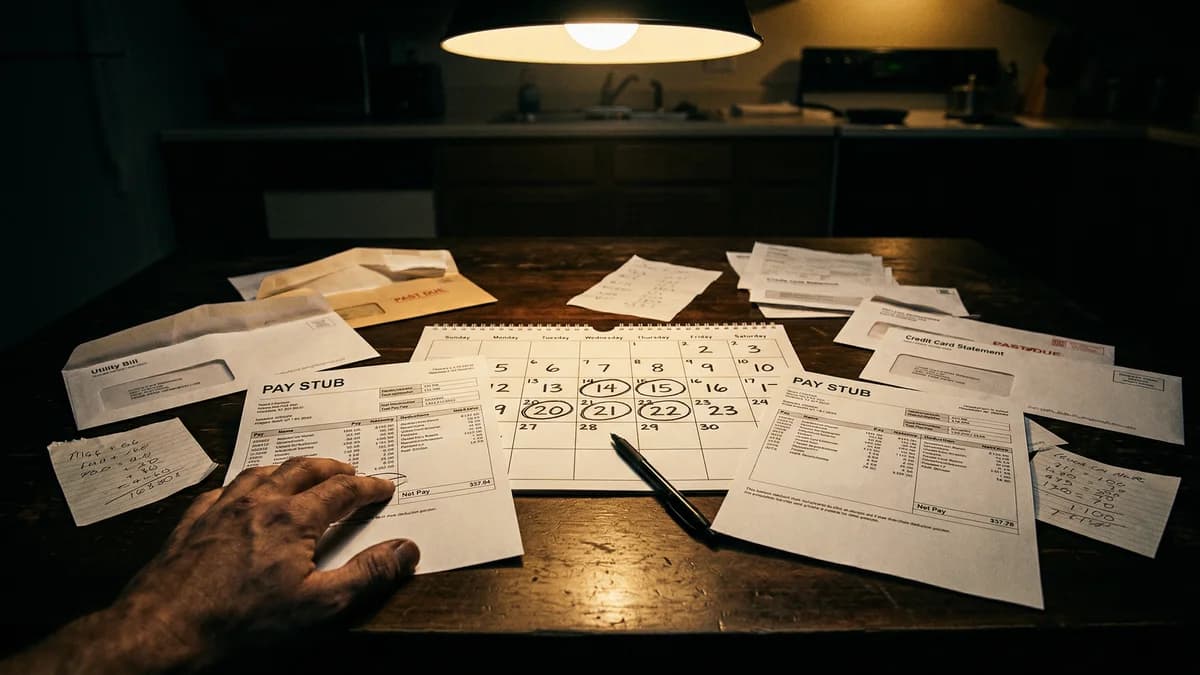
62% of Americans live paycheck to paycheck as of 2025, including one in five households earning over $150,000 annually. 59% cannot cover a $1,000 emergency from savings. Stagnant wages, rising costs, and no financial education in most schools have made this the default condition for the majority of working Americans.
You get paid. You pay bills. The money disappears. You wait for the next paycheck. Repeat.
If that sounds like your life, you are not alone. According to a 2025 report by LendingClub and PYMNTS, 62% of Americans are living paycheck to paycheck. Not just people earning minimum wage. Not just the struggling. The majority.
Read that number again. Nearly two out of three adults in the richest country on Earth cannot get ahead of their own bills. And you've been told your whole life that it's your fault. That you should have budgeted better, worked harder, skipped the avocado toast.
That's a lie. The system is designed this way. And understanding that is the first step to breaking out.
Living paycheck to paycheck is not a personal failure. It is the predictable result of a system built to extract money from working people: stagnant wages, rising costs, zero financial education, and an economy that profits from your spending. The exit starts with finding hidden waste in your existing spending and redirecting even $20 a week toward something that grows.
This Is Not a Personal Failure
Every financial guru on the internet will tell you the problem is your spending. Make a budget. Cut the lattes. Stop eating out.
But here is a question none of them ask: why are 62% of Americans in the same boat?
If one person is bad with money, that's a personal problem. If 160 million people are struggling to cover basic expenses, that's a systemic one.
The numbers tell the story.
Wages stopped keeping up decades ago. The Economic Policy Institute has tracked this for years. Since the 1970s, worker productivity has risen over 60%. But real wages, adjusted for inflation, have barely moved. You are producing more. You are getting paid the same, or less in real terms.
The cost of everything went up. Housing, healthcare, childcare, education, groceries. The Bureau of Labor Statistics tracks these prices. They have all climbed faster than wages. The gap between what you earn and what you need to survive has been widening for 50 years.
Nobody taught you how money works. Only 23 states require a personal finance course for high school graduation. The rest just send you into the world and hope for the best. No lessons on compound interest. No lessons on inflation. No lessons on how the dollar loses value every single year. That wasn't an accident. That was by design.
When 62% of a country is stuck in the same financial trap, the problem is not 62% of the people. The problem is the system they live in.
It Hits Every Income Level
Here is the part that shocks people. Living paycheck to paycheck is not just a low-income problem.
The same LendingClub/PYMNTS report broke down the numbers by income:
Paycheck-to-Paycheck Rate by Household Income
Percentage of households living paycheck to paycheck by income bracket
Source: LendingClub/PYMNTS New Reality Check Report, 2025
Look at that last number. One in five households earning over $150,000 a year is still living paycheck to paycheck. These are people with six-figure salaries, and they still cannot build a cushion.
Why? Because spending expands to fill whatever comes in. Bigger paycheck, bigger house, bigger car payment, more subscriptions, more delivery orders. The system is very good at making sure every dollar has somewhere to go before you can save it. Advertisers, lenders, and retailers spend billions each year making sure you spend every cent you earn.
That is why the "just make more money" advice is a trap. A raise, on its own, does not fix the problem. The same machine that drained your $50,000 paycheck will happily drain your $150,000 paycheck. Only the brand names on the statements change.
59%
of Americans can't cover a $1,000 emergency
Bankrate, 2025
A Bankrate survey from 2025 found that 59% of Americans could not cover a $1,000 emergency expense from savings. Not $10,000. Not $5,000. One thousand dollars. A car repair. A medical bill. A broken appliance.
That means most people are one bad week away from debt. One flat tire away from a payday loan. One unexpected bill away from a credit card spiral. That is not a life. That is a trap. If you are already carrying debt on a tight income, start with how to get out of debt when you are living paycheck to paycheck.
Why the System Wants You Stuck
This is the part nobody says out loud.
The paycheck-to-paycheck cycle is profitable. Not for you. For everyone else.

Banks profit from it. Overdraft fees alone generate over $6 billion a year for U.S. banks, according to the Consumer Financial Protection Bureau. When you have no cushion, every miscalculation becomes a fee. Late payment charges. Minimum balance penalties. Returned check fees. Your financial fragility is their revenue stream.
Credit card companies profit from it. When you cannot pay your balance in full, you pay interest. The average credit card APR is now over 20%, according to the Federal Reserve. Americans carry over $1.28 trillion in credit card debt. The companies do not want you to pay it off. They want you making minimum payments forever.
Retailers profit from it. Buy now, pay later. Zero percent for 12 months. Easy monthly installments. These are not favors. They are tools designed to get you to spend money you do not have yet. And when you miss a payment, the interest kicks in.
The government profits from it. State lotteries pull in over $100 billion a year from people who feel like a lucky ticket is their only shot at getting ahead. The lottery is marketed hardest in low-income neighborhoods. It is a tax on desperation, and nobody in power wants to shut it off.
The paycheck-to-paycheck cycle is not a bug in the system. It is the system. Banks, lenders, retailers, and even the government profit when you stay stuck.
The Stress Tax Nobody Talks About
Living paycheck to paycheck does not just drain your bank account. It drains everything.
A 2025 survey by AMFM Healthcare found that 87% of Americans feel anxious about their finances. That anxiety is not just a feeling. It shows up in your body. Sleep problems. Headaches. Relationship strain. Difficulty concentrating at work.
87%
of Americans feel anxious about their finances
AMFM Healthcare, 2025
When you are worried about money every single day, it takes up mental space that could go toward better decisions. Researchers call this "cognitive bandwidth." When your brain is consumed with survival math (Can I afford gas this week? Will the rent check clear?), you have less capacity to plan, think long term, or make the kind of choices that break the cycle.
The trap feeds itself. You are too stressed to plan. Too broke to save. Too exhausted to research alternatives. And every business in the economy is counting on exactly that.
The Exit: It Starts Smaller Than You Think
So here is the honest question: can you actually escape this?
Yes. But not the way most financial advice tells you.
Most advice says "make more money" or "cut your budget to the bone." That is not wrong, but it misses the point. Most people already have money leaking out of their lives that they do not even see.
The exit does not start with a raise. It starts with awareness.
Step 1: Find the Money You Are Already Wasting
You are almost certainly spending money on things you forgot about, do not need, or barely notice.
Here are the most common leaks:
Subscriptions you forgot. The average American carries 12 active subscriptions and underestimates what they pay by over $130 a month. Read the full breakdown in The Subscription Trap.
Daily convenience spending. That $6 coffee every morning is $180 a month. Lunch out every workday is $200 or more. Delivery app fees add another $50 to $100. These are not luxuries. They are habits. And habits can be adjusted. The Latte Factor explains the full math.
Impulse buys. The average American spends $314 a month on unplanned purchases, according to Slickdeals. That is nearly $3,800 a year on things you did not intend to buy.
You are not broke. You are leaking.
Step 2: Plug the Biggest Leak First
You do not have to fix everything at once. Pick the easiest win.
For most people, that is subscriptions. Open your bank statement. Find every recurring charge. Cancel anything you have not used in the past 30 days. That single action recovers $50 to $150 a month for the average person.
That is not nothing. That is the beginning.
Step 3: Redirect, Do Not Just Save
Here is where most advice fails. People say "save more." But saving into a regular bank account means your money is losing value to inflation every single day. You need to redirect it toward something that actually grows.
Even $20 a week, automatically moved into an investment on payday, starts to add up. You do not have to pick stocks. You do not have to time the market. You just have to be consistent.
This is called dollar-cost averaging. You put in the same amount at the same time, no matter what the market is doing. Over years, the math does the heavy lifting for you. Learn how it works in How to Invest $20 a Week.
Ready to break the cycle?
Join thousands learning what the system never wanted you to know about money.
Step 4: Build the Habit Before the Budget
Forget the spreadsheet for now. The most important thing is not a perfect budget. It is a single automatic action that runs without your input.
Set up an automatic transfer. $10, $20, $50, whatever you can pull from the leaks you just plugged. Schedule it for payday. Before you see the money, it moves.
This is how you build a saving habit that actually sticks. Not through willpower. Through automation.
The amount almost does not matter at first. What matters is that the pattern starts. You go from "I spend everything I make" to "I move money toward my future before anything else." That identity shift is worth more than any dollar amount.
Open your bank statement right now. Find one subscription you forgot about. Cancel it. Set up a $20 automatic weekly transfer to a savings or investment account. That single move puts you ahead of most Americans. Start today, not tomorrow. Tomorrow is a trap.
Why $20 a Week Changes Everything
"$20 a week? That's nothing."
It sounds small. That is the point. It is so small that you will not miss it. But it is big enough to change your trajectory.
$20 a week is $1,040 a year. Invested consistently at historical market averages, that turns into real money:
| Time Frame | Total Invested | Approximate Value (8% avg) |
|---|---|---|
| 5 years | $5,200 | $6,400 |
| 10 years | $10,400 | $16,300 |
| 20 years | $20,800 | $55,000 |
| 30 years | $31,200 | $131,000 |
$131,000. From $20 a week. That is money most paycheck-to-paycheck households do not believe is possible for them. But it is. The math does not care about your income bracket. It only cares about consistency and time.
The trick is starting. Not tomorrow. Not next month. Not when you "make more money." Now. Because the start-tomorrow trap is one of the most expensive mistakes in personal finance. Every week you wait is a week of growth you never get back.

The System Will Not Fix This for You
Nobody in power benefits from you understanding this. The banks do not want you to stop overdrafting. The credit card companies do not want you to pay off your balance. The retailers do not want you to stop impulse buying. The state lottery does not want you to realize the money would be better invested.
And the education system? It had every chance to teach you how money works. It chose not to. In most states, it still chooses not to.
So you have to teach yourself. That is what this site is for.
Living paycheck to paycheck is not your destiny. It is a pattern. And patterns can be broken. Not all at once. Not overnight. But one decision at a time, starting with the $20 you are about to redirect this week.
The money is there. You just have to stop letting the system take it first.
Frequently Asked Questions
Keep Reading
Ready to go deeper? Start with the spending you already have and learn to redirect it.
- You're Already Wasting Money (and where to find it)
- Good Debt vs. Bad Debt: The Difference Nobody Explains
- The Subscription Trap: How forgotten charges drain your wealth
- The Latte Factor: It's bigger than coffee
- How to Invest $20 a Week (and why it matters)
- Build a Saving Habit That Actually Sticks
This article is part of the You're Already Wasting Money series on Untaught. The system counts on you not paying attention. These articles exist to help you see clearly.
This article is for educational purposes only and does not constitute financial advice. Untaught does not hold, move, or custody any funds. Past performance does not guarantee future results. Always do your own research before making investment decisions.
Quick calculator
Your coffee money could have become
$16,301
from $9,900 invested