Americans Spend $100 Billion a Year on Lottery Tickets
U.S. lottery sales topped $113 billion in 2023. That's more than Americans spend on books, movies, and video games combined. Here's where that money actually goes.
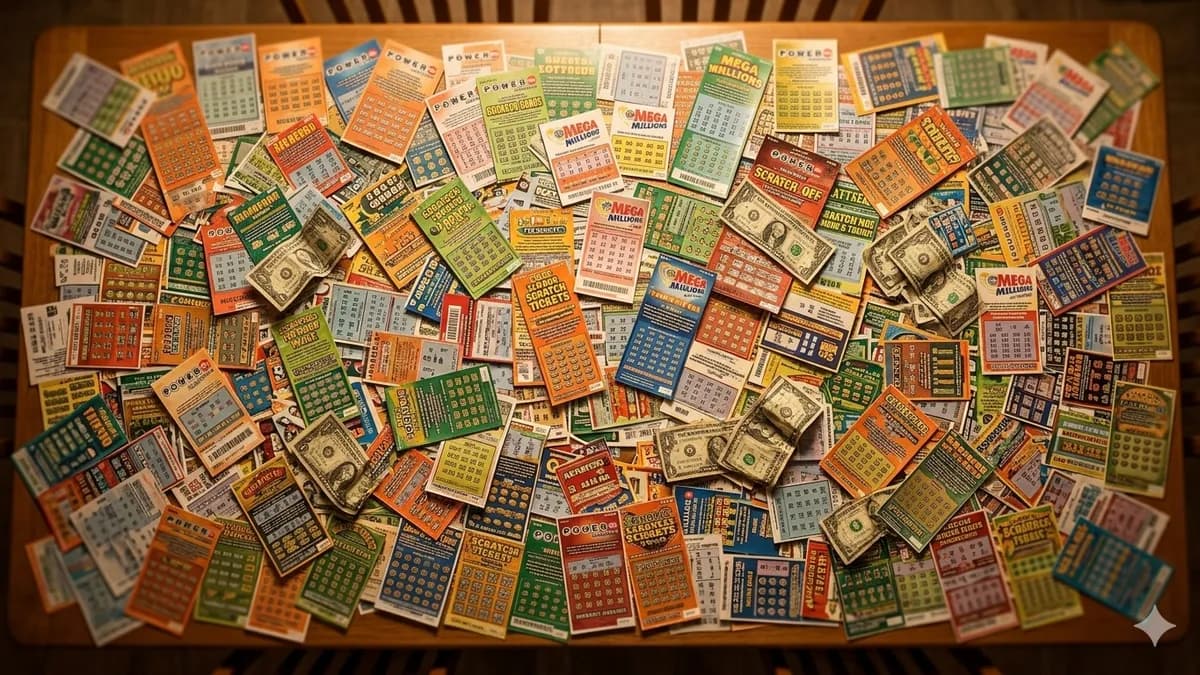
Americans spent $113.3 billion on lottery tickets in fiscal year 2023, more than they spent on books, movies, video games, concerts, and sporting events combined, according to the North American Association of State and Provincial Lotteries. Roughly 25% of that revenue goes directly to state governments, while players receive back only 50 to 65 cents for every dollar spent.
The number is so big it almost does not register: $113.3 billion.
That is how much Americans spent on lottery tickets in fiscal year 2023, according to the North American Association of State and Provincial Lotteries (NASPL). Not million. Billion, with a B.
To put that in perspective, Americans spent more on lottery tickets than they spent on books, movies, video games, concert tickets, and sporting event tickets combined. This is the biggest legal gambling market in the country, and most people have no idea how massive it really is.
Americans spent $113.3 billion on lottery tickets in 2023 (NASPL). Lower-income households spend a higher share of their income on tickets than anyone else. The lottery is not a game. It is a wealth extraction system that drains billions from the people who can least afford it, and state governments depend on it.
How Much Does the Average Person Spend?
That $113.3 billion works out to roughly $340 per person across every adult in the United States, according to population data from the U.S. Census Bureau. But averages are misleading. Plenty of people never buy a single ticket. The real spending is concentrated among regular players.
Among people who actually play, spending typically runs between $50 and $150 per month. That is $600 to $1,800 a year on pieces of paper with a near-zero chance of paying off.
And some states take it much further. In Massachusetts, per-capita lottery spending exceeds $935 per year, the highest in the nation, according to the U.S. Census Bureau's Annual Survey of State Government Finances. New York generates the most total revenue. Texas, Florida, and California are not far behind.
Here is a breakdown of the top-spending states:
| State | Annual Per-Capita Lottery Spend | Total Annual Sales |
|---|---|---|
| Massachusetts | ~$935 | ~$5.9 billion |
| New York | ~$480 | ~$10.7 billion |
| Georgia | ~$470 | ~$6.2 billion |
| Maryland | ~$430 | ~$3.8 billion |
Sources: NASPL, U.S. Census Bureau
Those are not small numbers. In Massachusetts alone, the average household is spending the equivalent of a monthly car payment on lottery tickets.
Who Spends the Most on Lottery Tickets?
Here is where the story turns from surprising to painful. The people spending the most on lottery tickets are the people who can afford it the least.
Research published in the Journal of Gambling Studies has consistently found that lottery spending is inversely correlated with income. The less you earn, the larger the share of your paycheck goes to tickets.
Households earning under $30,000 per year spend an average of $412 annually on lottery tickets, according to CBS News. For the lowest-income households, that can represent 5% or more of their total income. Meanwhile, households earning over $100,000 spend about $289, which amounts to less than 0.3%.
Think about that. Families making under $30,000 a year are spending significantly more on lottery tickets than families making three times as much.
$412/year
Average lottery spending by households earning under $30,000
CBS News
This is not random. Lottery retailers are disproportionately concentrated in lower-income neighborhoods. The advertising targets aspiration and desperation in equal measure. The system was built to extract money from the people with the fewest options. And it works because nobody taught them how to see through it.
The term "regressive tax" gets thrown around in policy debates, but the lottery is the most regressive revenue mechanism in American life. It takes from the bottom and funds the state.
Most people assume a tax is something the government takes. The lottery flips that. It is a tax you volunteer to pay, dressed up as entertainment, marketed the hardest to the people who can least afford it. No politician has to vote for it. No one has to explain it in a campaign ad. It just sits there, in every convenience store in the country, quietly pulling $412 a year out of the households with the least margin.

Where Does All That Money Go?
Not into your pocket. That much is certain.
Of the $113.3 billion in 2023 sales, here is how the money breaks down, according to NASPL:
- ~60-65% goes back to players as prizes (roughly $65-70 billion)
- ~25% goes to state governments (roughly $28 billion)
- ~5-7% goes to retailer commissions
- ~3-5% goes to operating costs and administration
The state's cut, about $28 billion in 2023, funds everything from education to infrastructure. Politicians love this arrangement because it generates revenue without the political pain of raising taxes. Nobody has to vote for a tax increase. People just hand over their money willingly.
But here is the catch: the effective "tax rate" on a lottery ticket is brutal. For every dollar you spend, you can expect to get back roughly 50 to 65 cents in prize money, depending on the game. The rest goes to the state, to retailers, and to the companies that operate the games.
Compare that to a slot machine, which is legally required to return 80-90% in most states. The lottery has a worse payout rate than the casino. And it is not even close.
Most people we've talked to have no idea where their lottery dollar actually goes. They assume most of it goes to prizes. It does not. The state takes its cut before you ever scratch the ticket.
How Does Lottery Spending Compare to Other Categories?
This comparison makes the $113 billion hit differently.
According to data from the U.S. Bureau of Economic Analysis and various industry reports, here is what Americans spend annually on other categories:
| Category | Annual U.S. Spending |
|---|---|
| Lottery tickets | $113.3 billion |
| Video games (hardware + software) | ~$57 billion |
| Movie theater tickets | ~$9 billion |
| Books (all formats) | ~$28 billion |
| Music (streaming + physical) | ~$17 billion |
| Sporting event tickets | ~$22 billion |
Americans spend more on lottery tickets than on video games and books combined. More than movies, music, and live sports put together.
We talk endlessly about "screen time" and entertainment spending as cultural problems. Nobody talks about the fact that the lottery quietly consumes more money than nearly every entertainment category in the country.
What Are the Actual Odds of Winning?
Here is the number the lottery industry would prefer you never sit with: the odds of winning the Mega Millions jackpot are 1 in 302,575,350. Powerball is not much better at 1 in 292,201,338. These are not round numbers pulled from thin air. They are calculated directly from the combinatorics of each game.
Big numbers like that are hard to feel, so make them real. You are far more likely to be struck by lightning in a given year (1 in 1,222,000, per the National Weather Service). You are more likely to be struck by lightning twice in your lifetime (roughly 1 in 9 million). You are more likely to be killed by a vending machine, attacked by a shark, or to give birth to identical quadruplets. Every one of those events is something you would call basically impossible, and every one is hundreds of times more likely than hitting the jackpot.
If you bought one ticket per week, every week, without missing, it would take you roughly 5.8 million years to have a coin-flip chance of winning. Not a guarantee. Just a 50/50 shot. The dinosaurs went extinct 66 million years ago. You would need to play for nearly a tenth of that timespan.
Things More Likely Than Winning the Lottery
Odds of various events compared to winning Powerball or Mega Millions
Sources: National Weather Service, Consumer Product Safety Commission, International Shark Attack File, Multi-State Lottery Association
The human brain does not handle a number like 1 in 302 million well. It mostly just registers "a chance" and stops doing the math. That is exactly what lottery marketing is engineered to exploit. A billboard advertising a $1.5 billion payout is not trying to help you calculate expected value. It is trying to make you stop calculating entirely. The chart above shows the gap visually: the lottery bar is not just taller than the others, it is in a different unit entirely.
The comparisons sound almost cute until you stack them on a real scale. A shark attack is rare. A vending machine death is a punchline. A quadruplet birth is the stuff of morning-show segments. All of them still dwarf your odds of hitting a jackpot by hundreds of times over. None of that ever makes it onto the ticket.
The Smaller Prizes Are Not Saving You Either
The industry knows the jackpot odds sound bad, which is why they lean so hard on the smaller prize tiers: "even if you don't win the big one, there are nine ways to win." It sounds reassuring. It is also the part of the pitch designed to keep you buying after the jackpot dream wears off. The smaller prizes are not a consolation. They are the hook that keeps the habit alive between drawings.
Here is what those "nine ways to win" actually pay out for Mega Millions.
| Prize | Odds | Payout |
|---|---|---|
| Jackpot (5 + Mega Ball) | 1 in 302,575,350 | Hundreds of millions |
| $1,000,000 (5 numbers) | 1 in 12,607,306 | $1,000,000 |
| $10,000 (4 + Mega Ball) | 1 in 931,001 | $10,000 |
| $500 (4 numbers) | 1 in 38,792 | $500 |
| $200 (3 + Mega Ball) | 1 in 14,547 | $200 |
| $10 (3 numbers) | 1 in 606 | $10 |
| $4 (1 + Mega Ball) | 1 in 89 | $4 |
| $2 (Mega Ball only) | 1 in 37 | $2 |
Source: Multi-State Lottery Association
The overall odds of winning any prize are about 1 in 24. That sounds decent until you realize most of those prizes are $2 or $4. The bottom tier, matching just the Mega Ball, pays $2 on a $2 ticket. You broke even. You are spending $2 to win $2 and calling it a win. According to analysis based on those odds, the expected return on a $2 Mega Millions ticket is roughly $0.63 to $0.95 depending on the jackpot size. You lose between $1.05 and $1.37 on average, every single ticket.
The Lottery Is Not a Game. It Is a System.
State lotteries spend over $725 million per year on advertising, according to NASPL. That money goes toward one goal: making you forget the math.
The commercials never show the odds table. They show the boat, the beach house, the moment you quit your job. They sell a fantasy because the reality, a guaranteed long-term loss, does not make for a good ad.
And the advertising works. A Gallup poll found that roughly 49% of American adults purchased at least one lottery ticket in the past year. Half the country is playing a game where the house takes 35 to 50 cents of every dollar.
Meanwhile, state lottery commissions aggressively promote new games, scratch-off variants, and multi-state jackpots to keep revenue growing. The product pipeline looks less like a public service and more like a consumer goods company optimizing for maximum extraction.
The games themselves are engineered around the same psychology that makes slot machines addictive. Matching 3 out of 5 numbers feels like you were close, even though the odds of a near-miss and the odds of the jackpot exist in completely different universes. Researchers at the University of Cambridge found that near-misses activate the same reward pathways in the brain as actual wins. Scratch-offs go further, using variable-ratio reinforcement: small, unpredictable wins at random intervals, the single most powerful driver of compulsive behavior behavioral psychologists have ever documented. B.F. Skinner identified it in the 1950s. Lottery game designers use it today.
When the Powerball or Mega Millions jackpot crosses $500 million, media coverage creates a buying frenzy. This is manufactured FOMO. The odds do not change. They are still roughly 1 in 292 million for Powerball and 1 in 302 million for Mega Millions. The headline changed. The math did not.
Tired of feeding the machine?
Join thousands learning where their money actually goes and what to do about it.
What Else Could That Money Do?
Here is the question the system does not want you to ask.
You do not need to "find" extra money to start building wealth. If you buy lottery tickets, you are already making a weekly investment. You are just investing in a system designed to take your money and give almost nothing back. So what happens if you take that exact same amount, the money you have already decided you can live without, and point it somewhere that works in your favor?
Let's keep it conservative and run two amounts: $20 per week ($1,040 a year) and $50 per week ($2,600 a year). Those are normal numbers for a regular player. The only question is where the money goes next.

The safest, most boring option is a high-yield savings account at around 4.5% APY. No risk, FDIC insured, your money just sits there and grows. At $20 a week, that becomes about $12,640 after 10 years and $32,040 after 20. At $50 a week, you cross $80,000 in 20 years. Nothing flashy. Just your money growing quietly while you sleep, instead of a guaranteed loss at the counter.
Step up to an S&P 500 index fund, which has returned roughly 10% per year on average over the last several decades. You do not pick stocks. You do not watch CNBC. You buy an index fund and keep adding to it. That is dollar cost averaging, and it works. At $20 a week, that grows to about $17,500 in 10 years and $65,500 in 20. At $50 a week, $52,000 in total contributions becomes over $163,000. Same money. Same weekly habit. Different destination. And you never had to get lucky.
How the Alternatives Stack Up Against the Lottery
Here is every option side by side. Twenty dollars a week for 10 years. Same money, different choices.
| Where Your $20/Week Goes | 10-Year Total In | 10-Year Value | Net Gain/Loss |
|---|---|---|---|
| Lottery tickets | $10,400 | ~$5,500* | -$4,900 |
| High-yield savings (4.5%) | $10,400 | $12,640 | +$2,240 |
| S&P 500 index fund (10%) | $10,400 | $17,500 | +$7,100 |
| Bitcoin DCA (30%) | $10,400 | $49,200 | +$38,800 |
*Lottery expected return calculated at roughly 53 cents per dollar spent, the average across U.S. state lotteries.
Every single alternative beats the lottery. Even the most conservative option imaginable, a plain savings account, still puts you over $7,000 ahead of the tickets across a decade. The index fund puts you $12,000 ahead. Bitcoin, projected here at a deliberately conservative 30% annualized return (well below its historical average, with the understanding that growth moderates as it matures), puts you over $43,000 ahead. Past performance never guarantees future results, and Bitcoin is volatile enough to drop 50% or more in a single stretch, so treat that line as a possibility, not a promise.
That negative number is the part the billboards never show. A decade of $20 weekly tickets is not "breaking even while you wait for the big one." It is actively losing $4,900 of your own money. If any private company sold a product with a guaranteed negative expected return and advertised it on highway billboards, regulators would shut it down within a week. Because the state runs the lottery, the same math gets called entertainment. Same outcome, different branding.
Zoom out and the gap only widens. Run the same $20 a week for 30 years in an index fund and you cross $180,000. Run it for 50 years, an adult lifetime, and the S&P 500 line passes $1.4 million. Over that same half-century, $20 a week on Powerball returns expected total winnings of about $27,500 against $52,000 spent. You lose more than half, while the saver beside you quietly builds a retirement. Time does not punish the saver. It punishes the person still standing at the counter.
The Difference Is One Line Climbing and One Draining
The cleanest way to see it is to put the boring option, a plain index fund, next to the lottery on a single chart. Not Bitcoin. Not day trading. Just $20 a week and time.
$20/Week for 10 Years: Lottery vs. Real Investments
Net gain or loss on $10,400 total invested over 10 years
Sources: Multi-State Lottery Association, NYU Stern, FDIC, BTC historical data
The chart above is the real punchline. One line climbs. The other drains. Same dollar in both cases. The only variable is where you let it land. Once you see the gap, the idea of a $2 ticket stops feeling harmless and starts looking like a slow, recurring withdrawal from your future self. The lottery is not an investment. It is a leak, sold to generations of working people as a harmless shot at a better life.
How to Actually Make the Switch
Knowing the math is step one. Acting on it is everything. Here is how to redirect your lottery money starting this week.
1. Pick your amount. Whatever you currently spend on tickets, that is your number. If you are not sure, start with $20 a week. You will not miss it. You were already spending it.
2. Automate it. Remove willpower from the equation. Set up a recurring weekly transfer or buy so the money moves without you thinking about it. Automation is what makes dollar cost averaging stick.
3. Choose where it goes. You do not have to pick just one. A high-yield savings account at an online bank for the safe portion. A total-market index fund in a brokerage account for long-term growth. A recurring weekly Bitcoin purchase if you want exposure to a fixed-supply asset and can stomach the swings.
4. Stop buying tickets. This is the hard part, not because you need the money, but because the habit is comfortable. Replace the ritual. Every time you would have bought a ticket, check your investment balance instead. Watch it grow. That is your new dopamine hit.
You do not need a windfall. You do not need to get lucky. The money is real, the habit is already formed, and the only thing missing is a better destination for it.
Run the numbers on your own lottery spending. Multiply what you spend per week by 52. That is your annual cost. Now imagine that amount growing at 10% per year for a decade. The gap between those two numbers is what the lottery is really costing you.
And lottery tickets are just one leak. Daily coffee, impulse purchases, forgotten subscriptions: they all add up. See: The latte factor is real (but it is bigger than coffee)
Frequently Asked Questions
This article is part of the You're Already Wasting Money series on Untaught. The system was built to keep you spending without thinking. These articles exist to help you see where the money actually goes.
This article is for educational purposes only and does not constitute financial advice. Untaught does not hold, move, or custody any funds. Past performance does not guarantee future results. Always do your own research before making investment decisions.
Quick calculator
Your coffee money could have become
$16,301
from $9,900 invested