What Are the Odds of Winning the Lottery? (The Math They Hope You Never Do)
Mega Millions: 1 in 302.6 million. Powerball: 1 in 292.2 million. You're more likely to be struck by lightning twice. Here's the math the lottery industry hopes you never see.
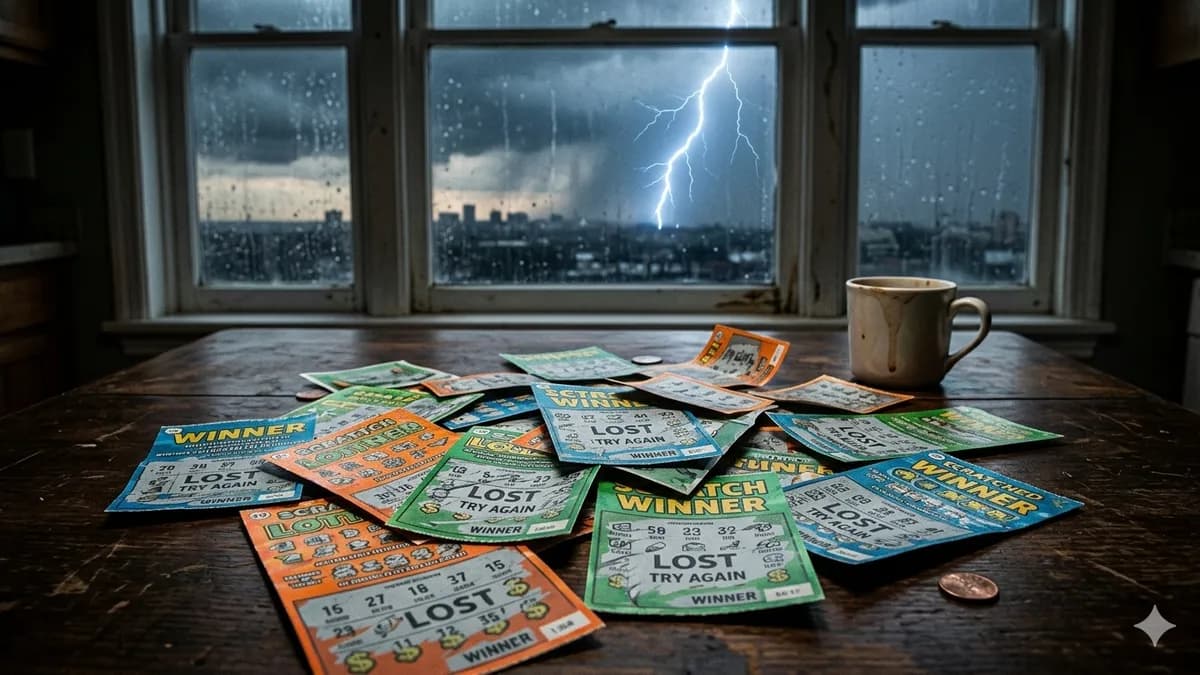
The odds of winning the Mega Millions jackpot are 1 in 302,575,350. Powerball odds are 1 in 292,201,338. The expected return on a $2 lottery ticket is roughly $0.63 to $0.95, a worse payout rate than casino slot machines. State lotteries spent over $725 million on advertising in 2023 to keep players from doing this math.
Here is a number the lottery industry would prefer you never think too hard about: 1 in 302,575,350.
That's your chance of winning the Mega Millions jackpot. Not "slim." Not "unlikely." Effectively zero.
Powerball isn't much better: 1 in 292,201,338.
Your odds of winning the Mega Millions jackpot are 1 in 302,575,350. You're 20,000 times more likely to be struck by lightning. The expected return on a $2 ticket is roughly $0.63 to $0.95 (Multi-State Lottery Association). In 2023, U.S. lottery ticket sales topped $113 billion, with about $28 billion going to state governments. The lottery isn't a game. It's a tax on people who were never taught expected value.
Let that number sink in:
These aren't round numbers pulled from thin air. They're calculated from the exact combinatorics of each game. And they tell a story that no lottery commercial will ever tell you.
What 1 in 302 Million Actually Means
Big numbers are hard to feel. Your brain wasn't built to process odds this small. So let's make them real.
You are more likely to:
- Be struck by lightning in a given year (1 in 1,222,000, per the National Weather Service)
- Be struck by lightning twice in your lifetime (roughly 1 in 9 million)
- Be killed by a vending machine (1 in 112 million, per the Consumer Product Safety Commission)
- Become a movie star (roughly 1 in 1.5 million)
- Be attacked by a shark (1 in 11.5 million, per the International Shark Attack File)
- Give birth to identical quadruplets (1 in 15 million)
Every single one of those events is something you'd call "basically impossible." And every single one is hundreds of times more likely than winning the Mega Millions jackpot.

The comparisons sound cute until you stack them on a real scale. A shark attack is rare. A vending machine death is a punchline. A quadruplet birth is the stuff of morning-show segments. All of them still dwarf your odds of hitting a jackpot.
The human brain does not handle numbers like 1 in 302 million well. It mostly just sees "a chance" and stops doing math. That is exactly what lottery marketing is engineered to exploit. A billboard advertising a $1.5 billion payout is not trying to help you calculate expected value. It is trying to make you stop calculating entirely.
The chart below shows the gap visually. Notice that the lottery bar isn't just taller than the others, it's in a different unit entirely.
Things More Likely Than Winning the Lottery
Odds of various events compared to winning Powerball or Mega Millions
Sources: National Weather Service, Consumer Product Safety Commission, International Shark Attack File, Multi-State Lottery Association
Here's another way to think about it. If you bought one ticket per week, every week, without missing, it would take you roughly 5.8 million years to have a coin-flip chance of winning. Not a guarantee. Just a 50/50 shot.
The dinosaurs went extinct 66 million years ago. You'd need to play for almost a tenth of that timespan.
The Smaller Prizes Aren't Saving You Either
The lottery industry knows the jackpot odds sound bad. That's why they promote the smaller prize tiers. "Even if you don't win the big one, there are nine ways to win!"
Let's look at what that actually means for Mega Millions:
| Prize | Odds | Payout |
|---|---|---|
| Jackpot (5 + Mega Ball) | 1 in 302,575,350 | Varies (hundreds of millions) |
| $1,000,000 (5 numbers) | 1 in 12,607,306 | $1,000,000 |
| $10,000 (4 + Mega Ball) | 1 in 931,001 | $10,000 |
| $500 (4 numbers) | 1 in 38,792 | $500 |
| $200 (3 + Mega Ball) | 1 in 14,547 | $200 |
| $10 (3 numbers) | 1 in 606 | $10 |
| $10 (2 + Mega Ball) | 1 in 693 | $10 |
| $4 (1 + Mega Ball) | 1 in 89 | $4 |
| $2 (Mega Ball only) | 1 in 37 | $2 |
That bottom tier, matching just the Mega Ball, pays $2. The ticket costs $2. You broke even. Congratulations.
The overall odds of winning any prize are about 1 in 24. Sounds decent until you realize most of those "prizes" are $2 or $4. You're spending $2 to win $2 and calling it a win.
According to analysis based on Multi-State Lottery Association odds data, the expected return on a $2 Mega Millions ticket is roughly $0.63 to $0.95, depending on the jackpot size. You lose between $1.05 and $1.37 on average, every single ticket. That's a worse return than almost any casino game.
The Machine Is Designed to Keep You Playing
The lottery isn't just bad math. It's bad math wrapped in sophisticated psychology.
Near-misses keep you hooked. Matching 3 out of 5 numbers feels like you were close. You weren't. The odds of the full jackpot and the odds of matching 3 numbers exist in completely different universes. But your brain doesn't process it that way. Researchers at the University of Cambridge found that near-misses activate the same reward pathways in the brain as actual wins. The game is engineered to make losing feel like almost-winning.
Jackpot rollovers create urgency. When nobody wins, the jackpot grows. Media coverage explodes. Suddenly everyone at the office is buying tickets. This is manufactured FOMO. The odds didn't change. Only the headline did.
Scratchers use variable-ratio reinforcement. The same psychological mechanism that makes slot machines addictive. Small, unpredictable wins at random intervals are the most powerful driver of compulsive behavior behavioral psychologists have ever documented. B.F. Skinner identified this in the 1950s. Lottery game designers use it today.
Advertising targets hope, not math. State lottery commissions spent over $725 million on advertising in 2023, according to the North American Association of State and Provincial Lotteries. You'll notice the commercials never show the odds table. They show the boat, the house, the quit-your-job moment.
Who Actually Plays the Most?
This is where it gets uncomfortable.
Multiple studies, including research published in the Journal of Gambling Studies, have found that lottery spending is inversely correlated with income. The less money you make, the larger the share of your income you spend on lottery tickets.
Households earning under $10,000 per year spend an average of $597 annually on lottery tickets, according to research on lottery spending patterns. That's roughly 6% of their income. Households earning over $100,000 spend about $289, or less than 0.3% of their income.
6% of income
Share of income spent on lottery tickets by the lowest-earning households
Consumer Federation of America
State-level data tells the same story. In Massachusetts, which has the highest per-capita lottery spending in the country, residents spend an average of over $900 per person per year on lottery tickets, per the U.S. Census Bureau's Annual Survey of State Government Finances.
The people who can least afford to lose money are losing the most. This isn't an accident. Lottery retailers are disproportionately concentrated in lower-income neighborhoods. The marketing targets aspiration and desperation in equal measure.
The "Voluntary Tax" You're Not Supposed to Notice
Here's the part state governments would rather you not connect.
In 2023, U.S. lottery ticket sales topped $113 billion, according to the North American Association of State and Provincial Lotteries. After prizes are paid out, roughly $28 billion went to state governments.
Politicians love the lottery because it's revenue without the political cost of raising taxes. It's a tax that people pay voluntarily, even eagerly.
But "voluntary" does a lot of heavy lifting in that sentence. When the revenue comes disproportionately from low-income communities, when the advertising is specifically designed to exploit psychological vulnerabilities, when the games are engineered around addictive reward patterns, calling it "voluntary" starts to feel generous.
Some economists call it the most regressive tax in America. It's a wealth transfer from people who have the least to state budgets that could be funded through progressive taxation instead.
The lottery doesn't create wealth. It redistributes it. From the pockets of working people to the general fund, with a 50-60% cut taken off the top. No other "investment" in history has a guaranteed loss rate that high.
See what the lottery is really costing you?
Join thousands learning what the system never wanted you to know about money.
So What Happens If You Stop?
Let's say you spend $20 a week on lottery tickets. That's not unusual. Many regular players spend more.
That's $1,040 a year. Over 10 years, that's $10,400. Over 30 years, $31,200.
Gone. All of it. Statistically, you won a handful of $4 payouts and maybe one $10 winner. Net loss: almost everything you put in.
Now imagine you took that same $20 per week and put it somewhere it could actually grow. What would happen to that money over 10, 20, or 30 years?
The answer might surprise you. And it might make you angry about every ticket you've ever bought.
The truth is that the lottery is designed to be an emotional product, not a financial one. It sells the feeling of possibility, not the statistics of probability. And once you see the math clearly, the feeling tends to go away fast.
Which is exactly why the state spends more on lottery advertising per dollar of revenue than almost any other consumer product in the country. They are not selling you numbers. They are selling you hope, at a markup.
Stop buying lottery tickets this week. Take that $20 and open a high-yield savings account, buy an index fund, or set up a recurring Bitcoin purchase. The money is the same. The destination changes everything.
Next read: What if you invested your lottery money instead?
Frequently Asked Questions
This article is part of the You're Already Wasting Money series on Untaught. For more on how the system profits from what you were never taught, read Who profits from financial ignorance? For the full picture on lottery spending in America, see Americans spend $100 billion a year on lottery tickets.
This article is for educational purposes only and does not constitute financial advice. Untaught does not hold, move, or custody any funds. Past performance does not guarantee future results. Always do your own research before making investment decisions.
Quick calculator
Your coffee money could have become
$16,301
from $9,900 invested