How Credit Card Interest Actually Works (The Math They Hope You Skip)
Credit cards charge compound interest, daily. 47% of Americans don't know their APR. A 22.3% card actually costs 25% a year. Here's how the math works.

Credit card interest compounds daily, not annually. Your card converts the advertised APR into a Daily Periodic Rate (APR divided by 365), then charges that rate on your average daily balance each billing cycle. A 22.3% APR card has an effective annual rate of 25% once daily compounding is factored in. Americans paid $160 billion in credit card interest in 2024.
Your credit card company advertises a 22% APR. You think you understand what that means. You probably don't, and that's not an accident.
APR stands for Annual Percentage Rate. The word "annual" sounds like you're being charged 22% once a year, at the end. You're not. Your card charges a small slice of that rate every single day, on a balance that grows each time interest is added. By the time the full math plays out, that 22% card costs closer to 25%.
47.1% of Americans don't know the current APR on their credit cards, according to a Propeller Insights survey of 1,013 U.S. adults (August 2024). Another 28.3% don't understand how credit card interest is calculated at all. The system depends on that confusion. It cost Americans $160 billion last year.
Your credit card's advertised APR isn't your real rate. Because interest compounds daily, a 22.3% APR card costs about 25% annually in effective terms. The grace period disappears the moment you carry any balance forward. And 47% of Americans don't know their card's APR at all (Propeller Insights, 2024). Here's the math the industry counts on you skipping.
Also in this series: The Minimum Payment Trap | What 6 Purchases Actually Cost at Minimum Payments | What Is Compound Interest?
What Does APR Actually Mean?
APR is the annual cost of borrowing, expressed as a percentage. At 22% APR, you'd pay $220 to borrow $1,000 for a full year, if interest were charged once at year-end. Credit cards don't work that way. They charge interest every single day.
The average APR for cards actively accruing interest hit 22.30% in Q4 2025, according to Federal Reserve G.19 data analyzed by LendingTree (January 2026). General-purpose cards averaged 25.2% APR in 2024, the highest since at least 2015, per the CFPB's 2025 Consumer Credit Card Market Report. Retail store cards averaged 31.3%. Some cards now charge 29-30% as a matter of course.
The number on your card is the starting point. The daily math is where the real cost hides.
Do Credit Cards Charge Compound Interest?
Yes. Credit cards charge compound interest, and it compounds daily, not monthly or yearly. Each day, the card adds that day's interest to your balance, then the next day charges interest on the new, slightly larger total. Your issuer applies a daily periodic rate to your balance every single day of the billing cycle, according to the CFPB.
That daily compounding is exactly why a 22.3% APR card actually costs you about 25% over a year, and why a balance you "pay on" every month barely moves. The rest of this article shows the mechanics, one step at a time.
The Daily Periodic Rate: Your Balance's Clock
Your credit card doesn't calculate interest once a month. It calculates it every day, on that day's balance. The number it uses is your Daily Periodic Rate, or DPR.
The formula is simple:
DPR = APR ÷ 365
At 22% APR, your DPR is 0.0603% per day. That sounds small. On a $2,000 balance, it's about $1.21 added to what you owe every single day, whether you use the card or not. That's $36 in interest for a 30-day billing cycle before you've spent another dollar.
Here's what makes it worse: the interest from each day gets added to your balance. The next day's interest is calculated on that slightly larger number. Day one you owe interest on $2,000. Day two, on $2,001.21. Day three, on $2,002.43. It compounds. The meter never stops.
This is what creates the gap between the APR on your card and what you're actually paying.
APR vs. Effective Annual Rate: The Number They Don't Show You
Because interest compounds daily rather than once per year, a 22.3% APR card doesn't cost exactly 22.3% annually. It costs more. The real figure is called the effective annual rate (EAR):
EAR = (1 + APR ÷ 365)^365 − 1
Run that at today's average rates:
- 20% APR → Effective annual rate of 22.1%
- 22.3% APR → Effective annual rate of 25.0%
- 25.2% APR → Effective annual rate of 28.7%
The average general-purpose card at 25.2% APR actually costs 28.7% per year once you account for daily compounding. That's 3.5 percentage points more than advertised. On a $5,000 balance, that difference is roughly $175 per year, just from the compounding math.
What You're Actually Paying After Daily Compounding
Advertised APR vs. effective annual rate (daily compounding, 2025 averages)
Effective rate calculated as (1 + APR/365)^365 − 1. Average APR from Federal Reserve G.19 and CFPB 2025 Report.
Your card company is legally required to disclose the APR. It is not required to show you the effective rate. The CFPB explains daily periodic rates, but most cardholders have never seen that page.
This is why people who "pay their bills on time" still feel like the balance never shrinks. They are making payments calculated against an APR that was never the real number. Every day interest is stacking on interest, silently, before the next statement even arrives.
That's the gap between "I'm handling this" and "this is handling me." Most cardholders land somewhere in the middle, making payments on time, watching the balance barely move, and never getting a straight answer about why. The answer is always the same. Daily compounding. A rate they never saw advertised. And a payment structure designed to keep them paying.
How Your Balance Is Calculated Each Month
Most people assume their credit card interest is based on what they owe at the end of the month. It isn't. Your issuer charges interest on your average daily balance across the entire billing cycle.
That means when you make a purchase during the month affects the cost.
Buy something for $1,000 on day one of a 30-day billing cycle and the issuer treats you as if you owed that $1,000 for all 30 days. Buy the same thing on day 25 and you only owe interest for 5 days. Same purchase, different cost.
The interest charge for the month is calculated as:
Interest = Average Daily Balance × DPR × Days in Billing Cycle
For a $2,000 average daily balance at 22% APR over 30 days:
$2,000 × 0.000603 × 30 = $36.16
That number never appears as a line item in large text. You see the minimum payment due and most people pay it. The math behind the charge stays hidden.
The Grace Period: A Feature That Disappears When You Need It
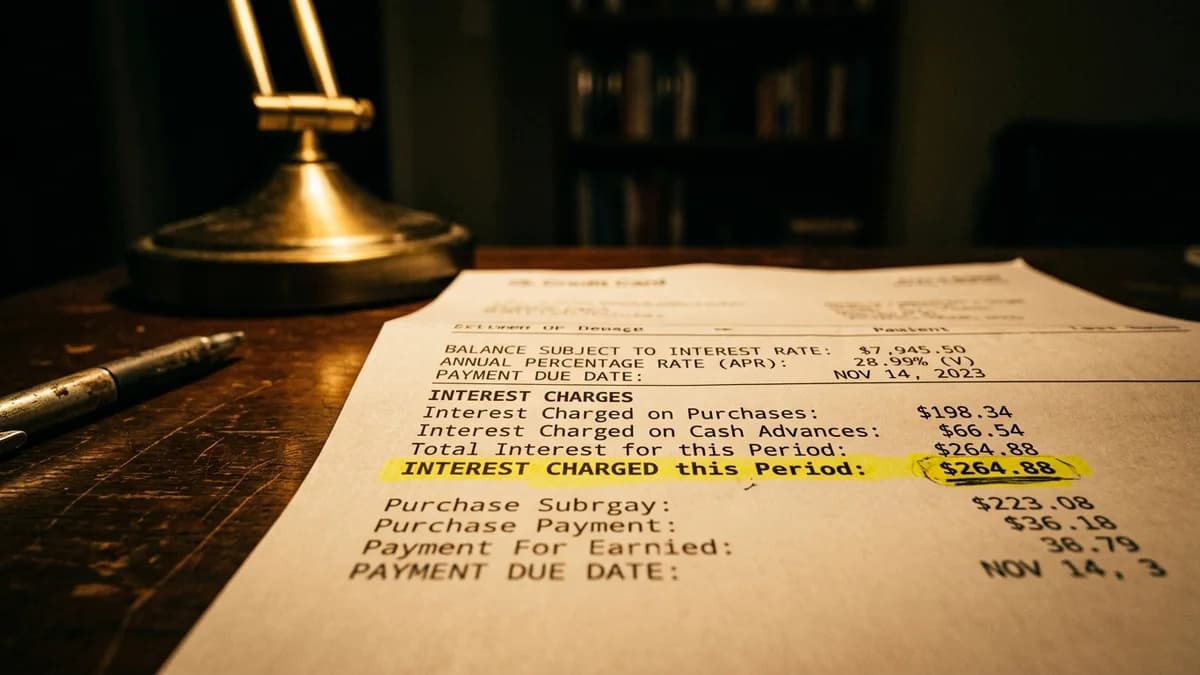
Credit cards typically offer a grace period, around 21 to 25 days between your statement closing date and your payment due date, during which no interest accrues on new purchases. Pay your full statement balance by the due date and you pay zero interest. For people who pay in full every month, this makes credit cards essentially free to use.
Here's the catch: the grace period only applies if you paid your previous statement balance in full. The moment you carry even one dollar forward to the next month, most cards eliminate the grace period entirely. New purchases start accruing interest from the day you swipe, not the day the statement closes.
The CFPB's own guidance states: "If you don't pay your balance in full... you may not get a grace period on new purchases until you pay the balance in full for two billing cycles in a row."
Nearly half of all American cardholders are in this situation. 46% of credit card owners carried a balance at least once during the prior year, per the Federal Reserve's Survey of Household Economic Decisionmaking (May 2025). For most of them, there is no free period. Interest starts the day they swipe, whether they know it or not.
If you carry any balance month to month, your card has no grace period. Interest on new purchases starts accruing from the day you use the card, not when the statement closes.
Where Does Your Payment Actually Go?
When you make a payment, it doesn't go straight to reducing your balance. Interest gets paid first. This is the allocation order, and it's built to benefit the lender.
On a $2,000 balance at 22% APR, your minimum payment in month one is approximately $56 (using the standard 1% of balance + interest formula, $25 floor). Here's where that $56 goes:
- $36 to interest. About 64% of the payment. Gone.
- $20 to principal. Your balance drops to $1,980.
Month two, the minimum is recalculated on $1,980. The interest portion is slightly smaller. The principal reduction is slightly larger. But only slightly. The balance barely moves. This process repeats for years.
This is why paying even $50 extra per month changes the timeline dramatically. Every extra dollar goes straight to principal. Interest is calculated on a smaller balance the next day. The minimum payment trap works in reverse when you pay more than required.
For what 6 common purchases cost from start to finish at minimum payments, see the true cost of minimum payments on a credit card.
The $160 Billion System
Americans paid $160 billion in credit card interest in 2024, up from $105 billion in 2022, per the CFPB's 2025 Consumer Credit Card Market Report. That works out to roughly $1,220 per U.S. household, or over $3,000 for every household actually carrying a balance. And the number keeps growing.
The CFPB found that credit card interest rate margins hit an all-time high of 14.3% above benchmark rates in 2023, up from 9.6% a decade earlier. The agency concluded that nearly half of the APR increase over the past decade reflects pure profit expansion by issuers, not Federal Reserve policy or cost of capital.
Only 27% of U.S. adults answered at least 5 of 7 basic financial literacy questions correctly in the FINRA Foundation's National Financial Capability Study (July 2025, 25,500+ adults surveyed). The average score was 3.3 out of 7.
None of this is accidental. A population that doesn't understand daily compounding is a population that keeps paying interest on it. The complexity isn't a flaw in the system. It's how the system works.
According to the CFPB's 2025 report, 13% of cardholders are in "persistent debt," meaning they pay more in interest and fees each year than they put toward reducing principal. That share is up from 9.9% in 2022. The more you understand how the math works, the harder it is to stay in that group. If you are ready to act on that understanding, here is how to get out of debt when money is tight.
Once you clear credit card debt, redirect that same monthly payment into something that compounds in your favor. The DCA calculator shows what consistent small amounts add up to over time.
Frequently Asked Questions
The way credit card interest actually works runs against what most people assume. The questions below come up constantly, and most card agreements bury the answers in legal disclosures nobody reads.
If you've ever wondered why your balance won't budge even though you pay every month, or why the card company suddenly started charging interest on new purchases, the rules below explain it.
Understanding how credit card interest works doesn't require a finance degree. It requires one afternoon and a willingness to do the math the industry hopes you'll skip. The daily rate, the average daily balance, the lost grace period, the compounding gap. These aren't obscure technicalities. They're the mechanics behind a $160 billion annual transfer from your pocket to theirs.
Knowing how it works is the first step to stopping it.
Start here: This article is part of The Debt Trap, our complete guide to how the system keeps you borrowing.
Next step: See exactly how the minimum payment trap is designed to keep you in debt, and what 6 common purchases actually cost when you only pay the minimum. Then run your card balance through the good-debt-vs-bad-debt test so you know exactly what kind of debt you're paying off. Once you've cleared the balance, learn how the same compounding math works in your favor when you redirect that money into something that grows.
Don't miss the rest of the story.
Join thousands learning what school never taught.
This article is for educational purposes only and does not constitute financial advice. Untaught does not hold, move, or custody any funds. Past performance does not guarantee future results. Always do your own research before making investment decisions.
Quick calculator
Your coffee money could have become
$16,301
from $9,900 invested