Small Steps, Real Results: How $5 a Week Can Change Your Financial Future
You don't need a huge salary or a lucky break. $5 a week, consistently invested, can build real wealth over time. Here's the math and the method.
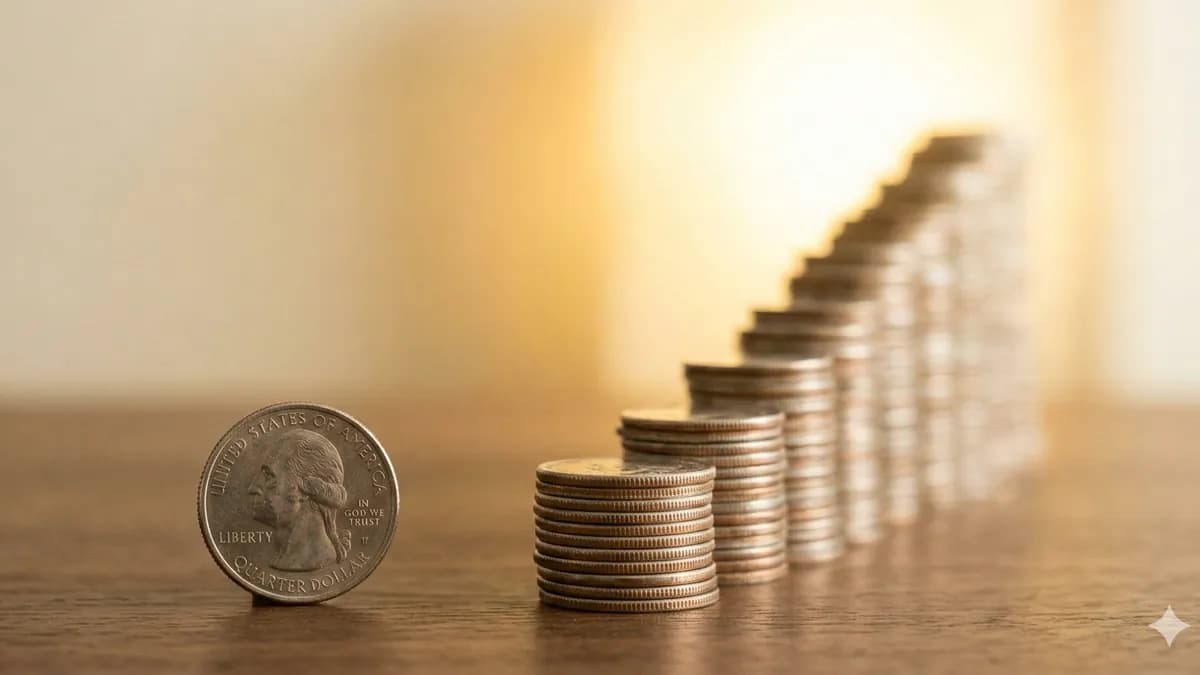
$20 a week at a 10% average annual return becomes $179,300 over 30 years. You contribute $31,200. Compound growth adds the rest. Even $5 a week grows to $44,800 in 30 years. On this model, doubling what you set aside moves the 30-year total more than a three-point better return does. You don't need a windfall. You need a weekly habit.
"I Don't Have Enough to Invest" Is the Biggest Lie You've Been Told
Someone told you that investing is for people with money. That you need $10,000 sitting in a brokerage account before you're allowed to play the game. That you should "get your finances in order first" and then, maybe someday, start building wealth.
That's not just wrong. It's a lie that keeps you broke.
The financial industry built a system that caters to people who already have money. Minimum account balances. Management fees that eat your lunch. Jargon designed to make you feel stupid so you hand everything over to an "advisor" who takes a percentage whether your money grows or not.
Meanwhile, nobody taught you the one thing that actually matters: small amounts, invested consistently, turn into real money. Not theoretical money. Not "someday when the market is right" money. Real, tangible, life-changing wealth.
Five dollars a week.
That's less than a fancy coffee. Less than a single lottery ticket habit. Less than the streaming service you forgot you were paying for.
And over time, it becomes something that could genuinely change your life. Not because $5 is magic, but because the habit of investing is the most powerful financial tool that exists. A tool the system never wanted you to have.
Let's do the math.
The Math: What $5, $10, and $20 a Week Actually Becomes
Numbers don't lie, and these numbers should make you angry about every year you spent thinking you couldn't afford to invest.
Before the tables, here is the model behind every projection on this page, so you can check the arithmetic yourself instead of taking our word for it. You contribute the same amount every week, and the balance grows at the stated annual rate. Written out, that is FV = C × ((1 + r)^n - 1) / ((1 + r)^(1/52) - 1), where C is the weekly contribution, r is the annual return, and n is the number of years. Every figure below is rounded to the nearest $100. Nobody hands you a guaranteed 7%, 10%, or 15%, so read these as what the arithmetic does over a long stretch, not as a promise about any particular decade.
Here is what each weekly amount becomes at a 10% average annual return, the S&P 500's long-run figure. Contributions are what leaves your pocket. Everything above that line is growth you did not work for.
| Time Period | $5/week ($260/yr) | $10/week ($520/yr) | $20/week ($1,040/yr) |
|---|---|---|---|
| 5 years | $1,700 | $3,300 | $6,700 |
| 10 years | $4,300 | $8,700 | $17,400 |
| 20 years | $15,600 | $31,200 | $62,400 |
| 30 years | $44,800 | $89,700 | $179,300 |
| You contributed | $7,800 | $15,600 | $31,200 |
Read that last column again. $20 a week for 30 years, at a 10% average annual return, becomes $179,300. Your total contributions? Just $31,200. The other $148,100 is compound growth doing the heavy lifting.
$179,300
What $20/week becomes in 30 years at 10% annual return
Weekly-contribution model above, $31,200 total contributed
That number is not a typo and it is not a sales pitch. It is ordinary arithmetic done over an ordinary career. The reason it feels unreal is that nobody ever ran the math in front of you. School skipped it. The banks have no reason to show you. The only people who talk about compound growth out loud are the ones already using it.
The math itself is not complicated. Your contribution earns a return. Next year, the contribution plus the return earns a return. Year after year after year, the interest starts earning interest on the interest. That is where the curve bends.
Notice what the table does across its rows rather than down its columns. Going from $5 a week to $20 a week is a four-fold increase in what you set aside, and the 30-year result scales almost exactly four-fold with it, from $44,800 to $179,300. There is no penalty for being small and no bonus for being big. The engine treats every dollar the same. What it does not treat the same is time: the jump from year 20 to year 30 adds more than the entire first twenty years produced. That is not a quirk of these particular numbers. That is the shape of the curve.
Every week you say "I'll start tomorrow" is a week of compound growth you never get back.
What If the Return Isn't 10%?
Nobody guarantees you 10%. So here is the same $20 a week run at three different rates, side by side, over the same thirty years.
Where does the 7% number come from? The S&P 500 has returned roughly 10% per year on average since 1928, according to data from NYU's Stern School of Business. In that dataset, $100 invested at the start of 1928 with dividends reinvested was worth $1,157,598.95 at the end of 2025, which works out to 10.02% a year compounded across 98 years. Subtract the roughly 3% average annual inflation over that same stretch (BLS Consumer Price Index) and you land near 7%. The 10% figure is nominal, before inflation. The 7% figure is what your money actually buys at the end. Both are true; they answer different questions.
And 15%? That is the high-growth column. It is the kind of rate a volatile asset has produced across some stretches and missed badly across others, and it is in this article so you can see the shape of the curve at the top end, not because anyone should plan around it.
The chart below stacks all three rates on the same axes. Notice how boring the gap looks in year five and how absurd it looks by year thirty. That bend is the whole game, and the higher the rate, the later the bend arrives and the harder it hits.
$20/Week: How Return Rates Change Everything
Same $20/week, different vehicles, dramatically different outcomes
$20 contributed weekly, balance growing at the stated annual rate. 10% is the S&P 500's long-run average, 1928 to 2025 (NYU Stern). 15% is a high-growth scenario, not a forecast.
The honest read on this chart is not "chase 15%." It is that the three lines are nearly indistinguishable for the first decade. Whatever rate you end up earning, the first ten years look disappointing and feel like nothing is happening. That is the stretch where almost everyone quits. The people who end up on the right side of this chart are not the ones who picked the best line. They are the ones who were still contributing when the lines separated.
The point isn't which number is "right." The point is that all of them turn pocket change into something meaningful. And the longer you wait, the more you lose.
What Is Dollar-Cost Averaging (and Why It Removes Timing Anxiety)
Here's where most people get stuck. They think investing means picking the perfect moment to buy. They watch the news, see "markets plunge" or "Bitcoin crashes," and think: "See? I'd lose everything."
That fear is based on a misunderstanding.
Dollar-cost averaging (DCA) is the strategy of investing a fixed amount on a regular schedule, regardless of what the price is doing. Every week, every two weeks, every month. Same amount. Rain or shine.
Here's why this works:
When prices are high, your fixed amount buys fewer shares (or less Bitcoin, or fewer fund units). When prices are low, that same amount buys more. Over time, this averages out your purchase price, which means you don't need to "time the market." You just need to be in it.
That sentence sounds like a slogan until you run it. Here are four months of $20 buys into something whose price swings hard, which is exactly the situation people say they are afraid of.
| Month | Price per unit | Units your $20 buys |
|---|---|---|
| January | $40 | 0.50 |
| February | $25 | 0.80 |
| March | $20 | 1.00 |
| April | $50 | 0.40 |
| Total | average price $33.75 | 2.70 units for $80 |
You spent $80. The average of the four listed prices is $33.75, but you paid an effective $29.63 per unit, because your fixed $20 automatically bought the most when the price was lowest and the least when it was highest. Nobody predicted anything. The schedule did the work. That is the entire mechanism, and it runs in your favor specifically because prices move around.
Vanguard's research concludes that if you already have a lump sum, the wise move is to invest it immediately rather than feed it in over time. But here's what that finding doesn't tell you: most people don't have a lump sum. They have $10 a week. And DCA is the only strategy that works when you're starting from zero.
More importantly, DCA removes the psychological barrier that stops most people from ever starting. You don't need to know if the market is "up" or "down." You don't need to watch CNBC. You don't need a finance degree. You just set it and let the math do what math does.
The biggest advantage of DCA isn't mathematical. It's behavioral. It turns investing from a scary, complicated decision into a boring, automatic habit. And boring, automatic habits are how ordinary people build extraordinary wealth.
The Vehicles: Where to Put Your $5, $10, or $20 a Week
Not all investment vehicles are created equal, especially when you're starting small. Some have minimums that lock you out. Some have fees that eat your returns alive. Here's what actually works for micro-investing.
1. High-Yield Savings Accounts (HYSAs)
What it is: A savings account that pays a higher interest rate than your standard bank account. As of August 2026, the best HYSAs pay in the high 3% to low 4% range, against an FDIC national average of 0.38%. Rates move, so check before you open.
Why it works for small amounts: No minimums, FDIC insured up to $250,000, completely liquid (you can pull your money out anytime).
The catch: Even at 4% APY, a HYSA barely beats inflation. If inflation is running at 3%, your real return is about 1%, and taxes on the interest take a bite out of that. You're not losing purchasing power as fast as a regular savings account, but you're barely treading water. A HYSA is a good place to park your emergency fund, but it's not going to build wealth.
Verdict: Safe. Easy. But your money is still losing value, just slowly.
2. Index Funds and Fractional Shares
What it is: An index fund tracks a broad market index, like the S&P 500 (the 500 largest U.S. companies). Instead of picking individual stocks, you own a tiny piece of all of them. Fractional shares let you buy a portion of a single share, so you can invest $5 in a stock that trades at $500.
Why it works for small amounts: Platforms like Fidelity, Schwab, and others now offer fractional shares with no minimums and no commissions. You can buy $5 worth of an S&P 500 index fund today.
Historical performance: The S&P 500 has returned an average of roughly 10% per year (before inflation) since 1928. That's through the Great Depression, World War II, the dot-com crash, 2008, COVID. The market always recovered. Always.
The catch: You need a brokerage account. Markets are only open Monday through Friday, 9:30 AM to 4:00 PM Eastern. And while the long-term trend is up, short-term drops of 20-30% happen. You have to be able to stomach that without panic-selling.
Verdict: The workhorse of long-term wealth building. If you do nothing else, put your weekly amount into a low-cost S&P 500 index fund and don't touch it.
3. Bitcoin
What it is: A digital currency with a fixed supply of 21 million coins. Unlike the dollar, no government can print more of it. You don't need to buy a whole coin. You can buy fractions, down to 0.00000001 BTC (called a "satoshi" or "sat").
Why it works for small amounts: No minimums. You can buy $1 worth of Bitcoin. Markets are open 24/7, 365 days a year. No brokerage hours, no waiting for Monday. Platforms like Strike, Cash App, and River make buying as easy as sending a text. And fractional ownership is built into the design: Bitcoin was created to be divisible.
Historical performance: Bitcoin's annualized return since 2013 has outpaced every other major asset class, though with extreme volatility. It has experienced drawdowns of 50-80% multiple times. But for those who held through the drops and continued to DCA, the long-term trajectory has been dramatically upward. Past performance, as always, is not a guarantee of future results.
The catch: Volatility. Bitcoin can drop 30% in a week. That terrifies people. But if you're DCA-ing $10 a week, a 30% drop means you're buying more Bitcoin for the same $10. That's DCA working exactly as designed. The people who get hurt are the ones who buy a lump sum at the top and sell at the bottom. Consistent, small, scheduled buys remove that risk.
Verdict: Uniquely suited for micro-investing because of zero minimums, 24/7 access, and built-in fractional ownership. Higher risk, higher potential reward. Best used as one piece of a broader strategy. If you want to go deeper, check out our Bitcoin for beginners guide.
4. I-Bonds (Series I Savings Bonds)
What it is: A U.S. government savings bond designed to protect against inflation. The interest rate adjusts every six months based on the Consumer Price Index (CPI).
Why it works for small amounts: You can buy I-Bonds for as little as $25 through TreasuryDirect.gov. They're backed by the full faith and credit of the U.S. government.
The catch: You can only buy $10,000 per year. You can't cash them out for the first 12 months. If you cash out before five years, you lose the last three months of interest. And you have to buy them through a clunky government website.
Verdict: A solid, safe option for money you won't need for a year or more. Good complement to a HYSA for your "safety net" money. But the annual cap and liquidity restrictions make it a supporting player, not your primary wealth-building vehicle.
Lined up against each other on the same $20 a week over the same ten years, using the model from the top of this page, the four vehicles land here:
| Vehicle | Assumed Annual Return | $20/week After 10 Years |
|---|---|---|
| Regular savings account | 0.5% | $10,700 |
| High-yield savings (HYSA) | 4% | $12,700 |
| S&P 500 index fund | 10% (historical avg) | $17,400 |
| Bitcoin | Varies widely | Depends on entry/exit, but DCA historically favorable |
| I-Bonds | ~3.5% (inflation-adjusted) | $12,400 |
The Real Comparison: Where Does Your Money Go the Furthest?
Let's put $20/week into each of these vehicles for 10 years and see what happens.
Your total contributions in all scenarios: $10,400. The difference between a regular savings account and an index fund after 10 years is $6,700. That's not a rounding error. That's the cost of not knowing where to put your money.
Look at what separates those rows, because it is not effort. It is not a better job, a side hustle, a windfall, or a smarter pick. Every row above represents the same person putting the same $20 into an account on the same day of the same week for ten years. The only variable is which account. One choice, made once, at the start, worth $6,700.
And notice the middle of the table. The gap between a plain savings account and a high-yield savings account is about $2,000 over ten years, and that one takes about ten minutes of paperwork to capture with no added risk whatsoever. If you do nothing else in this article, do that. It is the closest thing to free money in personal finance, and the only reason most people leave it on the table is that nobody ever told them the number.
The chart makes the spread easier to see than the table does:
Where Does $20/Week Go the Furthest?
Same $20/week for 10 years, different vehicles
Sources: FDIC rates, Treasury.gov, NYU Stern S&P 500 historical data
Ten years is also the shortest horizon in this article. Every gap on that chart widens the longer you leave it alone, because the higher the rate, the more of the final balance comes from growth rather than from what you put in.
And that cost was by design. You were never taught this.
How to Actually Start Today
Not next Monday. Not after your next paycheck. Today.
Step 1: Pick your amount
Start with whatever doesn't scare you. $5 a week is fine. $10 is better. $20 is great. The amount matters less than the consistency. You can always increase it later.
Where does the money come from? Look at what you're already wasting. That $7 latte twice a week. The $2 scratch ticket at the gas station. The streaming service you haven't opened in three months. You're not adding a new expense. You're redirecting money that was already disappearing.
One practical way to find the number: pull up the last 30 days of your checking account and read every line out loud. Not to shame yourself, just to see it. Almost everyone finds at least one recurring charge they forgot existed and at least one category that is double what they would have guessed. That is where your $5, or your $20, is already sitting.
Step 2: Pick your vehicle
For most people starting from zero, match what you want to what you open:
| What you want | Where to open it | What to set up |
|---|---|---|
| Maximum simplicity and safety | A high-yield savings account at Marcus, Ally, or SoFi | An automatic weekly transfer. This is the baseline. |
| Real growth, and you can handle the dips | A brokerage account at Fidelity or Schwab | A recurring weekly buy of a total-market or S&P 500 index fund, such as FXAIX or SWTSX |
| 24/7 access, zero minimums, Bitcoin exposure | Strike or Cash App | A recurring weekly Bitcoin buy, in an amount you would be comfortable losing entirely |
| All three | All of the above | Split it: $10 index fund, $5 Bitcoin, $5 high-yield savings for emergencies |
None of these take more than about ten minutes to open, and none of them have a minimum balance that will lock you out. The hard part was never the paperwork. It was deciding.
Step 3: Automate it
This is the most important step. Do not rely on willpower. Set up automatic transfers or recurring purchases so the money moves without you having to think about it. Every single week.
The best investment plan is one you never have to remember to execute.
Step 4: Don't touch it
Seriously. Don't check it every day. Don't panic when the market dips. Don't cash out because you want new sneakers. The power of DCA and compound growth only works if you leave your money invested. Set it, automate it, and go live your life.
Step 5: Increase when you can
Got a raise? Bump your weekly amount by $5. Cut a subscription? Redirect it. Tax refund? Drop a chunk in. The habit is the foundation. Every increase accelerates the compounding.
$5 a week. That's all it takes.
Join thousands who are turning pocket change into real wealth. We'll show you how.
A Stamp Book, a Bicycle, and the Thing Nobody Taught You
When I was six years old, I used to ride my bike to the bank in Canada to deposit a dollar or two. Sometimes less. The teller would open my little passbook and stamp it. Every deposit, a new stamp. I could hold that book in my hands and flip through the pages and watch my savings grow, stamp by stamp.
That stamp book changed my brain. It made saving feel real. It made future me feel real. I could see, physically see, what I was building. Not a spreadsheet. Not an app notification. A book with ink stamps that proved I was worth more today than I was yesterday.
I've been obsessed with saving ever since. That one little book, given to a six-year-old kid by a small-town Canadian bank, rewired how I thought about money for the rest of my life.
Most people never got that stamp book.
Nobody sat them down and showed them what consistent saving looks like. Nobody made it tangible. Nobody made it feel real. And that wasn't an accident. The system profits when you spend everything you earn. Credit card companies, payday lenders, lottery commissions, the entire consumer economy runs on people who never learned to save.

Untaught is the digital version of that stamp book. We're building it for a generation that the system forgot on purpose. Not because they can't learn. Because nobody wanted them to.
You don't need a financial advisor. You don't need a trust fund. You don't need to "wait until you're ready."
You need $5, a weekly habit, and someone who finally tells you the truth: you were always capable of this. You just weren't taught.
The Habit Is the Real Investment
Here's something the financial industry will never tell you: the specific vehicle matters less than the habit.
A person who puts $10 a week into a plain savings account for 20 years will be in dramatically better financial shape than someone who "plans to invest" $500 a month but never starts. The "I'll start tomorrow" trap has destroyed more wealth than any market crash in history.
The tables at the top of this page prove it without needing anyone's study. Over 30 years, keeping $20 a week and improving your return from 7% to 10% adds $77,700. Keeping the return at 7% and moving from $20 a week to $40 a week adds $101,500. The amount you set aside moves the final number more than the asset you pick does, and unlike the return, it is entirely yours to decide.
Saving More Beats Earning More
Same 30 years. Doubling the contribution adds more than a three-point better return.
Weekly contribution, balance growing at the stated annual rate over 30 years. 7% and 10% are the S&P 500's long-run averages after and before inflation (NYU Stern, 1928 to 2025).
Sit with the two middle bars for a second, because that is the whole argument. The financial media spends almost all of its oxygen on the second bar: which fund, which asset, which entry point, how to squeeze three more points out of your return. The third bar is the one nobody sells you, because there is no product attached to it. Finding another $20 a week is unglamorous, it involves cancelling things, and no company earns a fee when you do it. It is also the bigger number, and it is the only one of the two you can decide on today with certainty.
That's why building a saving habit is the foundation of everything we teach at Untaught. The compounding happens in the account, but the real transformation happens in your behavior. Once you prove to yourself that you can save $5 a week for three months, something shifts. You start to see yourself differently. You start making different decisions. You stop accepting the story that "people like me don't invest."
That story was never true. It was just useful for the people who benefit from your financial ignorance.
What You're Really Fighting Against
Let's be honest about the stakes.
Inflation averaged 3.18% per year in the United States from 1914 to 2024, according to the Bureau of Labor Statistics Consumer Price Index. That means every dollar you hold in cash loses roughly a quarter of its purchasing power every decade. The $100 in your wallet today will buy about $73 worth of stuff in 10 years if inflation continues at its historical pace.
Your money is losing value right now. Not in theory. Right now, as you read this.
Every dollar you redirect from something that loses value (lottery tickets, impulse purchases, forgotten subscriptions) into something that gains value (index funds, Bitcoin, even I-Bonds) is an act of self-defense. You're not just "saving money." You're fighting back against a system that was designed to drain your purchasing power without you noticing.
$5 a week won't make you a millionaire overnight. But it will do something more important: it will make you someone who invests. Someone who builds. Someone who sees through the lie that you need to be rich before you can start getting richer.
The math is real. The tools are available. The only question is whether you'll start.
Pick your number: $5, $10, or $20 a week. Set up an automatic recurring purchase today. Index fund, Bitcoin, high-yield savings, it does not matter as much as starting. Automate it so you never have to think about it again.
The trick is to pick a number small enough that you will not touch it on a rough week. Most people fail at this not because they cannot afford to save, but because they picked a hero number, missed one month, and quit. A weekly $5 you never cancel is worth more than a weekly $50 you stop after two months.
Once the automation is running, the only job you have is to leave it alone. Do not check the balance every day. Do not pause it when the market drops. Do not raise it to impress yourself and then panic. Set it, forget it, and let the curve do the work it was always going to do.
Run that forward and the erosion stops looking gentle:
| If you hold $100 in cash for | It still says $100, but it buys |
|---|---|
| 10 years | $73 worth of goods |
| 20 years | $53 worth of goods |
| 30 years | $39 worth of goods |
Thirty years is one working career. Over that stretch, cash under a mattress quietly gives up about 61% of what it could buy, without a single headline, a single crash, or a single decision on your part. Doing nothing is not neutral. Doing nothing is the loss.
The math is real. The tools are available. The only question is whether you'll start.
Frequently Asked Questions
Keep Reading
This is one piece of a bigger picture. Small steps work, but only when you understand the system you're fighting against.
- Pillar 1: Your Money Is Losing Value. Why every dollar you hold buys less every year, and what's actually causing it.
- Pillar 2: Nobody Taught You This. How financial literacy was deliberately kept out of the classroom.
- Pillar 3: You're Already Wasting Money. The invisible spending that drains your wallet before you even notice.
- Pillar 5: The Debt Trap. Credit cards, student loans, BNPL. How the system keeps you borrowing.
Deep Dives From This Pillar
If this article opened your eyes, go deeper:
- Understand the strategy: Learn exactly how dollar-cost averaging works and why it's the best approach for people starting small.
- See the long game: Check the projections for $20 a week over 10 years. The numbers get serious, fast.
- Learn about Bitcoin: Our Bitcoin for beginners guide explains what it is, how to buy it safely, and why it matters, all in plain language.
- Build the habit: Read our guide on building a saving habit that actually sticks.
- Find the money: You probably don't need to earn more. You just need to stop wasting what you have. Here's proof that you're already spending money on things that lose value.
- Get a plan for $20/week: Our step-by-step guide on how to invest with $20 a week will walk you through exactly what to do.
- Is it too late? People asked this at every price. Here's what the math actually says.
- See $100/month in action: What happens if you invest $100 a month in three different places.
- Build your safety net first: How much emergency fund do you actually need?
- Bitcoin vs stocks: An honest side-by-side for your first $20.
- When Bitcoin drops: Crashes scare most people away. Here's what DCA investors actually do when the price falls 50%.
- Stuck in debt? Before you can invest, you may need to break free. The Debt Trap explains how credit cards, student loans, and BNPL are designed to keep you borrowing.
The system was built to keep you in the dark. You just turned on the light.
Start with $5. Start today. Watch it grow, stamp by stamp.
This article is for educational purposes only and does not constitute financial advice. Untaught does not hold, move, or custody any funds. Past performance does not guarantee future results. Always do your own research before making investment decisions.
Quick calculator
Your coffee money could have become
$16,301
from $9,900 invested