What Happens If You Invest $100 a Month? (The Real Numbers Nobody Shows You)
$100 a month in a savings account, the stock market, or Bitcoin. Three paths, three very different outcomes. Here are the real numbers.

Investing $100 a month consistently is one of the most impactful financial habits a person can build. At the S&P 500's historical 10% average annual return, $100 a month grows to approximately $19,750 over 10 years on $12,000 contributed. The same amount left in a standard savings account at 0.5% earns just $275 in interest over that same decade, less than inflation by a wide margin.
One hundred dollars a month. That is a phone bill. A couple of takeout dinners. A gym membership you barely use.
Most people burn through that much before Wednesday. It leaves their account and does nothing. No growth. No future. Just gone.
But what if it didn't disappear? What if you put $100 a month somewhere it could actually work for you?
The answer depends entirely on where you put it. And the gap between the three most common options is so wide it should make you angry that nobody showed you this in school.
$100 a month for 10 years is $12,000 in contributions. In a savings account, you end up with roughly $12,275. Adjusted for inflation, that money buys less than what you put in. In the S&P 500, it grows to about $19,750. In Bitcoin, based on historical data, the number gets much bigger. The chart below shows all three paths. The difference is not luck. It is knowledge.
Read more: What Is Dollar Cost Averaging? | Your Savings Account Is Losing Money
Path 1: The Savings Account ($100/Month)
Let's start with what most people do. They put money in a savings account because it feels safe. The number goes up every month. The bank sends a cheerful notification. Everything looks fine.
But it is not fine.
The national average savings account interest rate is about 0.5%, according to the FDIC. Some big banks pay even less. At that rate, here is what $100 a month becomes:
| Time Period | Total Deposited | Account Value | Growth |
|---|---|---|---|
| 5 years | $6,000 | $6,075 | +$75 |
| 10 years | $12,000 | $12,275 | +$275 |
After 10 years of saving $100 every month, you earned $275 in interest. That works out to about $2.29 per month. Less than the cost of a gas station coffee.
$12,275
What $100/month becomes in 10 years sitting in a savings account (before inflation eats it)
Federal Reserve average savings rate data
Now here is the part they never tell you.
Inflation in the U.S. has averaged roughly 3.3% per year since 1914, per the Bureau of Labor Statistics. At that rate, the things that cost $12,000 when you started now cost about $16,400 ten years later. Your account shows $12,275. You are nearly $4,000 behind in real purchasing power.
Your savings account didn't protect your money. It watched it shrink. Slowly. Quietly. While you thought you were doing the right thing.
Read more: Why Your Savings Account Is Quietly Losing Money
Path 2: The S&P 500 ($100/Month)
The S&P 500 is a collection of 500 of the largest U.S. companies. It is the benchmark that professional investors measure themselves against. And it has returned an average of about 10% per year since 1926, according to NYU Stern School of Business.
Same $100 a month. Same starting point. Very different destination.
| Time Period | Total Deposited | Portfolio Value | Growth |
|---|---|---|---|
| 5 years | $6,000 | $7,633 | +$1,633 |
| 10 years | $12,000 | $19,754 | +$7,754 |
After 10 years, your $12,000 in contributions became nearly $20,000. The extra $7,754 came from compound growth. Your money made money. Then that money made money. Then that money made more money. That is how compound interest works, and it is the single most powerful force in personal finance.
The S&P 500 is not smooth. It crashed 37% in 2008. It dropped about 34% in the early days of the pandemic in 2020. It fell roughly 19% in 2022. Those drops are terrifying when you are in the middle of them.
But here is what matters. Every crash in the history of the stock market has been followed by a recovery. The people who kept buying their $100 a month through those crashes picked up shares at massive discounts. The people who panicked and sold locked in their losses.
Showing up every month, rain or shine, is the whole strategy. That is what dollar-cost averaging means. You do not need to guess when to buy. You just buy. Every month. No matter what.
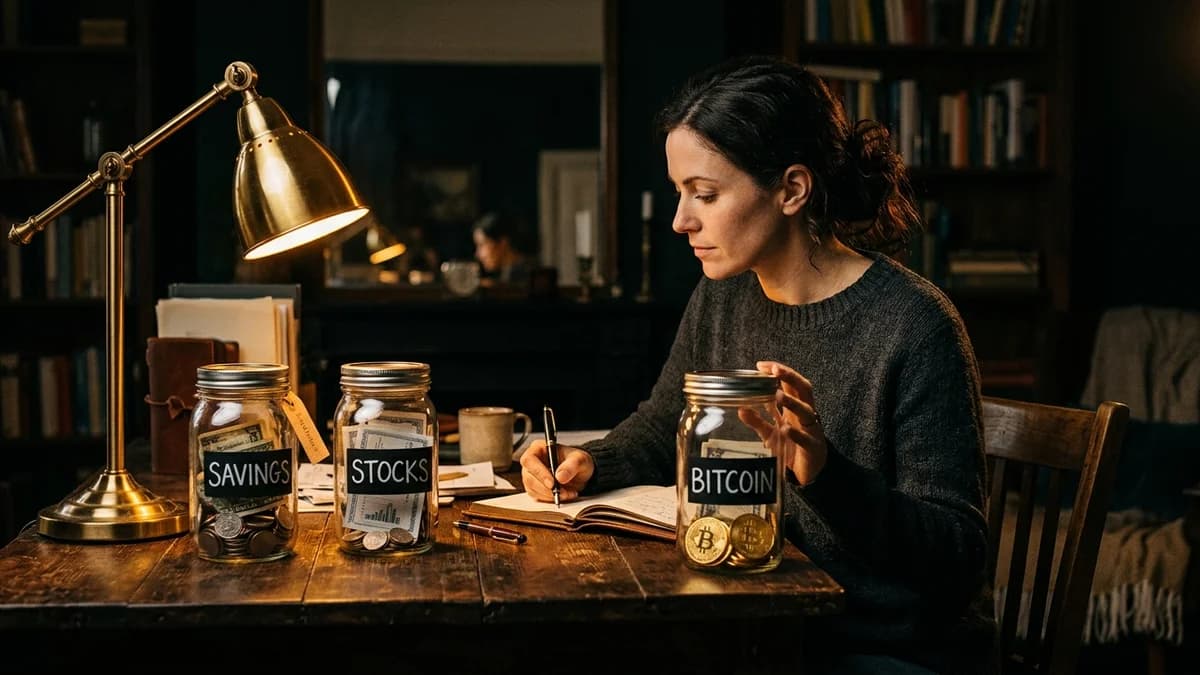
Path 3: Bitcoin DCA ($100/Month)
Bitcoin has only existed since 2009. That is a much shorter track record than the stock market. The volatility is extreme. Drops of 75% to 80% have happened multiple times.
But the data we do have is remarkable.
According to publicly available price data and analysis from Bitcoin Magazine, someone who dollar-cost averaged $100 per month into Bitcoin over the 5-year period from 2019 to 2024 turned $6,000 in contributions into roughly $15,000. Over 10-year horizons that include Bitcoin's earlier growth phases, the numbers get much more dramatic.
Here is an honest look at approximate 10-year outcomes based on historical return data:
| Vehicle | Total Deposited | Approximate Value After 10 Years | Growth |
|---|---|---|---|
| Savings account (0.5%) | $12,000 | $12,275 | +$275 |
| S&P 500 (10% avg) | $12,000 | $19,754 | +$7,754 |
| Bitcoin (historical DCA) | $12,000 | $52,000+ | +$40,000+ |
That gap is not a typo. It is the difference between parking your money and putting it to work. Between a system designed to keep you earning nothing and one that rewards patience and consistency.
$40,000+
Estimated difference between a savings account and Bitcoin DCA over 10 years on $100/month
Historical BTC price data, publicly available
But there is a catch. A big one. Bitcoin's historical returns came during a period of massive adoption growth, from nearly zero users to hundreds of millions. Nobody serious expects those exact returns to repeat. The asset is maturing. The easy gains are harder to find. And along the way, you will watch your portfolio drop 50%, 60%, even 80% from its peak. Multiple times. That is the price of admission.
The people who came out ahead were the ones who did not sell during the crashes. They kept putting in their $100 every single month. Rain or shine. Bull market or bear market. That discipline is the real edge, not the asset itself.
The Chart Tells the Story
Look at all three paths side by side. Same $100 per month. Same person. Three very different outcomes depending on one single decision: where the money goes.
$100/Month: Three Paths, Three Very Different Outcomes
Same $100/month over 10 years in a savings account, the S&P 500, or Bitcoin
Sources: FDIC savings rate data, NYU Stern S&P 500 historical returns, publicly available BTC price data. Bitcoin figures reflect approximate historical DCA outcomes and are not a guarantee of future performance.
The savings account line barely separates from the "total invested" line. That should bother you. Ten years of discipline, and the bank gave you back almost nothing extra. Adjusted for inflation, you actually lost ground.
The S&P 500 line curves upward. Steadily. Reliably. Not exciting, but effective. This is the path that has built more quiet wealth for regular people than any other vehicle in history.
The Bitcoin line climbs steeper. More volatile. More unpredictable. But for those who held through the dips, significantly more rewarding.
The biggest difference between these three paths is not the asset. It is the knowledge. Nobody taught you that a savings account loses purchasing power. Nobody showed you that $100 a month in an index fund turns into nearly $20,000 in a decade. The system profits from your ignorance. This chart is what they did not want you to see.
Where Does $100 a Month Come From?
You are probably already spending $100 a month on things that vanish. Here are some common ones:
- Coffee runs: $5 a day, five days a week, is $100 a month
- Forgotten subscriptions: The average American spends $219/month on subscriptions they barely use, per a C+R Research study
- Impulse Amazon purchases: A few "add to cart" moments per week adds up fast
- Eating out for lunch: $12 to $15 per meal, three times a week, that is $150 to $180 a month
- Lottery tickets: Americans spend over $100 billion a year on lottery tickets, per the North American Association of State and Provincial Lotteries
You do not need to earn more money. You need to redirect money that is already leaving your pocket. The dollars are the same. The destination changes. And so does everything else.
See what YOUR spending could become
Try the Untaught DCA Calculator with your actual numbers.
The Real Risk Is Doing Nothing
People worry about picking the wrong investment. They worry about a crash. They worry about timing.
None of those are the real risk.
The real risk is doing nothing. Leaving $100 a month in a checking account earning 0.01%. Or spending it on things that are gone by the end of the day. Every month you wait is a month of compound growth you never get back.
Consider this. If you start investing $100 a month at age 25, by age 35 you have a meaningful head start. If you wait until 35 to begin, you have lost 10 years of compound growth. Not 10 years of contributions. 10 years of compounding. That is the part you cannot recover. Time is the one ingredient in this equation that money cannot buy.
A 2019 study in the Journal of Financial Planning found that savings rate, not income, not investment returns, is the strongest predictor of long-term wealth. How much you set aside consistently matters more than which asset you pick.
Read more: The "Start Tomorrow" Trap

Which Option Should You Pick?
Here is a simple framework.
If you have no emergency fund: Start with a high-yield savings account (one paying 4% to 5%, not the 0.5% kind). Build a cushion of $1,000 to $2,000. Then shift to investing.
If you want steady, proven growth: Put your $100 a month into an S&P 500 index fund. This is the most battle-tested approach for regular people. Low cost. Low effort. Decades of data supporting it.
If you want Bitcoin exposure: Allocate a portion, not all, of your $100. Maybe $50 into an index fund and $50 into Bitcoin. Or $70 and $30. The split matters less than the consistency.
If you want to play it safe: $60 into an index fund, $20 into Bitcoin, $20 into a high-yield savings account. Diversified. Simple. Repeatable.
The worst option is doing nothing. The second worst option is waiting for the "right time." There is no right time. There is only now, and later. Later always costs more.
Frequently Asked Questions
The System Did Not Want You to See This
Nobody in a position of power benefits from you understanding compound growth. Banks profit from your deposits earning 0.01%. Credit card companies profit from your spending. The lottery profits from your hope. The entire system runs on people not doing this basic math.
One hundred dollars a month is not glamorous. It is not exciting. It will not make you rich overnight. But it is the single most powerful financial habit a regular person can build. And the fact that nobody taught you this in school should tell you everything about whose interests the school curriculum serves.
You now have the numbers. You have the chart. You know the three paths and where each one leads.
The only question left is which one you pick.
Pick one path. Open an account today. Set up a $100 monthly recurring purchase. The first month feels like nothing. The tenth month starts to feel real. By year three, you will wonder why nobody told you sooner. Start now. Adjust later.
If you want to go deeper, read $20 a Week for 10 Years for a breakdown of even smaller amounts. And to understand the engine that makes all of this work, read What Is Compound Interest?.
This article is part of the Small Steps, Real Results series on Untaught.
This article is for educational purposes only and does not constitute financial advice. Untaught does not hold, move, or custody any funds. Past performance does not guarantee future results. Always do your own research before making investment decisions.
Quick calculator
Your coffee money could have become
$16,301
from $9,900 invested