How Much Emergency Fund Do You Actually Need? (And What to Do After You Have It)
53% of Americans can't cover a $1,000 emergency. How much you really need in months not dollars, what $10,000 or $50,000 actually buys, and where to keep it.

An emergency fund is a dedicated cash reserve kept in a liquid, safe account to cover unexpected expenses without taking on debt. Financial experts recommend three to six months of essential living expenses. The first milestone is $1,000, which covers most common emergencies. As of December 2025, 53% of Americans cannot cover a single $1,000 emergency from savings, according to Bankrate.
You know you need an emergency fund. Every financial advice article ever written says so. Three to six months of expenses. That is the magic number everyone repeats.
But here is the problem. Most people hear "three to six months of expenses" and freeze. That is $10,000 or more for a lot of families. It sounds impossible. So they save nothing. And the cycle keeps spinning.
Let's fix that right now.
That stat is not a scare tactic. It is reality. More than half of Americans would have to put a surprise $1,000 expense on a credit card, borrow from family, or just not pay it. That is how fragile things are for most people. In the same Bankrate survey, fielded December 2 to 8, 2025, 24% reported having no emergency savings at all, and only 46% had enough to cover three months of expenses, against the 85% who say three months is what they would need to feel comfortable and the 63% who say they would need six months or more. The shortfall is not unique to you: the typical American's savings by age barely rises above a few thousand dollars across an entire working life.
The system never taught you how to build a financial cushion. That was not an accident. A population living paycheck to paycheck is easier to sell to, easier to lend to, and easier to profit from. But you can break the cycle. And it starts with a number that is way smaller than you think.
You do not need $20,000 in the bank to start feeling secure. You need $1,000. That is target number one. Build that cushion in a high-yield savings account paying near the FDIC's 4.38% rate cap, not the 0.38% national average. Once you have it, stop hoarding cash and start investing the rest. Your emergency fund is important, but it should never become an excuse to avoid building real wealth.
Could You Cover a $1,000 Emergency?
Share of Americans who could pay a surprise $1,000 expense from savings vs. those who could not
Source: Bankrate 2026 Emergency Savings Report. Nearly 1 in 4 Americans (24%) have no emergency savings at all.
Read more: Small Steps, Real Results
How Much Do You Actually Need?
Forget the one-size-fits-all advice. Your emergency fund should be built in stages. Here is the roadmap.
Stage 1: The Starter Cushion ($1,000)
This is your first target. One thousand dollars. It covers a flat tire, a trip to urgent care, a busted water heater. The stuff that turns into credit card debt when you do not have cash on hand.
This is not a big number. At $25 a week, you hit it in 40 weeks. At $50 a week, you are there in 20. The point is to get something between you and disaster as fast as possible.
Set up an automatic transfer of $25 per week into a separate savings account. Do not touch it. In less than a year you will have a $1,000 cushion that most Americans do not have.
Stage 2: The Safety Net (3 Months of Expenses)
Once you have $1,000, keep going until you have three months of essential expenses covered. Not three months of your full income. Three months of the bare minimum: rent, utilities, groceries, insurance, transportation.
For most people, that is somewhere between $4,000 and $8,000. This covers a job loss, a medical situation, or a major repair without spiraling into debt.
Stage 3: The Full Buffer (6 Months of Expenses)
Six months is the gold standard. If you are self-employed, a single-income household, or work in an unstable industry, this is your target. It buys you time. Time to find a new job. Time to recover from an illness. Time to make decisions without panic.
But here is the thing nobody tells you. You do not need to fully complete Stage 3 before you start investing. In fact, waiting too long is a mistake.
Which Stage Is Actually Yours?
The "3 to 6 months" range is not a coin flip. Where you land inside it depends on how predictable your income is and how many people depend on it. The dollar column below runs the arithmetic on a household with $3,000 a month in essential costs, meaning rent or mortgage, utilities, groceries, insurance, and transportation. Swap in your own number and the multipliers still hold.
| Your situation | Target | Why | At $3,000/mo essentials |
|---|---|---|---|
| Two incomes, stable jobs, renting | 3 months | Two paychecks rarely stop at once, and a landlord handles the broken furnace | $9,000 |
| One income, stable job, renting | 4 to 5 months | One layoff stops all of it, but repairs are not your bill | $12,000 to $15,000 |
| Homeowner | 6 months | The roof, the water heater, and the HVAC are now your problem | $18,000 |
| Freelance, commission, or seasonal | 6 to 9 months | Income arrives in lumps, so the buffer covers the gaps between them | $18,000 to $27,000 |
| Single income with dependents | 6 months, minimum | Nobody else can absorb the shock for you | $18,000 |
If the right-hand column looks impossible today, that is the point of doing it in stages. Nobody starts at six months. Everybody starts at the first $1,000.
Is $10,000 Too Much? Is $50,000 Enough?
Neither question has an answer until you divide by your own monthly essentials. A $10,000 emergency fund is four months of runway for a household spending $2,500 a month and less than two months for a household spending $6,000. The dollar figure on its own tells you nothing. The quotient tells you everything.
That is why the "is $30,000 too much" arguments never resolve. Two people can hold the identical balance and one of them is over-saved while the other is a bad quarter from a credit card. Notice what gets left out of the popular version of this question. People search for a verdict on a round number because a round number is easy to hold in your head, and every calculator on the first page of results happily returns one. But a target of $25,000 that was produced by a stranger's assumptions about your rent is not a plan. It is a number with someone else's life behind it, and it will be wrong in whichever direction their household differs from yours.
Run your own number instead. Add up rent or mortgage, utilities, groceries, insurance and transportation for one month. That figure is your denominator for the rest of this article. Then find your balance in the left column below and read across.
| If your fund holds | At $2,500/mo essentials | At $4,000/mo essentials | At $6,000/mo essentials |
|---|---|---|---|
| $1,000 | 0.4 months | 0.3 months | 0.2 months |
| $5,000 | 2.0 months | 1.3 months | 0.8 months |
| $10,000 | 4.0 months | 2.5 months | 1.7 months |
| $20,000 | 8.0 months | 5.0 months | 3.3 months |
| $30,000 | 12.0 months | 7.5 months | 5.0 months |
| $50,000 | 20.0 months | 12.5 months | 8.3 months |
Now the four questions people actually type, answered against that grid.
Is $10,000 too much? Almost never. At $2,500 a month in essentials it is four months of runway, which sits inside the standard three to six month range. At $4,000 a month it is two and a half months, which has not even reached the low end yet. The only household for which $10,000 is genuinely too much is one with very low fixed costs and no dependents, and even then the surplus is small.
Is $20,000 too much? For a two income household renting at $2,500 a month in essentials, yes, mildly. Eight months exceeds the three months that situation calls for, and since three months at $2,500 is $7,500, the other $12,500 is sitting in cash instead of compounding. For a homeowner at $4,000 a month it is exactly five months, which is right where it should be. For a freelancer at $6,000 a month it is three and a bit months, which is short.
Is $30,000 a good emergency fund? It is a good emergency fund for a household spending $4,000 to $6,000 a month on essentials, where it buys five to seven and a half months. It is an expensive one for a household spending $2,500, where it buys a full year. Six months at that spending level is $15,000, so half the balance has no job to do.
Is $50,000 enough? Yes, for nearly everyone, and for most households it is more than enough. Fifty thousand dollars only fails to reach six months once your essentials pass about $8,300 a month. If you are holding $50,000 in cash and your essentials are under $5,000, the honest read is that you have an over-funded emergency fund and an under-funded investment account.
The number that matters is months, not dollars. Anyone who answers "is $20,000 enough" without asking what you spend in a month is guessing, and so is the calculator that skips the question.
How Much Should You Put In Each Month?
For most households the honest answer is $250 a month, because that is the rate at which a three month cushion arrives in under three years instead of being a permanent someday project. The chart below runs the arithmetic for a household with $3,000 a month in essentials, so $9,000 buys three months and $18,000 buys six.
What the Sixth Month Actually Costs You
Months of saving to reach a three month and a six month cushion, for a household with $3,000 a month in essentials
Untaught model. Level monthly deposits compounded monthly at 4.38% APY, the FDIC national rate cap for savings as of August 17, 2026. Rounded up to the month the balance crosses each target.
Look at what the second half costs. At $250 a month, three months of cushion takes 34 months and six months takes 65. The extra $9,000 does not take a little longer. It takes almost exactly as long again, because the target doubled while the deposit did not. Nobody says that part out loud when they tell you to keep six months in cash.
That is the whole case for the staged approach earlier in this article. Sixty-five months is five and a half years. If you refuse to invest a dollar until the six month buffer is finished, you have handed away five and a half years of compound interest to buy insurance against a risk you were already mostly covered for at month 34.
Three rules make the monthly number easier to pick.
- Pick a number that survives a bad month. A $400 transfer you cancel twice a year saves less than a $250 transfer you never touch. Consistency beats size, which is the entire lesson of building a saving habit.
- Raise it with your income, not your rent. A raise is the cheapest time to increase the transfer, because the money was never in your budget to begin with.
- Stop when you hit your number. An emergency fund is the one account with a finish line. Past your target, every additional dollar of cash is a dollar not compounding.
Take your monthly essentials, multiply by three, and divide by 36. That is your monthly transfer for a three year plan. If the answer is uncomfortable, use 48 months instead and start anyway.
America's Emergency Cushion Just Shrank for the First Time in 15 Years
The share of US adults with three months of expenses set aside fell to 46% in 2024, down from 53% in 2021. That is the first decline since the FINRA Foundation started asking the question in 2009, and it erased twelve years of steady gains in a single wave.
America's Emergency Cushion Peaked in 2021
Share of US adults with three months of expenses set aside, every wave of the National Financial Capability Study since 2009
FINRA Investor Education Foundation, National Financial Capability Study, sixth edition, released July 16, 2025. The 2024 wave surveyed more than 25,500 US adults between June and October 2024.
The National Financial Capability Study is the largest survey of its kind in the country, and the 2024 wave reached more than 25,500 adults across all fifty states between June and October 2024. It has asked the same rainy day question in all six waves: have you set aside enough money to cover three months of expenses in case of sickness, job loss, an economic downturn or other emergencies.
The answer climbed every single time, from 35% in 2009 to 53% in 2021, and then reversed. Pandemic-era transfers, paused student loan payments and a frozen travel and dining budget pushed savings up. When those ended and prices did not, the cushion came back out.
Independent numbers say the same thing. Bankrate's 2026 emergency savings report also puts the three month figure at 46%, and the Federal Reserve's survey of household economic well-being finds 63% of adults could cover a surprise $400 expense with cash or its equivalent, a share that has not moved in several years. Three separate national surveys, three versions of the same finding: a little under half of American households have a real cushion, and that fraction stopped improving.
The averages hide something worse. The national 46% is not spread evenly, and the gap between groups is much larger than the gap between years.
Who Actually Has Three Months Saved
Share with three months of rainy day funds, by age, income and education. The dashed line is the 46% national figure.
FINRA Investor Education Foundation, National Financial Capability Study, sixth edition, released July 16, 2025, fielded June through October 2024.
Sixty-six percent of households above $75,000 have three months saved. Twenty-two percent of households under $25,000 do. That is a three to one gap, and it is wider than any of the age or education splits. An emergency fund is not primarily a discipline problem. It is an income problem with a discipline component, which is why advice that starts and ends at "spend less" fails the people who need it most.
The age split points the other way and is worth reading carefully if you are young. Only 36% of adults aged 18 to 34 have three months saved, against 59% of those 55 and up. Some of that is simply time. But the typical American's savings by age shows the gap opening early and never closing, which means the people who start the habit at 25 are not catching up later. They are the 59%.
Where to Keep Your Emergency Fund
This part matters more than most people realize. The wrong account quietly eats your money.
Do not settle for the national average. The average savings account pays 0.38% APY, according to the FDIC as of August 17, 2026. Against the 3.4% rise in consumer prices over the twelve months through August 2026, reported by the Bureau of Labor Statistics, that is a guaranteed loss. Your savings account is losing money against inflation every single year. A high-yield account is the right home for this specific money, which is exactly when a high-yield savings account is the right call even though it still trails inflation after taxes.
Use a high-yield savings account. The FDIC caps what a competitive institution can advertise at 4.38% for savings, and online banks price right up against that ceiling. That is roughly 11.5 times the national average. On a $5,000 emergency fund, that is the difference between earning about $19 per year and about $219.
4.38%
FDIC savings rate cap, versus the 0.38% national average
FDIC National Rates and Rate Caps, August 17, 2026
Here is what each kind of account does to the same $10,000 over a year. The first three APYs are FDIC national averages as of August 17, 2026. The fourth is the 4.38% national rate cap, which is the ceiling a competitive online bank prices against.
| Where the cushion sits | APY | One year on $10,000 | Reachable in a day or two? |
|---|---|---|---|
| Interest checking | 0.07% | $7 | Yes, and that is the problem, it is the account you spend from |
| Regular savings at a big bank | 0.38% | $38 | Yes |
| Money market account | 0.63% | $63 | Yes, often with check writing |
| High-yield savings at the cap | 4.38% | $438 | Yes, one to two business days |
The gap between the top row and the bottom row is $431 a year for the same money, the same insurance, and the same access. Nothing about the emergency fund changes. Only the institution holding it does.
Your emergency fund needs to be liquid. That means easy to access within a day or two. High-yield savings accounts fit perfectly. They are FDIC insured, they earn real interest, and you can transfer money out when you need it.
The FDIC insurance matters. Every account at a member bank is insured up to $250,000 per depositor. If the bank fails, the government covers you. That protection is the entire reason savings accounts exist as a category.
Treat that guarantee like the backstop it is, then stop parking more than you need in an account earning a fraction of what inflation takes every year. The emergency fund is a tool, not a retirement plan. Its job is to be available the day you need it, nothing more.
Never put your emergency fund in stocks, crypto, or any investment that can lose value. The whole point of an emergency fund is that it is there when you need it. Market crashes tend to happen at the same time as job losses. You do not want both hitting you at once.
Related: Why Your Savings Account Is Quietly Losing Money | Your Money Is Losing Value
Opening a high-yield account takes about ten minutes online. You do not need a minimum deposit. You do not need to close your existing bank account. You just need a second account that you treat as off-limits for everyday spending.
Most online banks let you nickname the account. Call it something that matters to you. "Don't Touch." "Break Glass." "Emergency Only." Whatever makes you hesitate for half a second before you pull from it. That tiny bit of friction is the whole point.
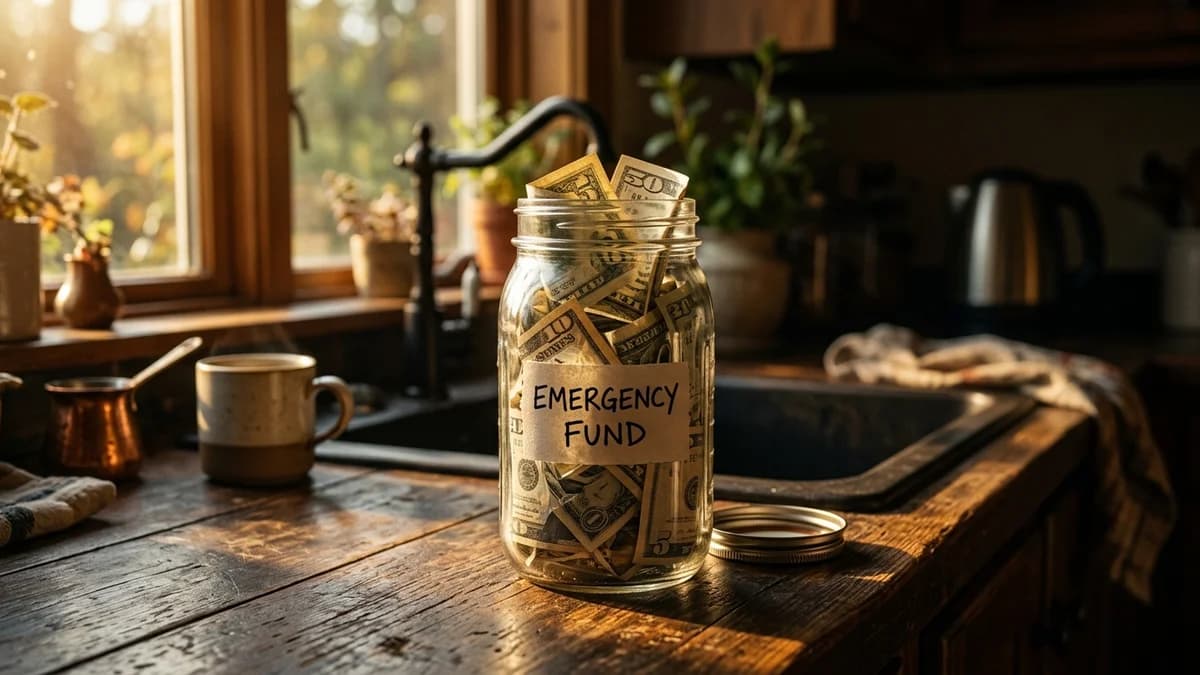
The Trap: When Saving Becomes an Excuse Not to Invest
Here is where most financial advice gets it wrong. They tell you to build a six-month emergency fund before you invest a single dollar. That sounds responsible. But it is actually terrible advice for most people.
Why? Because it takes years to save six months of expenses. And during those years, your cash is sitting in a savings account losing purchasing power every single day.
Even at 4.38% APY, your high-yield savings account barely keeps pace with the 3.4% rise in consumer prices over the twelve months through August 2026. After taxes on the interest, you might actually be losing ground. Meanwhile, the S&P 500 has averaged roughly 10% annual returns since 1928, according to NYU Stern. $100 invested at the start of 1928 was worth $1,157,598.95 by the end of 2025, a 10.02% geometric return across 98 years.
Every month you delay investing because you are "still building your emergency fund" is a month of compound growth you will never get back. The start tomorrow trap is one of the most expensive mistakes in personal finance.
The sweet spot: once you have $1,000 to $2,000 saved, start splitting your savings. Keep building the emergency fund with part of your money. Start investing the rest. You do not have to choose one or the other.
Here is what that looks like. Say you are saving $100 per month.
- Before $1,000 cushion: All $100 goes to your emergency fund.
- After $1,000 cushion: Split it. $50 continues building the emergency fund toward three months of expenses. $50 goes into investments, whether that is an index fund, Bitcoin DCA, or both.
- After three months of expenses: $25 continues topping off the emergency fund. $75 goes to investments.
You are doing both at once. The emergency fund grows. Your investments grow. And you are not sitting on the sidelines watching compound interest work for everyone except you.
Who Can Cover a $1,000 Emergency?
Percentage by generation who could pay a $1,000 surprise expense from savings
Source: Bankrate Emergency Savings Report, 2025
The picture above is the reality most Americans live in. Just over a third have a real cushion. Almost as many have nothing at all. This is the landscape the financial advice industry keeps pretending does not exist when it tells you to keep six months of expenses in cash before you invest a dime.
What to Invest in After Your Cushion Is Built
Once you have that starter cushion locked in, it is time to put the rest of your money to work. The vehicle matters less than the consistency. But here are your main options.
Index funds like the S&P 500 are the simplest starting point. Low fees. Broad diversification. Historically returns around 10% per year. Set up a recurring buy at a brokerage like Fidelity or Schwab. Do not try to pick stocks. Do not try to time the market.
Bitcoin is worth considering for a portion of your portfolio. Its fixed supply of 21 million coins means no government can print more. It is available 24/7 and has no minimum purchase. Dollar cost averaging removes the stress of timing.
The key word is consistent. Twenty dollars a week invested for ten years becomes real money. Not because the amount is big. Because the habit is.
Three different jobs, three different accounts. Mixing them up is where people get hurt:
| High-yield savings | Index funds | Bitcoin | |
|---|---|---|---|
| Its job | Be there on the worst day of your year | Grow steadily for decades | Asymmetric upside on a small slice |
| Can it lose value? | No, FDIC insured to $250,000 | Yes, and it has fallen 36.55% in a single year (2008) | Yes, and it has fallen more than 75% four times |
| How fast can you get it? | One to two business days | Days | Minutes |
| Right amount here | Your full emergency target, and not a dollar more | The bulk of long-term money | Only what you can watch fall by half |
Read that middle column again. The 2008 drawdown is exactly why the warning above exists: the year your index fund fell 36.55% is the same kind of year people lose jobs. That is what the cash cushion is protecting.
Build your safety net, then start building wealth
Join thousands learning what the system never wanted you to know about money.
How to Actually Build Your Emergency Fund (Step by Step)
You do not need a complicated plan. You need five steps and ten minutes.
Step 1: Open a high-yield savings account
Not at your regular bank. Open a separate account at an online bank pricing near the 4.38% cap. The separation is important. When your emergency fund is in your checking account, you spend it. Out of sight, out of reach.
Step 2: Set a $1,000 target
Write it down. Put it on your phone. Make it real. This is your first finish line.
Step 3: Automate $25 to $50 per week
Set up an automatic transfer on payday. You will not miss it. Building a saving habit is about systems, not willpower. Make it automatic and your brain barely notices.
Step 4: Hit $1,000, then split
Once you reach $1,000, start splitting your savings between the emergency fund and investments. Do not wait for perfection. Start investing $20 a week alongside your continued saving.

Step 5: Revisit every six months
Life changes. Your expenses change. Check your emergency fund target twice a year and adjust. Got a raise? Bump the automatic transfer by $10. Paid off a debt? Redirect that payment.
Frequently Asked Questions
Your Emergency Fund Is a Launchpad, Not a Finish Line
The financial industry wants you to think that saving money is the goal. It is not. Saving is just the first step. The emergency fund protects you from disaster. But the real wealth building happens when you take the money above that cushion and put it somewhere it can actually grow.
Most people either save nothing or save forever without investing. Both are mistakes. The first leaves you vulnerable. The second leaves you treading water while inflation slowly drains your purchasing power.
Build the cushion. Then build wealth. In that order. But do not wait years between steps.
Open a high-yield savings account today. Set up a $25 weekly automatic transfer. Hit $1,000, then start splitting between your emergency fund and investments. That is the entire plan. Start this week.
Here is the whole article on one line per stage:
| Stage | Target | Where it lives | What you do with new money |
|---|---|---|---|
| Starting out | $1,000 | High-yield savings near 4.38% | 100% to the cushion |
| Cushion done | 3 months of essentials | High-yield savings | Split it, half cushion and half invested |
| Safety net done | 3 to 6 months, per the table above | High-yield savings | Mostly invested, top off the cushion |
| Buffer done | Your number from the table above | High-yield savings, and stop adding | All of it invested |
The system was designed so you would never learn this. The lack of financial education in schools was not an oversight. It was a feature. A population that understands money is harder to exploit.
Now you understand. So do something about it.
This article is part of the Small Steps, Real Results series on Untaught.
This article is for educational purposes only and does not constitute financial advice. Untaught does not hold, move, or custody any funds. Past performance does not guarantee future results. Always do your own research before making investment decisions.
Quick calculator
Your coffee money could have become
$16,301
from $9,900 invested