Bitcoin vs the Stock Market: Where Should Your First $20 Go?
Bitcoin returned 437,000%+ since 2011. The S&P 500 returned ~400%. But Bitcoin swings 3-4x harder. Here's an honest side-by-side for your first $20.
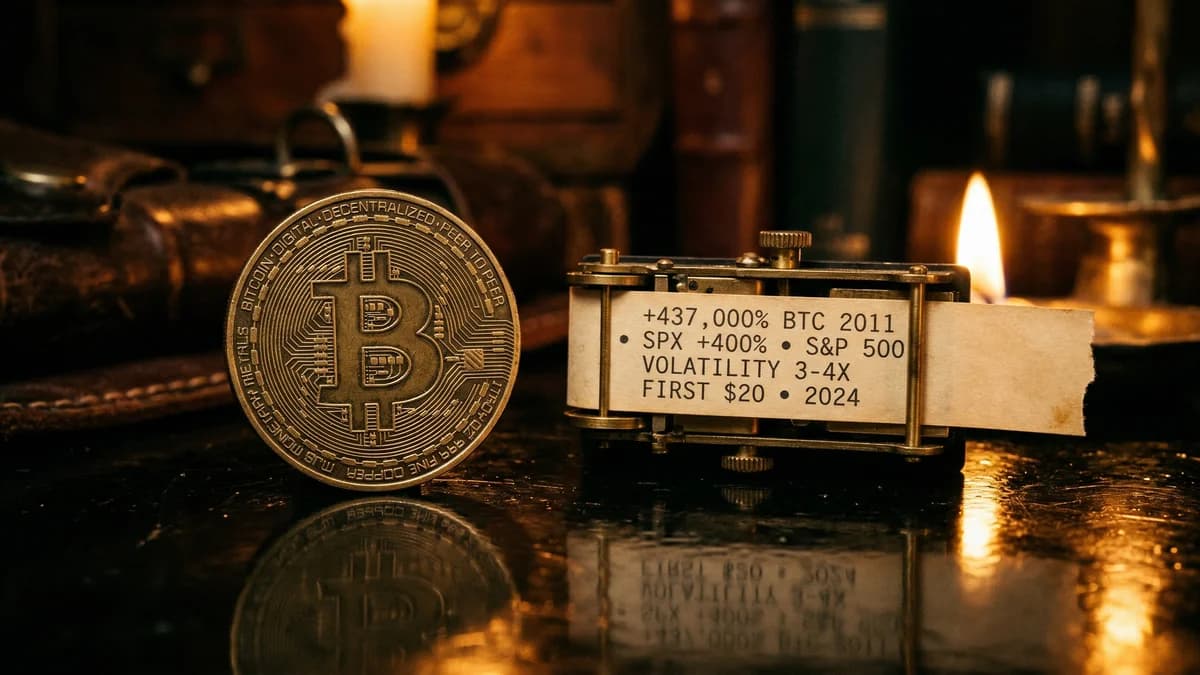
Bitcoin vs. the stock market is the most common investing question beginners ask. Bitcoin returned over 437,000% since 2011. The S&P 500 returned roughly 400% in the same period. The catch: Bitcoin's worst peak-to-trough drop was 81%, compared to 57% for the S&P 500. Here is what the numbers actually show.
You have $20 a week. You want to start investing. But where does it go?
Both camps have the charts to back up their arguments. Neither will tell you the honest answer: both can work. The question is not which one is "right." The question is what fits your goals, your risk tolerance, and your timeline.
Let's put them side by side. Real numbers. No hype. No tribalism. Just an honest look at what your first $20 would have done in each place.
Since 2011, Bitcoin returned over 437,000% while the S&P 500 returned roughly 400%. But Bitcoin's worst peak-to-trough drop was 81%, compared to 57% for the S&P 500. If you are starting with $20 a week, you do not have to pick just one. The best move is to start investing at all. Dollar cost averaging works with both.
The Tale of Two Assets
The S&P 500 is a collection of the 500 largest U.S. companies. Think Apple, Amazon, Walmart, JPMorgan. When people say "the stock market," they usually mean this. The index in its current 500-company form launched on March 4, 1957, built on a 90-stock predecessor that Standard & Poor's had been publishing since the 1920s. The return series economists use for its long-run average reaches back to 1928. Either way, it has a long, documented track record.
Bitcoin is digital money with a fixed supply of 21 million coins. It launched in 2009. It has a shorter track record, but a much more explosive one.
Both have made people money. Both have also scared people into selling at the worst possible time.
Here is the core difference. The stock market is a bet on the U.S. economy. Bitcoin is a bet on a new kind of money that no government controls and no one can print more of. These are different bets with different risk profiles.
Read more: Bitcoin for Beginners | What Is Dollar Cost Averaging? | Bitcoin vs Index Funds
The Numbers: Bitcoin vs. S&P 500
Let's start with raw returns. These are the headline numbers from January 2011 through December 2024.
~400%
S&P 500 total return since 2011
NYU Stern historical data
| Metric | Bitcoin | S&P 500 |
|---|---|---|
| Total return (2011-2024) | 437,000%+ | ~400% |
| Average annual return | ~75% (historical, with huge variance) | ~10% |
| Best single year | +1,318% (2013) | +32.4% (2013) |
| Worst single year | -73% (2018) | -36.55% (2008) |
| Max drawdown (peak to trough) | -81% (2017-2018) | -57% (2007-2009) |
| Volatility (annualized) | ~70-80% | ~15-20% |
| Minimum to invest | $1 (most apps) | $1 (fractional shares) |
| Available to buy | 24/7/365 | Market hours only |
| Fees | Low (0-1.5%) | Very low (0.03% for index funds) |
| Years of track record | 15 | 98 |
Read that table carefully. Bitcoin's returns are eye-popping. But so are the drops. An 81% crash means a $10,000 portfolio turns into $1,900. That is not a typo. Bitcoin has done that more than once: down about 81% in 2013-2015, again about 81% in 2017-2018, and about 76% in 2021-2022.
The S&P 500 drops too, and its worst modern drawdown was 57% from the October 2007 peak to the March 2009 trough. That hurts. But it is a very different kind of hurt than 81%, and it took the index sixteen months rather than a single year.
What $20 a Week Actually Becomes
Forget the percentages for a second. Let's talk about real dollars.
If you had put $20 a week into both assets over the last 10 years, here is roughly what you would have seen, based on historical DCA backtests from Curvo and publicly available price data.
After 10 years of putting in $20 a week:
- Total invested: $10,400
- S&P 500 portfolio value: roughly $19,000
- Bitcoin portfolio value: roughly $62,000
That is a massive gap. The S&P 500 nearly doubled your money. Bitcoin turned it into six times what you put in. Plotted against each other, though, the gap is not the interesting part of the picture. The shape of the two lines is.
$20/Week DCA: Bitcoin vs. S&P 500 Over 10 Years
Approximate portfolio values based on historical performance (2014-2024 window)
Sources: Curvo historical backtest data, NYU Stern S&P 500 returns, BTC historical price data
But there is something the chart does not show. Along the way, the Bitcoin line crashed. Hard. Multiple times. In 2018, your Bitcoin portfolio would have been worth less than what you put in. In 2022, it dropped by more than half in just a few months. If you panicked and sold during either of those crashes, you locked in a loss.
The S&P 500 line is smoother. Not smooth. Just smoother. You still had bad stretches. But nothing like watching 80% of your value disappear.
The people who got Bitcoin's monster returns were the ones who kept buying through the crashes. Dollar cost averaging at $20 a week means you bought more Bitcoin when it was cheap and less when it was expensive. But you had to stomach the drops to get the gains.
The psychology of this is the whole game. Most people say they could sit through a 50% drawdown, right up until it actually happens. Then they check the app twice a day, read every doom headline, and eventually tap the sell button at the exact worst moment. The ones who win do the opposite. They automate the buy, delete the price app, and let the next few years do the work.
Volatility: The Price of Higher Returns
Here is a rule that applies to almost every investment in history: higher returns come with higher risk. There is no cheat code around this.
Bitcoin's volatility is roughly 3 to 4 times higher than the S&P 500. In practical terms, that means:
- The S&P 500 might swing 1-2% in a day. That is normal. Most people barely notice.
- Bitcoin might swing 5-10% in a day. That is also normal for Bitcoin. But it makes new investors want to throw their phone in a lake.
Over a month, the S&P 500 rarely moves more than 10%. Bitcoin has moved 30% or more in a single month, multiple times.
This is not a flaw. It is a feature of being a young, globally traded, 24/7 asset with a fixed supply. Supply cannot expand to absorb demand shocks. So the price absorbs them instead.
If you are the kind of person who checks your investments every day, Bitcoin will stress you out. If you are the kind of person who sets up a weekly buy and checks once a quarter, it probably won't bother you much.
Never invest more in Bitcoin than you can afford to lose entirely. This is not a cliche. It is survival advice. If your rent money is in Bitcoin and it drops 50% overnight, you have a real problem. Start small. Stay small until you truly understand the swings.
A good rule of thumb: if losing the money would change how you pay rent, feed your family, or handle an emergency, it does not belong in Bitcoin. Start with money you could afford to light on fire. That is not a joke. That is the mental filter that keeps you from panic selling the first time the price cracks.
Once the amount is small enough to forget about, the volatility stops feeling like a threat and starts feeling like noise. That is the mindset that builds a stack over years, not weeks.
Read more: $20 a Week for 10 Years
The DCA Advantage: Why It Works for Both
Dollar cost averaging is the strategy of buying a fixed dollar amount on a regular schedule. $20 every week. No matter what the price is doing. No matter what the news says.
This works beautifully for both assets, but it is especially powerful for Bitcoin.
Why? Because Bitcoin's drops are so extreme. When Bitcoin crashes 50%, your $20 buys twice as many sats (the smallest unit of Bitcoin) as it did before the crash. When it recovers, those cheap sats are now worth a lot more. DCA turns Bitcoin's wild volatility from a problem into an advantage, as long as you do not stop buying during the dip.
For the S&P 500, DCA smooths out the smaller bumps. You buy more shares when prices dip and fewer when they rise. It removes the need to guess when the market is high or low.
In both cases, DCA does the same thing: it removes emotion from the equation. You do not need to predict anything. You just show up every week with $20. Here is a full breakdown of how dollar cost averaging works.
What that looks like when the price falls by half, on a $20 weekly buy:
| Price scenario | What your $20 buys | What most people do | What DCA does |
|---|---|---|---|
| Price doubles | Half as much | Buy more, feeling smart | Same $20, fewer units |
| Price flat | The same each week | Lose interest | Same $20, same units |
| Price falls 50% | Twice as much | Stop the transfer | Same $20, double the units |
| Price falls 80% | Five times as much | Sell at the bottom | Same $20, five times the units |
Read the bottom two rows again. The scenarios that feel like disasters are the ones where the strategy is doing its best work. That is the entire trick, and it only pays off if you do not cancel the transfer.
Run the numbers for yourself
Try the Untaught DCA Calculator with your actual weekly spending.
Past Performance Is Not a Promise
You have seen Bitcoin's incredible historical numbers. Now here is the honest disclaimer.
Bitcoin's 437,000% return happened during a period when it went from a niche experiment to a globally recognized asset. From nearly zero adoption to hundreds of millions of users. That kind of growth phase does not repeat once it has already happened.
Most serious analysts expect Bitcoin's returns to moderate as its market cap grows. A $1 trillion asset does not double as easily as a $1 million asset. The growth story is not over, but the early explosive phase probably is.
The S&P 500, on the other hand, has nearly a century of data. It has survived world wars, pandemics, recessions, inflation, and political chaos. It returned 10.02% a year on average since 1928 through all of it, turning $100 into $1,157,598.95 by the end of 2025 (per NYU Stern equity returns data). That does not mean it will return 10% next year or the year after. But the track record is longer and more consistent.
Neither asset is guaranteed to go up. Both can lose money. The S&P 500 returned -36.55% in 2008, per that same NYU Stern series. Bitcoin fell about 76% from its November 2021 peak near $69,000 to its late-2022 bottom near $16,500. If you invest in either one, you will eventually watch your portfolio drop. The question is whether you keep going.
So Where Should Your $20 Go?
Here is the honest answer: it depends on who you are.
If you want the most proven, least stressful option: Go with a low-cost S&P 500 index fund. Vanguard's VOO or Fidelity's FXAIX. Set up $20 a week. Do not look at it. Come back in 10 years. The historical data is about as strong as it gets for any investment.
If you want higher potential returns and can handle the ride: Put some or all of your $20 into Bitcoin via an app like Strike or Cash App. Set up a recurring weekly buy. Do not sell during crashes. Understand that you might watch your money cut in half before it grows.
If you want both: Split it. $10 a week into an S&P 500 index fund. $10 a week into Bitcoin. This gives you exposure to both the traditional economy and the new digital one. You get the stability of stocks and the upside potential of Bitcoin. Many people find this is the approach that lets them sleep at night while still building for the future.
Pick the row that sounds like you, not the one with the biggest number:
| If this is you | Your $20 | Why |
|---|---|---|
| You have never invested before | $20 to an index fund | Build the habit on the less volatile asset first |
| You check your balance daily | $20 to an index fund | An 81% drawdown will make you sell at the bottom |
| You want exposure without the stress | $15 index fund, $5 Bitcoin | Small enough that a crash does not change your life |
| You can genuinely ignore a 50% drop | $10 and $10 | The split most people land on |
| You have no emergency fund yet | $0 to either, $20 to savings | Neither belongs in front of a $400 emergency |
That last row is not filler. If a surprise car repair would put you on a credit card at 22.15%, investing $20 a week while carrying that balance is a losing trade before it starts.
You do not have to pick just one. A simple 50/50 split between an S&P 500 index fund and Bitcoin, with $10 a week into each, gives you the best of both worlds. The important thing is not the split. The important thing is that you start.
The Real Enemy Is Not Picking Wrong
Most articles about Bitcoin vs. the stock market end with a winner. We are not doing that. Because the real enemy is not picking the wrong one.
The real enemy is not picking at all.
The person who puts $20 a week into the S&P 500 will be better off than the person who meant to invest but never got around to it. The person who puts $20 a week into Bitcoin, even if Bitcoin underperforms going forward, will be better off than the person who spent that $20 on lottery tickets and impulse buys.
Right now, that $20 is probably going somewhere that gives you nothing back. A coffee you forgot about by noon. A subscription you do not use. A scratch ticket that lost.
The whole decision comes down to one screen and one button, which is the part nobody warns you about.

Redirect it. Into stocks, into Bitcoin, into both. The vehicle matters less than the habit. Compound interest needs two things to work: money and time. You have the money. You are running out of time every single day you wait.
Frequently Asked Questions
Start Before You Feel Ready
You now have more information than most people ever get. You know the returns. You know the risks. You know the volatility numbers. You know that both assets have made money for patient, consistent investors.
What you do with that information is up to you. But if the answer is "nothing," then you already know how that ends. The same way it has always ended for people who wait. The dollars you are sitting on lose a little more purchasing power every single year.
One last reframe before the summary. Every number in this article compares two assets against each other, which quietly assumes the alternative is picking one. It is not. For most people the real alternative is the third column below, the one where the money stays in a deposit account because choosing felt too hard. That column has no drawdown and no bad years, and it is the only one guaranteed to lose to inflation every single year.
The whole comparison, stripped to what actually matters:
| Bitcoin | S&P 500 index fund | Cash in savings | |
|---|---|---|---|
| Track record | 15 years | 98 years | 98 years |
| Long-run return | Very high, very short history | 10.02% a year since 1928 | 0.38% national average |
| Worst it has done | -81% peak to trough | -57% peak to trough | Never falls, always erodes |
| Beats 3.4% inflation? | Historically yes, unreliably | Historically yes | No, guaranteed loss |
| The real risk | You sell during a crash | You sell during a crash | You feel safe while losing |
The DCA calculator can show you what your specific weekly amount would look like over time. Try it with $10. Try it with $20. Look at the numbers. Then decide.
You do not need to know everything. You just need to start.
This article is part of the Small Steps, Real Results series on Untaught.
This article is for educational purposes only and does not constitute financial advice. Untaught does not hold, move, or custody any funds. Past performance does not guarantee future results. Always do your own research before making investment decisions.
Quick calculator
Your coffee money could have become
$16,301
from $9,900 invested