What $100 Used to Buy: A Decade of Shrinking Dollars
A $100 bill has lost over 25% of its buying power since 2015, per the Bureau of Labor Statistics. See what that same bill used to cover and what it gets you now.
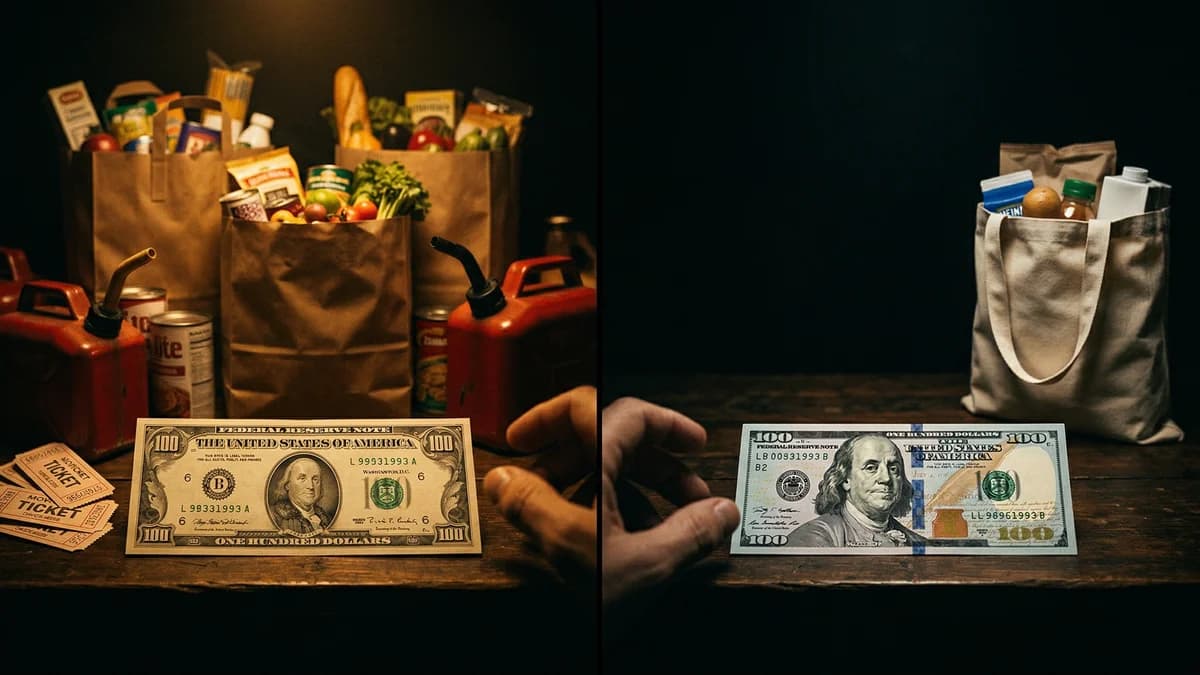
One hundred dollars in 1980 had the purchasing power of over $370 in 2025. That means goods that cost $100 forty-five years ago now cost $370. This is not because products got better. It is because the dollar got weaker. The U.S. Bureau of Labor Statistics CPI calculator shows this directly: the dollar has lost nearly 75% of its value since 1980.
Pull a hundred dollar bill out of your wallet. Look at it. Same paper. Same ink. Same Benjamin Franklin staring back at you with that smug expression.
But that bill is lying to you.
According to the Bureau of Labor Statistics (BLS) Consumer Price Index, $100 in 2015 has the purchasing power of roughly $73 today. You didn't spend that $27. You didn't lose it in the couch cushions. It was quietly taken from you through inflation, the silent tax nobody voted for.
This is what that looks like in real life. Not in economic theory. Not in charts you'll never read. In the stuff you buy every single week.
Your $100 bill buys about $73 worth of stuff compared to a decade ago, per BLS inflation data. This article breaks down exactly where that missing $27 went, item by item, from groceries to gas to rent. The prices went up. Your paycheck mostly didn't.
Read more: Your Money Is Losing Value | What Is Fiat Currency? | Is the Dollar Losing Value? 50+ Years of Data
What Did $100 of Groceries Look Like in 2015?
In 2015, $100 at the grocery store filled your cart. According to USDA Food Price Outlook data, grocery prices have risen over 30% since 2019 alone. Go back to 2015 and the gap is even wider.
Here's a rough snapshot of what $100 bought at an average U.S. grocery store in 2015 versus today:
| Item | 2015 Price | 2026 Price |
|---|---|---|
| Gallon of milk | $3.39 | $4.35 |
| Dozen eggs | $2.75 | $4.95 |
| Loaf of bread | $2.45 | $3.60 |
| Ground beef (1 lb) | $4.24 | $5.75 |
| Bag of apples (3 lb) | $4.50 | $6.20 |
| Chicken breast (1 lb) | $3.16 | $4.50 |
| Box of cereal | $3.35 | $5.10 |
| Bag of rice (5 lb) | $3.50 | $5.40 |
Sources: BLS Average Price Data, USDA ERS
In 2015, you could grab all of those items and still have money left for a bag of frozen vegetables and a carton of orange juice. Today, the same cart costs around $130. Same food. Same brands. Same quantities.
You're not eating more. You're just paying more.
The prices above are drawn from BLS average price series and USDA food expenditure data, adjusted for the most recent available reporting periods.
How Much More Are You Paying for Gas?
Gas is one of those prices you can't ignore. It's posted on giant signs at every corner. According to the U.S. Energy Information Administration (EIA), the national average for regular gasoline was about $2.43 per gallon in 2015.
By early 2026, that average sits above $3.50.
Let's say you drive a car with a 14-gallon tank and fill up once a week. In 2015, that cost you about $34 per fill-up. Today, it's closer to $49. That's an extra $780 a year just to do the exact same driving.
What could you do with an extra $780? That question matters. But nobody in the system is asking it for you.
According to the U.S. Energy Information Administration, the national average price of regular gasoline rose from $2.43 per gallon in 2015 to over $3.50 in 2026, a 44% increase that costs the average driver roughly $780 more per year for the same commute.
What Happened to Your Morning Coffee?
A cup of coffee seems small. That's the point. Small price increases are easy to ignore. But they add up fast.
In 2015, a medium drip coffee at most chains cost around $1.75 to $2.25. Today, that same cup runs $2.75 to $3.50 or more. At Starbucks, the average transaction price has climbed past $6, per the company's own quarterly earnings reports.
Do the math on a daily habit. If you bought one coffee per workday at $2.00 in 2015, that was about $520 a year. At $3.25 today, it's $845. That's $325 more per year for the same caffeine.
$325/year
Extra cost of the same daily coffee habit (2015 vs. 2026)
BLS, Starbucks Quarterly Earnings
Nobody gave you a raise to cover that. Prices went up. Your paycheck probably didn't keep pace. According to the Economic Policy Institute (EPI), real wages (meaning wages adjusted for inflation) for most American workers have barely budged in decades. You're paying more for everything and earning roughly the same in real terms.
Does that feel like progress?
How Much More Does Rent Cost?
Rent is where this really hurts. It's the biggest line item in most people's budgets, and it's the one that's hardest to cut.
According to Census Bureau data and Zillow's Observed Rent Index, median rent in the U.S. has increased roughly 30% since 2020 alone. Since 2015, the jump is closer to 40-50% depending on your city.
A one-bedroom apartment that cost $900 per month in 2015 now goes for $1,250 to $1,350 in many mid-size U.S. cities. In larger metros, the numbers are worse.
That's not $100 shrinking. That's $100 becoming almost irrelevant. A hundred bucks used to cover a significant chunk of rent. Now it barely covers two days.
If you've moved apartments in the last five years, you already felt this. You're not imagining it. The numbers confirm what your bank account has been screaming at you.
Median U.S. rent has increased roughly 30% since 2020 and 40-50% since 2015, according to Census Bureau data and Zillow's Observed Rent Index. A one-bedroom apartment that cost $900 per month in 2015 now rents for $1,250 or more in many mid-size cities.
What About Fast Food?
Fast food was supposed to be the cheap option. It's not anymore.
In 2015, a Big Mac cost about $3.99 on average in the U.S., per McDonald's pricing tracked by The Economist's Big Mac Index. By 2025, that same Big Mac costs around $5.69 in most markets. Some locations charge over $6.
A "value meal" that ran $5-6 in 2015 now costs $9-11. That's nearly double.
Think about what $100 used to get you in the drive-through lane. In 2015, you could feed a family of four at a fast food restaurant for about $25-30. That was four meals, drinks, maybe a dessert. Today, the same order runs $40-50. Your $100 covered three or four family fast food runs. Now it covers two.
Fast food isn't fast and cheap anymore. It's just fast.
The Pattern You're Not Supposed to See
Step back and look at all of these together.
| Category | 2015 Cost | 2026 Cost | Increase |
|---|---|---|---|
| Weekly groceries (2 people) | $100 | ~$130 | ~30% |
| Gas (weekly fill-up) | $34 | $49 | ~44% |
| Daily coffee (yearly) | $520 | $845 | ~63% |
| 1BR apartment (monthly) | $900 | $1,250+ | ~39% |
| Fast food family meal | $27 | $45 | ~67% |
Every category. Every item. The price went up. Your $100 bill didn't grow. It shrank.
How Prices Have Changed Since 2019
Percentage increase in common expenses
+1,200% College tuition since 1980 (NCES)
+100% Healthcare (per capita) since 2000 (CMS)
Sources: USDA, Census Bureau, EIA, NCES, CMS
Here's what makes this different from normal price changes: these aren't luxuries. This is milk, gas, rent, and a cup of coffee. The basics. The things you can't opt out of. When the cost of necessities outpaces your income, you don't just feel poorer. You are poorer. Even if your bank balance looks the same.
This is the quiet wage cut nobody warned you about. Your paycheck stayed the same, maybe it ticked up 3% in a good year, but the shelves repriced faster than your employer did. Every raise you got was already spent before it hit your account, absorbed by groceries that cost more, rent that climbed, a tank of gas that used to be twenty bucks and now isn't.
The numbers above aren't forecasts. They already happened. The next decade is the one you still get to decide about.
And this brings up a question worth sitting with: if the dollar keeps losing value at this rate, what will $100 buy in another ten years?
See what your money is really worth.
Join thousands learning the truth about inflation, purchasing power, and what to do about it.
BLS Consumer Price Index data shows the U.S. dollar lost over 25% of its purchasing power from 2015 to 2025. Grocery prices rose 30%, gas jumped 44%, and median rent climbed roughly 40%, all while real wages for most workers remained nearly flat according to the Economic Policy Institute.
Why Does This Keep Happening?
Prices don't rise on their own. They rise because the money you're using to pay for things is worth less than it used to be.
Between 2020 and 2022, the U.S. money supply grew by roughly 40%, according to Federal Reserve M2 data. The government created trillions of new dollars. More dollars chasing the same amount of goods means every existing dollar buys less.
It's supply and demand. Just applied to the currency itself.
And the people who made this decision? They don't shop at the same grocery store you do. They don't sweat the gas pump. The cost of inflation falls hardest on the people who earn and save in dollars, which is most of us. FRED (the Federal Reserve Bank of St. Louis) tracks all of this publicly. The data is right there. But nobody in the system has any reason to walk you through it.
That's not a conspiracy. It's just incentives. Banks profit from you keeping money in accounts that lose value. Governments profit from printing money instead of making hard budget choices. And you pay the tab.
What Are You Going to Do About It?
This isn't a history lesson. It's a preview. The same forces that shrank your $100 over the last decade are still running. They haven't stopped. They won't stop.
But knowing this puts you ahead of most people. Most people feel the squeeze without understanding why. You now have the numbers. You see the pattern. The question is whether you'll keep doing the same thing and watching your money melt, or try something different.
Understanding why your money keeps losing value is the first step. Learning why your savings account is actually losing money is the next one.
The $100 bill in your wallet is going to keep lying to you. But you don't have to believe it anymore.
Frequently Asked Questions
Your $100 bill says $100. But it buys what $73 bought a decade ago. The number on the bill never changes. What it can purchase does. That is the difference between nominal value and real value, and it is the most important distinction in personal finance.
This article is part of the Your Money Is Losing Value series. Your $100 buys less every year, and the system is counting on you not noticing. Start with the numbers. Then decide what to do next.
This article is for educational purposes only and does not constitute financial advice. Untaught does not hold, move, or custody any funds. Past performance does not guarantee future results. Always do your own research before making investment decisions.
Quick calculator
Your coffee money could have become
$16,301
from $9,900 invested