What Is a Satoshi? (Why You Don't Need $100K to Own Bitcoin)
A satoshi is the smallest unit of Bitcoin: 0.00000001 BTC. At about $83,000 per Bitcoin (October 2026), $1 buys you roughly 1,200 sats. You never needed a whole coin.
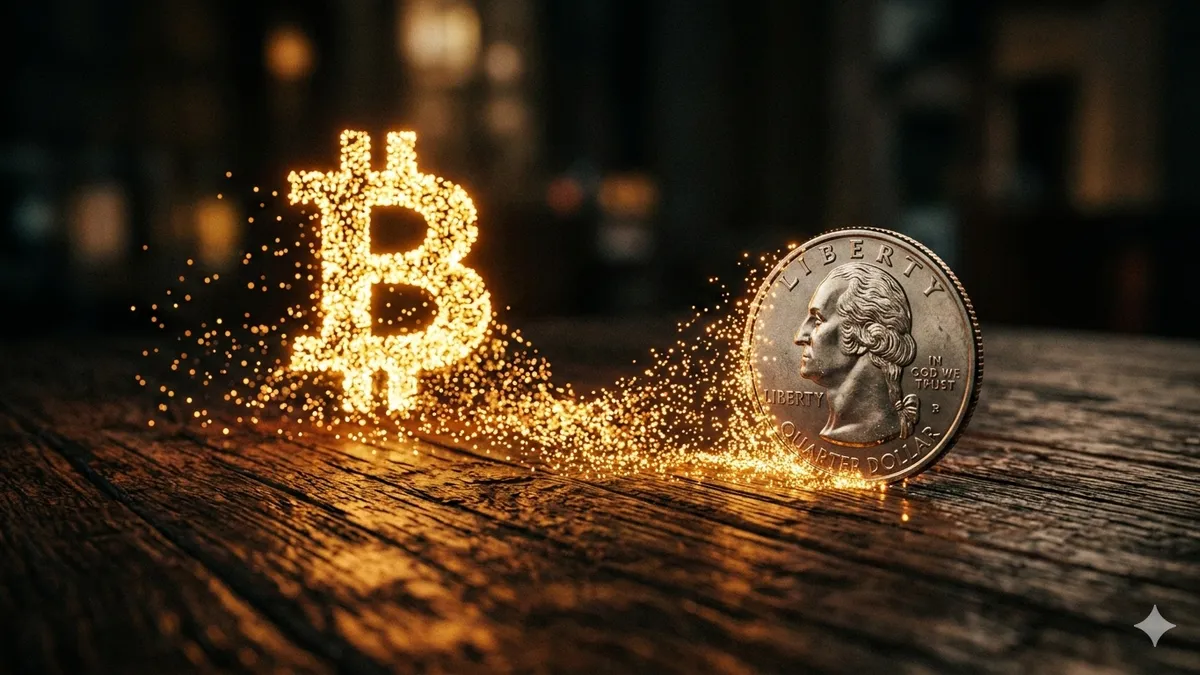
A satoshi (sat) is the smallest unit of Bitcoin: 0.00000001 BTC, or one hundred-millionth of a single coin. There are 100 million satoshis in one Bitcoin. At about $83,000 per Bitcoin (October 2026), one dollar buys approximately 1,205 satoshis. Cash App lets you buy as little as $1 and Strike advertises no minimums, so there is no whole-coin requirement.
The number one reason people don't buy Bitcoin? They think they can't afford it.
They see a price tag of $83,000 and assume that's the entry fee. Like buying a house. You either have the money or you don't.
That's wrong. And it's the most expensive misunderstanding in personal finance right now.
49% of Americans who don't own crypto say "lack of understanding" is the main reason they haven't started, according to a National Cryptocurrency Association / Harris Poll survey of 2,000 non-holders (2025). Nearly 90% of non-holders say they're "not knowledgeable" about how to buy or use crypto at all.
This article fixes that. In five minutes, you'll understand what a satoshi is, why it matters, and why $1 is enough to start.
A satoshi (sat) is the smallest unit of Bitcoin: 0.00000001 BTC. There are 100 million sats in one Bitcoin. At about $83,000/BTC, just $1 buys you roughly 1,205 sats. You don't need $83,000. You don't even need $100. Cash App lets you buy as little as $1 (Cash App), and Strike advertises recurring buys with no minimums (Strike). Most Bitcoin holders own fractions, not whole coins.
Read more: Bitcoin for Beginners | What Is a Bitcoin Wallet?
What Exactly Is a Satoshi?
A satoshi is the smallest piece of a Bitcoin. Named after Bitcoin's anonymous creator, Satoshi Nakamoto, it's the penny to Bitcoin's dollar. Except way smaller.
Here's the math:
- 1 Bitcoin = 100,000,000 satoshis
- 1 satoshi = 0.00000001 BTC
People in the Bitcoin world call them "sats" for short. When someone says "I'm stacking sats," they mean they're buying small amounts of Bitcoin regularly. Not whole coins. Fractions. Tiny pieces that add up over time.
Think of it like this: you don't need to buy the entire pizza to eat a slice. A satoshi is one hundred millionth of that pizza. And at today's prices, even a dollar buys you a pretty decent bite.
How Many Sats Does Your Money Buy?
This is where it gets real. At a Bitcoin price of roughly $83,000 (October 2026), here's what your everyday money buys in satoshis:
What Your Money Buys in Satoshis
At about $83,000 per Bitcoin (October 2026). 100,000,000 sats = 1 BTC.
Calculation: (dollar amount / $83,000) x 100,000,000 sats, using the CoinGecko price on October 10, 2026. Prices move daily.
The chart above isn't theoretical. That's what shows up in your app the second you hit the buy button. No minimums to clear, no broker to call, no round-lot weirdness like the stock market forces on you. Five bucks in, roughly 6,000 sats out. Done.
Most people look at the "$83,000 per Bitcoin" headline and check out before they even do the math. The math is the whole point. Break the coin into eight decimal places and suddenly a pocket of change owns a piece of the network.
This is the mental flip that takes the longest for new buyers. You stop counting dollars and start counting sats. Your brain gets used to balances like "47,300 sats" the same way it's used to "$47." It sounds weird at first. Then one day it doesn't.
~1,205 sats
What $1 buys you in Bitcoin at $83,000/BTC
Calculation: ($1 / $83,000) × 100,000,000
Read that chart again. Twenty bucks, the cost of a mediocre lunch, gets you about 24,000 sats. A hundred bucks gets you about 120,000 sats.
Those aren't rounding errors. They're real ownership of the scarcest asset in the world. And they add up fast when you invest consistently.
Here's the part that messes with people's heads: when Bitcoin's price drops, your dollars buy MORE sats. A crash isn't a disaster for someone stacking sats. It's a sale. At $41,500 per Bitcoin, half of today's price, that same $20 buys about 48,000 sats instead of 24,000. That's the power of dollar cost averaging into something denominated in sats, not dollars.
Why Do Most People Think They Need a Whole Coin?
It's called unit bias. Your brain looks at "$83,000 per Bitcoin" and immediately categorizes it as "too expensive." The same way you'd look at an $83,000 car and think, "I can't afford that."
But nobody told you that this "car" comes in pieces as small as one hundred millionth. That $1 gets you in the door. That you've been able to afford Bitcoin this whole time.
78% of Americans say they're uncomfortable investing in Bitcoin or other cryptocurrencies, according to Bankrate (2025). A Gallup poll of 2,017 adults found that 60% have no interest in buying crypto at all. Most of that discomfort comes from misunderstanding, not actual risk analysis.
The reality? Almost nobody owns a whole Bitcoin. About 970,000 addresses hold 1 BTC or more, roughly 1.6% of the nearly 60 million Bitcoin addresses that hold any balance at all, according to on-chain data from BitInfoCharts (October 2026). The other 98.4% hold fractions. Sats.
About 970,000 Bitcoin addresses hold 1 BTC or more, roughly 1.6% of all funded addresses (BitInfoCharts, October 2026). An address holding just 0.1 BTC is already ahead of more than 92% of funded addresses. Addresses are not people, since one person can have many and one exchange can hold coins for millions, but the pattern is clear. You don't need a whole coin. Almost nobody has one.
If you own any Bitcoin at all, even $5 worth, you're already ahead of 70% of American adults who own zero crypto (Security.org, 2026).

How Do You Actually Start Buying Sats?
Cash App lets you buy as little as $1 (Cash App), and Strike advertises recurring buys with no minimums (Strike). One dollar is enough.
Here's the ten-minute version:
- Download Strike or Cash App. Both work. Strike has lower fees for Bitcoin specifically. Follow our step-by-step guide for how to buy Bitcoin on Strike or how to buy Bitcoin on Cash App.
- Verify your identity. Standard stuff. Takes a few minutes with a photo ID.
- Link your bank account or debit card.
- Set a recurring buy. This is the key step. Don't buy once and forget about it. Set an automatic weekly purchase. $5. $10. $20. Whatever you can do without thinking about it.
- That's it. You're stacking sats.
The whole point is to make it automatic. You don't check the price. You don't time the market. You just let the money flow in, week after week, turning dollars into sats that add up over time.
Right now, at about $83,000 per Bitcoin, $20 buys you roughly 24,000 sats. That's a weekly DCA budget most people won't even miss. Download Strike or Cash App and set a $5 to $20 recurring buy. The whole setup takes 10 minutes. Shorter than reading this article.
Try it yourself: Use our DCA Calculator to see what your specific dollar amount turns into over time.
Two things the apps do not put on the buy button. Bitcoin held in an app is not a bank deposit: the FDIC lists crypto assets among the products it does not insure, and SIPC does not protect crypto that is not a registered security. If you would rather hold coins no company can freeze, that is what Bitcoin self-custody is for. And the IRS treats Bitcoin as property, so selling sats for more than you paid is a taxable gain.

The Power of Thinking in Sats
Here's a mental shift that changes everything. Stop thinking in Bitcoin. Start thinking in sats.
When Bitcoin costs $83,000, owning "0.0003 BTC" feels like nothing. It feels like you barely have any. But frame it as 30,000 sats and suddenly you can feel the weight of it. You own thirty thousand units of the scarcest money ever created.
This isn't just psychology. It's how the Bitcoin community actually talks. Nobody says "I bought 0.00015 BTC today." They say "I stacked 15,000 sats." It's cleaner. It's more tangible. And it makes small, consistent progress feel real.
Roughly 100 million people worldwide own Bitcoin, by one widely used estimate from Onramp (2026), though every count is rough because the blockchain records addresses, not people. Most of them are stacking sats, not buying whole coins. Most of them started small. If you start with $5 a week, you're joining a global movement, not sitting on the sidelines.
98.4%
Share of funded Bitcoin addresses holding less than one whole coin
BitInfoCharts, October 2026
And thinking in sats reframes market crashes entirely. When Bitcoin fell from about $126,000 in October 2025 to about $58,500 at the end of June 2026, the headlines screamed "CRASH." But a $20 weekly buy went from about 16,000 sats at the peak to about 34,000 sats at the low. Your purchasing power in sats went UP. If a drop like that has you wondering whether you missed it, read is it too late to buy Bitcoin.
How Many Sats Should You Own?
There's no magic number. But here's some perspective.
If you want to own a full Bitcoin someday, you need 100 million sats. At $20 a week, that's a long road. But nobody said you need a whole one. Here's what realistic stacking looks like:
| Weekly Investment | Sats per Week (at ~$83K) | Sats per Year | Years to 1 Million Sats |
|---|---|---|---|
| $5 | ~6,024 | ~313,253 | ~3.2 years |
| $10 | ~12,048 | ~626,506 | ~1.6 years |
| $20 | ~24,096 | ~1,253,012 | ~0.8 years |
| $50 | ~60,241 | ~3,132,530 | ~0.3 years |
The table assumes 52 weekly buys a year at a constant $83,000 price; real prices move every week. A million sats. At today's prices, that's about $830 worth of Bitcoin. Doesn't sound like much. But if Bitcoin reaches $200,000 (which it's done percentages of before from lower bases), a million sats would be worth $2,000. At $500,000, it's $5,000. The sats you stack today lock in your position for whatever comes next.
At about $83,000 per Bitcoin, investing just $20 a week stacks roughly 24,096 satoshis per week, reaching 1 million sats in about 42 weeks, under ten months. At $10 a week, you'd hit that milestone in roughly 19 months. Cash App lets you start at $1 and Strike advertises no minimums (Strike). There is no barrier to entry.
The point isn't to hit a specific number. It's to start. Every sat you buy today is one you didn't have yesterday. And unlike the dollars in your savings account, sats can't be inflated away. There will only ever be 2.1 quadrillion of them. Once they're claimed, they're claimed.
A million sats used to sound like a meaningless number. Then people started hitting the milestone on weekly $20 buys and realized it was the first real savings goal they'd ever crossed without a 401(k) match doing the heavy lifting. A sat at a time still counts as saving. It just looks different than what the old system trained you to expect.
The barrier was never the price of a coin. The barrier was the story in your head that said you needed to afford the whole thing before you could start. You don't. Nobody does.
The satoshi is the unit that makes Bitcoin accessible. That wasn't an accident. Whoever wrote the original protocol built in room for a world where one coin might someday be worth more than most people earn in a year, and still made sure the thing was usable by people holding pocket change. That design choice is worth more than any marketing campaign the crypto industry could dream up.
Most people think they can't afford Bitcoin. You just learned otherwise.
Learn to redirect small money into real wealth.
Sats vs. Dollars: A Quick Comparison
| U.S. Dollar | Satoshi | |
|---|---|---|
| Smallest unit | 1 cent ($0.01) | 1 sat (0.00000001 BTC) |
| Units in the whole | 100 cents = $1 | 100,000,000 sats = 1 BTC |
| Total supply | Unlimited (Fed prints more) | 2,100,000,000,000,000 (2.1 quadrillion, fixed forever) |
| Inflation | 3.4% over the year to August 2026 (BLS) | ~0.8% and decreasing (post-halving) |
| Can be diluted? | Yes, constantly | No, impossible |
| Minimum to buy | N/A | $1 on Cash App; no minimum on Strike |
That last row is the whole game. The dollar loses value every year because the government prints more. Sats can't be printed. The code won't allow it. When you stack sats, you're moving your money from a system designed to shrink your purchasing power into one designed to protect it.
Frequently Asked Questions
At a Bitcoin price of about $83,000, one satoshi is worth about $0.00083, or roughly 0.08 cents. That's less than a thousandth of a dollar. But satoshis are meant to be accumulated in bulk. At $20 a week, you stack roughly 24,000 sats. Over a year, that's about 1.25 million sats. Small units, real ownership.
Exactly 100,000,000 (one hundred million). This is hardcoded into the Bitcoin protocol and cannot be changed. It's like how 100 cents make a dollar, except Bitcoin is divisible to eight decimal places instead of two. This extreme divisibility is what makes fractional ownership possible.
Yes. The Lightning Network processed $1.17 billion in transactions in November 2025 alone, with an average transaction size of just $223, according to Bitcoin Magazine. Lightning makes sending small amounts of sats fast and nearly free. You can tip someone 100 sats or pay for a coffee with sats. It works.
No. Any Bitcoin wallet holds satoshis automatically. When you buy $10 of Bitcoin on Strike or Cash App at about $83,000 per coin, your wallet shows the balance in BTC (like 0.00012048) or in sats (12,048 sats), depending on your settings. Many apps now let you toggle the display to sats, which makes tracking small amounts much easier.
Yes. About 98.4% of funded Bitcoin addresses hold less than 1 BTC (BitInfoCharts, October 2026). Almost everyone in Bitcoin owns fractions. The power isn't in the size of any single purchase. It's in the consistency. $20 a week for three years builds a meaningful position. $100 a month does even more. Starting small and staying consistent beats waiting until you "have enough."
Next steps: Run your numbers with our DCA Calculator. New to Bitcoin? Start with Bitcoin for Beginners. Already understand the basics? Learn how to buy your first sats on Strike. And if you're wondering why any of this matters, read Your Money Is Losing Value.
This article is part of the Small Steps, Real Results series on Untaught. You don't need a fortune to start building one. You just need to start.
This article is for educational purposes only and does not constitute financial advice. Untaught does not hold, move, or custody any funds. Past performance does not guarantee future results. Always do your own research before making investment decisions.
Quick calculator
Your coffee money could have become
$19,233
from $9,900 invested
Monthly buys, Oct 2021 to Sep 2026, at Coin Metrics month-end closes. Past results, not a forecast.