The Bitcoin Cheatsheet: Everything You Need to Know in Plain English
30% of American adults own crypto but most can't explain it. This is the one-page Bitcoin reference guide you'll actually understand.
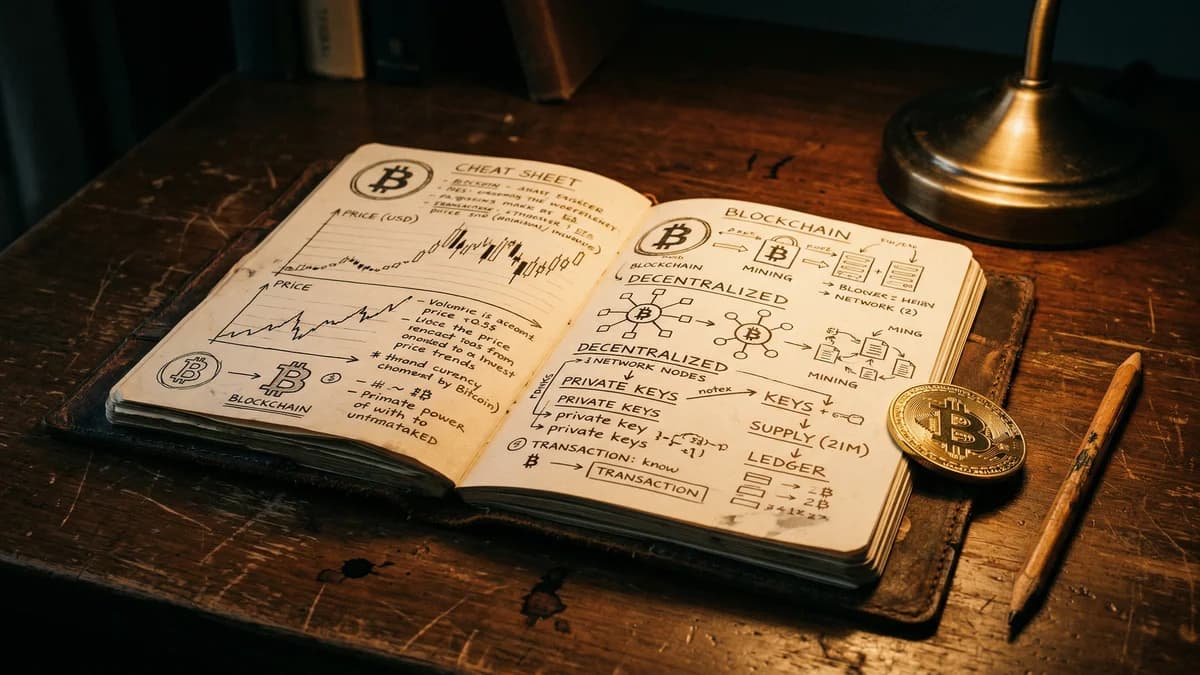
Bitcoin is a digital currency with a fixed maximum supply of 21 million coins. No government or company controls it. About 19.8 million coins have already been mined, with 3 to 4 million permanently lost. Roughly 30% of American adults own cryptocurrency, and the minimum purchase on apps like Strike or Cash App is $1.
You've heard about Bitcoin a thousand times. At dinner. On the news. From the guy at work who keeps checking his phone.
But here's the part nobody mentions: most people who talk about Bitcoin can't actually explain it. Not clearly. Not without drowning you in jargon.
Thirty percent of American adults own cryptocurrency, according to Security.org (2026). Most of them couldn't tell you how it works if you asked.
That's not their fault. Nobody taught them either.
This is the cheatsheet that fixes that. One article. Plain English. Every essential fact about Bitcoin, from what it is to how to buy it, stripped of the hype, the jargon, and the weird internet culture.
Bookmark it. Come back to it. Share it with someone who keeps asking "what even IS Bitcoin?"
Bitcoin is digital money with a hard cap of 21 million coins. Nobody can print more. 30% of American adults already own crypto (Security.org, 2026). You can start buying with as little as $1 through apps like Strike or Cash App. This is your one-page reference for everything you need to know, in language you'll actually understand.
What Is Bitcoin? (The 30-Second Version)
Bitcoin is digital money. No coins. No bills. Just a record on a global computer network that tracks who owns what.
Three things make it different from the dollars in your bank:
- Nobody controls it. No company. No CEO. No government. It runs on a network of computers spread across the world.
- The supply is fixed. Only 21 million Bitcoin will ever exist. Nobody can print more. Compare that to the dollar, where the Federal Reserve created trillions out of thin air between 2020 and 2022.
- You can send it to anyone, anywhere. No bank approval. No wire transfer fees. No waiting three business days.
Bitcoin runs on something called a blockchain. Fancy word, simple idea: it's a public ledger that records every transaction ever made. Think of it like a shared spreadsheet the whole world can read, but nobody can edit or cheat on.
It was created in 2009 by someone using the name Satoshi Nakamoto. Nobody knows who they are. That sounds weird, but it's actually the point. Bitcoin doesn't need a leader. It runs on code and math, not trust.
Read more: Bitcoin for Beginners: the full story | What Is Fiat Currency?
Why Should You Care?
Because your money is shrinking while you sleep.
~40%
How much purchasing power the U.S. dollar has lost since 2005
Bureau of Labor Statistics CPI data
The dollar's inflation rate sits around 2.8% per year. That means every dollar you hold buys less tomorrow than it does today. Your savings account isn't saving anything. It's slowly bleeding value.
Bitcoin's inflation rate? About 0.8% per year after the April 2024 halving, according to EZ Blockchain (2025). And that rate keeps dropping every four years until it hits zero.
The government can print unlimited dollars. Nobody can print more Bitcoin. That's the fundamental difference. And it's why people are choosing to move even a small slice of their money into something with a hard cap on supply.
This doesn't mean Bitcoin is a guaranteed win. It's volatile. It crashes hard. But if you understand that your purchasing power is being drained year after year, you start to see why a fixed-supply asset gets people's attention.
Bitcoin by the Numbers
Here's your quick-reference card. Pin this to the fridge.
| Fact | Number | Source |
|---|---|---|
| Maximum supply | 21 million BTC | Bitcoin protocol |
| Already mined | ~19.8 million (~94%) | DemandSage, 2026 |
| Lost forever | ~3-4 million BTC | Chainalysis |
| Effectively available | ~16 million BTC | Calculated (mined minus lost) |
| All-time high price | ~$126,000 (Oct 2025) | CoinDesk |
| Americans who own crypto | 30% (70.4 million) | Security.org, 2026 |
| Smallest unit (satoshi) | 0.00000001 BTC | Bitcoin protocol |
| Bitcoin ETF assets | ~$85 billion | CoinDesk, 2026 |
| Bitcoin's inflation rate | ~0.8% per year | Post-2024 halving calculation |
| Hash rate (security) | ~984 EH/s (record) | CoinWarz, 2026 |
| Sustainable mining energy | 52.4% | Cambridge University, 2025 |
| Lightning Network volume | $1.17B (Nov 2025) | Bitcoin Magazine |
19.8 million
Bitcoin already mined out of 21 million. Over 3 million are permanently lost.
DemandSage / Chainalysis
That last stat matters more than most people realize. Of the 21 million Bitcoin that will ever exist, nearly 20 million have already been mined. And somewhere between 3 and 4 million are permanently gone. People lost their private keys. Threw away hard drives. Died without passing along access.
The real supply on the market? Closer to 16 million. When something is both scarce and getting scarcer, that's when things get interesting.
Compare that to the dollar. Every time the government decides the economy needs a boost, more dollars get printed into existence. Nobody is calling up ATM owners to ask permission. The total supply just expands, and every dollar in your wallet quietly owns a smaller slice of the pie.
Bitcoin was designed to do the opposite. The rules are written in code that has never been changed. The cap is real, the scarcity is real, and the lost coins are not coming back. That is why long-term holders keep buying through every crash.
Bitcoin Supply Breakdown: 21 Million Total
Not all Bitcoin is available. Millions are lost forever.
Sources: DemandSage, Chainalysis, Bitcoin protocol. Estimates as of Feb 2026.
How Do You Actually Buy Bitcoin?
The biggest misconception: you need to buy a whole Bitcoin. You don't.
One Bitcoin costs tens of thousands of dollars. But you don't buy a whole one. You buy a fraction. The smallest unit is called a satoshi (or "sat"), and there are 100 million of them in a single Bitcoin. At today's prices, $20 gets you roughly 20,000 to 30,000 sats.
They add up.
Here are three ways normal people buy Bitcoin:
Apps (Easiest for Beginners)
Strike and Cash App are the simplest options. Download the app. Verify your identity. Link your bank account. Set up a recurring buy for $5, $10, or $20 a week. Done. The whole setup takes about 10 minutes.
Bitcoin ETFs (Through Your Brokerage)
Already have a brokerage account with Fidelity, Schwab, or Vanguard? You can buy spot Bitcoin ETFs. These are funds that hold real Bitcoin on your behalf. BlackRock's IBIT alone holds over $61 billion in Bitcoin, according to CoinDesk (2025). You buy shares like any stock. No crypto apps needed.
$85 billion
Total assets held in U.S. spot Bitcoin ETFs as of February 2026
CoinDesk
Peer-to-Peer
You can buy Bitcoin directly from another person. But this is more advanced and not recommended for beginners. Stick with regulated apps or ETFs when you're starting out.
Pick one path and stop researching. The most common way to never start is to keep reading "best exchange" comparisons for six months. An app takes ten minutes to set up. An ETF takes less time than that if you already have a brokerage. Neither requires a PhD. Neither requires you to get fancy. Start small, start this week, and you are already ahead of most of the country.
You don't need to pick the "best" option. Pick the one you'll actually use. For most beginners, Strike or Cash App is the simplest path. Download one right now and set up a $5 weekly buy.
What Is DCA and Why Does It Work?
DCA stands for dollar cost averaging. It means buying a fixed dollar amount on a regular schedule, regardless of price.
Why does this matter for Bitcoin? Because Bitcoin is volatile. It can drop 30% in a month. That scares people off. It's why most beginners buy once, watch the price crash, panic, and sell at a loss.
DCA removes the whole question of timing. When the price is high, your $20 buys fewer sats. When the price drops, your $20 buys more sats. Over time, you end up with a solid average cost. No charts to read. No predictions to make.
Here's the spending redirect that makes it painless: take the $6 daily coffee, the forgotten subscriptions, or the lottery tickets you're already buying. Redirect that money. $20 a week is $1,040 a year. You won't miss it. But in five or ten years, you'll feel the difference.
Every single person in Bitcoin's history who started DCA at what felt like "the top" and kept going is in profit today. Every one. Read the full breakdown in Is It Too Late to Buy Bitcoin?
Read more: What Is Dollar Cost Averaging? | DCA Calculator
This is what school should have taught you.
Join thousands learning how to protect their purchasing power. One email, no spam, just the stuff nobody else will tell you.
5 Bitcoin Myths That Won't Die
You'll hear these from friends, family, and talking heads on TV. Here's what the data actually says.
Myth 1: "It's Too Late to Buy"
People said this at $1,000, $10,000, $20,000, and $100,000. At every price point, someone who started buying $20 a week and kept going ended up profitable. The math doesn't care about feelings. Read the full breakdown.
Myth 2: "It's Only for Tech People"
30% of American adults own crypto. 74% of those own Bitcoin specifically (Security.org, 2026). That's roughly 52 million Bitcoin owners in the U.S. alone. These aren't all tech workers. They're nurses, teachers, truck drivers, and retirees who decided to learn something new.
Myth 3: "It Uses Too Much Energy"
52.4% of Bitcoin mining energy now comes from sustainable sources, up from 37.6% in 2022. Coal's share dropped from 36.6% to 8.9% in the same period, according to the Cambridge Centre for Alternative Finance (2025). Bitcoin's energy mix is cleaner than most countries' power grids. Is it perfect? No. Is it improving fast? Yes.
Bitcoin Mining Energy Mix: 2022 vs 2025
Sustainable sources now power over half of Bitcoin mining
Source: Cambridge Centre for Alternative Finance (CCAF), Cambridge Judge Business School, 2025
Myth 4: "It's Not Real Money"
The Lightning Network processed $1.17 billion in transactions in November 2025 alone, according to Bitcoin Magazine. That's 5.22 million transactions in a single month. People are buying groceries, paying bills, and sending money across borders with Bitcoin every day. "Real money" does whatever people agree to use it for. Increasingly, people are agreeing on Bitcoin.
Myth 5: "The Government Will Ban It"
The U.S. government approved spot Bitcoin ETFs in January 2024. Wall Street's biggest firms, including BlackRock, Fidelity, and Invesco, now offer them. Those ETFs have pulled in $57 billion in cumulative net inflows (CoinDesk, 2026). When the world's largest asset managers are building Bitcoin products, the "they'll ban it" argument doesn't hold up.
Notice a pattern? Most Bitcoin myths come from outdated information. The energy argument uses 2021 data. The "too late" argument ignores DCA. The "ban it" argument ignores that Wall Street is now all in. The facts changed. The myths didn't.
The Bitcoin Glossary
Keep this handy. These are the only terms you actually need to know.
Satoshi (sat): The smallest unit of Bitcoin. There are 100 million sats in one Bitcoin. Named after Bitcoin's creator. When you buy $5 of Bitcoin, you're buying sats.
Wallet: Where you store your Bitcoin. Can be an app on your phone (hot wallet) or a physical device (cold wallet). The app where you buy Bitcoin usually has a built-in wallet.
Private key: A long string of numbers that proves you own your Bitcoin. If someone else gets it, they can take your coins. If you lose it, your coins are gone forever.
Seed phrase: A set of 12 or 24 random words that backs up your private key. Write it on paper. Store it somewhere safe. Never type it into a website. Never share it with anyone. Ever.
Blockchain: The public ledger that records every Bitcoin transaction. Maintained by thousands of computers worldwide. Nobody owns it. Everybody can read it.
Mining: Using computers to verify Bitcoin transactions and add them to the blockchain. Miners get rewarded with new Bitcoin. This is how new coins enter circulation.
Halving: Every four years, the mining reward gets cut in half. The last one happened in April 2024, dropping the reward from 6.25 to 3.125 BTC per block. This is what makes Bitcoin's inflation rate shrink over time.
Hash rate: The total computing power securing the Bitcoin network. Higher means more secure. As of 2026, it's at an all-time high of ~984 EH/s (CoinWarz).
Lightning Network: A layer built on top of Bitcoin that makes small transactions fast and cheap. Think of Bitcoin as the highway and Lightning as the express lane.
DCA (Dollar Cost Averaging): Buying a fixed amount on a regular schedule, like $20 every week. Removes the need to time the market. Full guide here.
HODL: Internet slang for "hold." Started as a typo on a Bitcoin forum in 2013 and stuck. Means buying and holding for the long term instead of panic-selling.
ATH (All-Time High): The highest price Bitcoin has ever reached. As of this writing, that's approximately $126,000 in October 2025.
Market cap: The total value of all Bitcoin in circulation. Price times coins in existence. Ranges between $1 and $2 trillion depending on market conditions.
Cold storage: Keeping your Bitcoin offline on a hardware wallet. Most secure way to hold long-term. Not necessary for beginners, but important as your stack grows.
Self-custody: Holding your own Bitcoin instead of leaving it on an app or exchange. You control the keys. Nobody can freeze your account. More responsibility, more control.

Most of these terms will feel foreign on day one. By month three, they will sound normal. That is the point of starting small: the vocabulary sneaks up on you while the habit does the real work. You do not need to memorize the glossary. You just need to know enough to not get scammed and to keep stacking.
One rule solves most of it: never share your seed phrase with anyone, ever. Not customer support. Not a "verification" email. Not a stranger in a Discord. If someone asks for it, they are trying to steal from you. Write it down on paper, store it somewhere safe, and forget it exists until you actually need it.
Frequently Asked Questions
Your Next Move
This cheatsheet gave you the foundation. Every term, every number, every myth debunked. You know more about Bitcoin right now than most people who own it.
But knowledge without action is just trivia.
If you're ready to start, the path is simple: download Strike or Cash App, set up a $5 to $20 weekly recurring buy, and stop overthinking it. Use our DCA Calculator to see what your specific numbers look like over time.
Want to go deeper first? Start with Bitcoin for Beginners. Then read Is It Too Late to Buy Bitcoin? for the full historical DCA breakdown. For the bigger picture of why any of this matters, explore Your Money Is Losing Value.
The system was never going to teach you this. That's why we built Untaught.
Bookmark this page. Share it with one person who keeps asking about Bitcoin. Then go set up your first recurring buy. The whole thing takes 10 minutes. That's less time than you spent reading this article.
This article is part of the Small Steps, Real Results series on Untaught, where we break down simple, practical ways to build a better financial future with the money you already have.
Bitcoin is a volatile asset. Its price can and does drop significantly. Nothing in this article is financial advice. We don't hold, move, or manage your money. Do your own research. Only invest what you can afford to lose.
This article is for educational purposes only and does not constitute financial advice. Untaught does not hold, move, or custody any funds. Past performance does not guarantee future results. Always do your own research before making investment decisions.
Quick calculator
Your coffee money could have become
$16,301
from $9,900 invested