How Money Actually Works (What They Left Out of the Textbook)
US adults get only 49% of basic money questions right. Here's how money actually works, from creation to inflation, in plain English the textbook skipped.

You can probably explain how a car engine works better than you can explain how a dollar works. You burn fuel, it moves pistons, the wheels turn. Most people can sketch that. Now try the dollar. Where did it come from? What gives it value? Why does it buy less every year? You use dollars every single day, and almost nobody can answer those questions.
That is not because you are not smart enough. It is because nobody taught you. In 2025, US adults answered only 49 percent of basic personal finance questions correctly, the same as in 2017, according to the TIAA Institute-GFLEC Personal Finance Index. Eight years, zero progress. The most-used tool in your life is the one you understand the least.
School handed you a cartoon of the money system. Money is printed by the government, it said, and backed by gold in a vault somewhere. Both of those are basically false. This is the honest map: what money actually is, where it really comes from, why it keeps losing value, who that benefits, and what a normal person can do once they can see the whole board.
Money is not backed by gold and mostly is not printed by the government. About 92 percent of US bank deposits were created by commercial banks out of nothing when they made loans (Philadelphia Fed), and the M2 money supply has grown from about $4.9 trillion at the end of 2000 to $23.34 trillion in August 2026 (Federal Reserve H.6). The Federal Reserve openly targets about 2 percent inflation per year, which means the dollar is designed to lose value on purpose. Understanding the machine is step one. Redirecting some of your savings out of a unit built to depreciate is step two.
Read more: Where Does Money Come From? | What Is Fiat Currency? | Why Financial Literacy Isn't Taught
What Is Money, Really?
Money is anything widely accepted as payment, and economists grade it on three jobs it has to do. It has to be a medium of exchange, meaning you can spend it. It has to be a unit of account, meaning you can price things in it. And it has to be a store of value, meaning it should hold its worth over time. The US dollar nails the first two. It is engineered to fail the third.
That last part is not an accident or a flaw. The Federal Reserve openly targets inflation of about 2 percent per year. In plain terms, the institution in charge of the dollar has a public goal of making your dollar buy a little less every year, forever. A medium of exchange that is built to slowly leak value is a strange kind of money to save in, and yet it is the only kind most people are ever handed.
There is also more than one type of money, which trips people up. Commodity money is something with value of its own, like gold or silver coins. Representative money is paper you can redeem for that commodity. Fiat money, today's dollar, has value only because the government says it does. And commercial bank money, the digital balance in your checking account, is just a number a bank owes you. That last category is most of the money that exists. If you want the full breakdown of the decree-backed kind, fiat money has its own guide.
49%
Share of basic personal finance questions the average US adult answered correctly in 2025, unchanged since 2017
TIAA Institute-GFLEC Personal Finance Index 2025
So the textbook definition of money quietly fails the textbook's own test. The dollar is a great way to buy a sandwich today and a guaranteed way to lose ground over a decade. Keep that contradiction in your head. It explains almost everything that follows.
Where Do Dollars Actually Come From?
Most money is not printed by the government. About 92 percent of the deposits in the US banking system were created by banks' own lending, according to a Philadelphia Fed analysis averaging the years 2001 through 2020. The Bank of England put it bluntly in a 2014 paper: "Whenever a bank makes a loan, it simultaneously creates a matching deposit in the borrower's bank account, thereby creating new money."
Here is what that means in practice. You take out a $300,000 mortgage. You probably assume the bank is lending you someone else's savings. It is not. The bank types two numbers into a computer. It records a $300,000 loan as an asset, because you owe it, and a $300,000 deposit as a liability, because that money now sits in the seller's account. That deposit did not exist three seconds earlier. The loan did not move money from a vault. It conjured the money into being.
Pull up your banking app right now. The number you see is not cash sitting in a drawer with your name on it. It is a promise, a liability your bank owes you, and most of it began life as somebody else's loan. The whole system runs on entries in databases, not stacks of bills. The full mechanics, including why the Federal Reserve quietly killed the reserve requirement in March 2020, are laid out in where money actually comes from.

Does that mean the government has nothing to do with it? Not quite. There are two machines making money, and they work in very different ways.
The Two Machines: Banks and the Fed
There are two creators of US dollars, and confusing them is exactly the mistake the textbook teaches. The Federal Reserve issues physical cash and bank reserves. In August 2026, currency in circulation was about $2.48 trillion and banks' reserve balances at the Fed were about $2.94 trillion, per the Fed's H.6 release. Reserves stay inside the banking system and are not counted in the $23.34 trillion M2 money supply. Of that M2, cash in the public's hands is about $2.39 trillion. Bank deposits are about $19.1 trillion, and retail money market funds make up most of the rest. Cash is the small slice. Bank-created digits are the ocean.
The Fed's tools are the ones that make the news. It sets interest rates. It buys bonds in bulk, a process called quantitative easing, which is the closest thing to the "printing" people imagine. When you hear that the Fed "injected liquidity," that is the central bank creating new reserves and using them to buy assets. That side of the story has its own guide in how the government prints money.
But the larger, quieter engine is ordinary lending. Every car loan, every credit card swipe, every business line of credit, every mortgage is a new deposit created from nothing. Multiply that across every bank in the country and you get the real source of most of the dollars you have ever touched. The Fed sets the conditions. The banks do the volume.
Where U.S. Bank Deposits Actually Come From
Share of U.S. bank deposits that began as a bank loan, average 2001 to 2020. Most money is created when banks lend.
Source: Federal Reserve Bank of Philadelphia, “How Banks Use Loans to Create Liquidity” (June 2023), average of 2001 to 2020.
Two machines, one result: the supply of dollars goes up. And when the supply of anything goes up while demand holds steady, the price of each unit falls. For money, "price" means what it can buy. Which brings us to the part you feel in your wallet.
Why Does Money Keep Losing Value?
Money loses value because the supply keeps growing faster than the amount of stuff there is to buy. The US M2 money supply grew from about $4.9 trillion at the end of 2000 to $23.34 trillion in August 2026, per the Federal Reserve H.6 release. That is nearly a fivefold increase in under 26 years. More dollars chasing the same goods means each dollar buys less. It is not complicated, and it is not a glitch. It is the predictable result of the two machines above running for decades.
The clearest way to feel it: a single dollar from 1971 buys about 12 cents of goods today, according to Bureau of Labor Statistics consumer price data (1971 average CPI-U versus August 2026). Your grandparents' dollar and your dollar are the same green paper with the same number on it, but one of them does roughly eight times the work. The dollar did not shrink because products got fancier. It shrank because there are vastly more dollars now.
The biggest single burst happened recently. M2 grew at a year-over-year rate of 26.9 percent in February 2021, a pace the St. Louis Fed notes easily exceeds the money growth of either the 2008 financial crisis response or the inflation of the 1970s and 1980s. A lot of people noticed prices jump in 2022 and blamed "greedy companies" or "supply chains." Those played a part. But the deeper cause was simpler. The money supply exploded, and prices caught up.
U.S. Money Supply (M2): 60 Years of Growth, Then an Explosion
Total dollars in circulation, in trillions. December readings 1960 to 2025, plus February 2020, the March 2022 peak and August 2026.
Source: Federal Reserve, M2 Money Stock, seasonally adjusted (FRED series M2SL), through August 2026.
This is also why the official inflation number and your lived experience rarely match. The headline rate is an average across a basket of goods, while your reality is rent, groceries, and insurance, which have run hotter. The gap between them is covered in the real inflation rate, and the slow bleed it inflicts on cash is the whole point of your savings account losing money.
Who Actually Benefits When New Money Is Made?
New money does not land in everyone's wallet at the same moment. It enters the economy at specific points, near banks, large institutions, and people who already own assets, and it works outward from there. Whoever gets the new money first can spend it before prices rise. Whoever gets it last spends it after prices have already moved. That timing gap is the entire game, and you are almost certainly standing at the wrong end of it.
This is not a conspiracy theory. It has a name. The 18th-century economist Richard Cantillon described it nearly 300 years ago, and economists still call it the Cantillon Effect. The person closest to freshly created money buys assets at yesterday's prices. By the time that money reaches a wage earner six months or two years later, the grocery bill, the rent, and the used car all cost more. The early receiver is sitting on a gain. The late receiver is treading water in dollars that buy less.
If you have ever wondered why the stock market and home prices keep climbing while it gets harder to buy groceries on a normal paycheck, this is most of the answer. New money flows into assets first, because that is where the people nearest to it park their capital. Everyone holding plain cash is diluted to pay for it. This is the mechanical version of how the system profits from your financial ignorance: the less you understand the timing, the longer you stay at the back of the line.
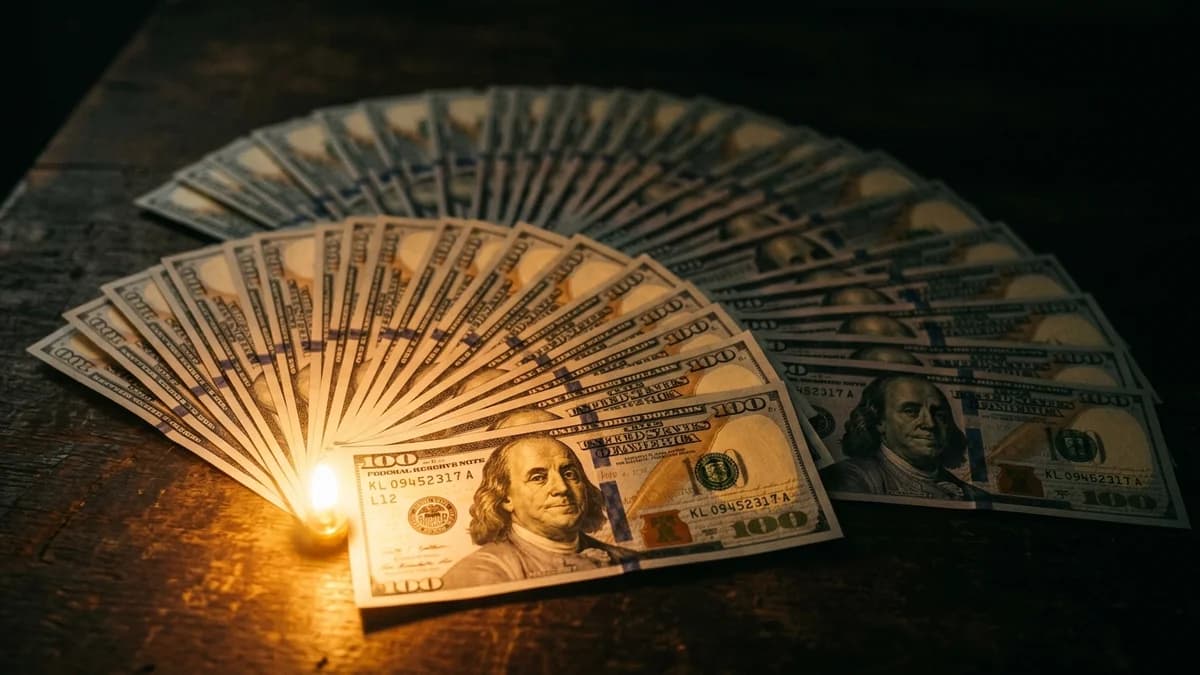
You never got a vote on how many dollars exist. The reserve requirement was set to zero in 2020 without your input. The 2 percent inflation target was chosen by economists you have never met. You just hold the currency you are paid in and absorb the cost. That is not a flaw in your character. It is the design of the system.
The Whole System in One Picture
Put the pieces together and the map is simple, even if no one ever draws it for you. The Fed and the banks create money, mostly through lending. The supply grows year after year. As it grows, each dollar buys less, which is inflation. The people nearest the new money capture the gains before prices rise, while wage earners and savers absorb the loss after. Anyone holding their long-term wealth in cash is on the losing side of a process that runs every single day, on purpose.
That is the machine. It is not evil and it is not hidden. The figures are published by the Federal Reserve, the Philadelphia Fed, and the Bureau of Labor Statistics, and they have been online for years. They are simply never assembled in one place and explained in plain English, because once you see them together, the picture is uncomfortable.
You did not get a vote on how much money exists, and you pay the price every time more is made. The one response that needs no permission from the system is to stop holding all of your future in a unit designed to lose value, and to redirect a little of it into something that cannot be diluted by a loan officer typing two numbers into a database.
Knowing the map does not change the map. But it changes where you choose to stand on it.
What Does This Mean for Your Money?
If the currency you save in is designed to lose roughly 2 percent or more of its value every year, then holding all of your long-term wealth in cash is a slow, guaranteed leak. You cannot vote the reserve requirement back into existence. You cannot opt out of dollars at the grocery store. What you can do is stop treating cash as a safe place to park your future, when the math guarantees it is the opposite.
Here is what that leak does to $10,000 kept in cash that earns nothing, at the Fed's own 2 percent target and at the 3.4 percent prices actually rose over the twelve months through August 2026:
| Years held in cash | Buying power at 2% a year (the Fed's target) | Buying power at 3.4% a year (the latest 12 months) |
|---|---|---|
| 10 | $8,203 | $7,158 |
| 20 | $6,730 | $5,124 |
| 30 | $5,521 | $3,668 |
Untaught calculation: $10,000 divided by (1 + inflation rate) raised to the number of years. Rates: Federal Reserve 2 percent longer-run goal; BLS CPI-U, August 2025 to August 2026.
Hitting the target exactly, for thirty years, still costs you almost half.
To be clear, cash is not the enemy. You still need an emergency fund you can reach in a day, and bills get paid in dollars. For what really happens to that cash in a downturn, see cash during a recession. The point is not to dump every dollar you own. The point is that the slice meant to grow over years should not sit in the one asset that is structurally promised to shrink.
Here is the structural contrast that makes Bitcoin interesting to people who are not crypto enthusiasts. Bitcoin has a fixed supply of 21 million coins, enforced by software, not by a Fed press release. No bank can create a new bitcoin by typing two numbers into a database. A fiat system assumes humans will show restraint with the money printer. A hard-capped system does not need them to. That is the whole pitch, and you can learn the basics in Bitcoin for beginners without buying anything.
You do not need to bet your future on it or time the market. The simplest approach is dollar-cost averaging, buying a small fixed amount on a schedule, and you can find the money to do it by redirecting spending you will not miss, as in how to start investing with no money. Run the numbers yourself with the DCA calculator. Even $20 a week out of the leak is a different position than $20 left in it.
They print. You pay.
Learn how the system actually works and what to do about it.
Frequently Asked Questions
These are the questions people ask first when they start pulling on this thread. None of them are dumb questions. They are the questions a system this opaque was always going to leave you with.
Money works as a shared agreement. It has value because everyone accepts it for goods, debts, and taxes, not because it is backed by gold. Today's dollar is backed only by government decree and trust. Most of it is digital money that commercial banks create when they make loans, not cash printed by the government.
Commodity money has intrinsic value, like gold or silver coins. Representative money is paper redeemable for a commodity. Fiat money is valuable only because a government says so, which describes today's dollar. Commercial bank money is the digital deposits in checking and savings accounts, and it makes up most of the modern money supply.
Nothing physical. Since 1971, the dollar has been backed only by "the full faith and credit of the US government," which in practice means the government's power to tax its citizens and enforce payment. It is not redeemable for gold, silver, or any other commodity. Its value rests entirely on collective trust and law.
Commercial banks, not the government. The Philadelphia Fed estimates that about 92 percent of US deposit money originated from bank lending on average between 2001 and 2020. The Federal Reserve issues physical cash and bank reserves, but of the $23.34 trillion M2 money supply (August 2026), cash in the public's hands is only about $2.39 trillion. Most of the rest is digital deposits banks created by issuing loans.
Because the money supply grows faster than the economy produces goods. More dollars chasing the same stuff means each dollar buys less, which is inflation. A 1971 dollar buys about 12 cents of goods today, per Bureau of Labor Statistics data. The Federal Reserve openly targets about 2 percent inflation per year, so the erosion is by design.
The mechanics above are not secret. They sit in published central bank papers and government statistics, hidden in plain sight by boredom and bureaucratic language. Most people are paid in money created by banks, taxed in money created by banks, and will retire on money created by banks, and almost none of them were ever told how the thing works. You now have the map. What you do with it is the only part the system cannot decide for you.
If you want the deeper pieces, where money comes from and how the government prints money cover the two machines in full. Your money is losing value is the hub for the purchasing power problem, and small steps, real results is the answer to "okay, so what do I actually do."
This article is part of the Nobody Taught You This series. The way money works is not a conspiracy. It is a published system most people were simply never walked through. Once you see the whole machine, you cannot unsee it.
This article is for educational purposes only and does not constitute financial advice. Untaught does not hold, move, or custody any funds. Past performance does not guarantee future results. Always do your own research before making investment decisions.
Quick calculator
Your coffee money could have become
$19,233
from $9,900 invested
Monthly buys, Oct 2021 to Sep 2026, at Coin Metrics month-end closes. Past results, not a forecast.