How to Teach Kids About Money When Nobody Taught You
Teach kids about money by age, even if nobody taught you: what the CFPB says forms at 3, 6 and 13, scripts to use, and what $5 a week becomes.

To teach kids about money, match the lesson to the age. From 3 to 5, teach waiting, because the CFPB says the ability to plan and delay a reward grows dramatically in the first five years. From 6 to 12, give them real money to manage and let them make small mistakes, because that is when money habits form, mostly from you, by watching and by being told. From 13 on, hand over real decisions: a paycheck, an account, a bill. You do not need to be good with money to do any of this. You need to be honest about what you were never taught, and to start earlier than school will.
That last part matters more than any script. Most parents reading this were never taught money at home or at school, which is the whole reason this site exists. The good news is that the earliest lessons are not about money knowledge at all. A four-year-old does not need to understand interest. They need to practice waiting for something they want. You can teach that tonight.
The Consumer Financial Protection Bureau's 2016 research model splits money learning into three overlapping stages: executive function at ages 3 to 5, money habits and norms at 6 to 12, and financial knowledge and real decisions at 13 to 21. The CFPB says parents are "typically the primary agents of financial socialization" through elementary and middle school, which means children learn money mostly from the adults at home, both by watching them and by being taught. The lessons that matter most early on are waiting, choosing and making small mistakes with real money. On the math side, $5 a week invested from age 5 to 18 is $3,380 put in. If it earned a steady 10% a year, about the S&P 500's long-run average, it would be about $6,700 at 18 and about $589,500 by 65, in future dollars before taxes and fees, or roughly $97,800 in today's money. Real returns swing year to year and are not guaranteed. A typical savings account, at the FDIC's 0.38% national average, pays a child 8 cents a year on $20, which teaches them nothing about interest.
Read more: How to Teach Yourself About Money | Financial Literacy for Teens
You Cannot Pass On What Nobody Gave You (Yet)
Search for how to teach kids about money and you will find lists of tips written by people who assume you already know the material. Open a savings account. Explain compound interest. Talk about credit scores. Fine advice, if your own parents explained compound interest to you at the dinner table.
Most did not. Money was the thing nobody talked about, or the thing people fought about behind closed doors. Then you got to school, and school did not teach it either. Only in recent years have most states started requiring a personal finance course before graduation, as our breakdown of which states require financial literacy shows. Most adults raising kids today graduated before those rules existed.
So the honest starting point for a lot of parents is this: you are being asked to teach a subject you were never taught, while you are still learning it yourself. That is not a reason to wait. It is the reason to start.
Here is the part that should take the pressure off. The research on how kids learn money says the earliest building blocks are not facts. They are behaviors: waiting, planning, choosing between two things you want, and living with the result. You can model all of those without knowing what an index fund is. And if you want to close your own gaps alongside your kids, teaching yourself about money is a shorter road than it looks.
The rest of this guide is an age-by-age script built on that research, plus the math that shows why the early years are worth so much.
What the Research Says About When Money Habits Form
In 2016 the Consumer Financial Protection Bureau published a research model called Building blocks to help youth achieve financial capability. It is still the clearest public framework for this question, and it is free. It describes three building blocks that children pick up "at different rates over three broad developmental stages."
When the Building Blocks of Money Form
Solid bars are the stage where each block mainly forms. The faded tail is how long it keeps developing.
Age in years. Source: Consumer Financial Protection Bureau, Building Blocks to Help Youth Achieve Financial Capability (September 2016). The CFPB calls the ages broad estimates.
The three stages, in the CFPB's own terms:
- Early childhood, ages 3 to 5: executive function. This is the mental toolkit that helps a person "plan, defer gratification, focus attention, remember information," and juggle tasks. The report says it "typically increases dramatically during the first 5 years of life."
- Middle childhood, ages 6 to 12: habits and norms. Children "develop financial attitudes, habits, and norms by observing and interacting with parents and caregivers." This is when a child decides what normal looks like.
- Teens and young adults, ages 13 to 21: knowledge and decisions. Explicit financial knowledge and decision-making skills "become more relevant," the report says, especially once young people start earning money, opening accounts or borrowing.
Two caveats from the report itself. The ages are "only broad estimates," because children mature at different speeds. And the blocks overlap. Executive function keeps developing through the teen years, and habits keep forming after 12.
Notice what this does to the usual order of money education. School, when it teaches money at all, starts with knowledge in high school. The research puts knowledge last. By the time a teenager sits in a personal finance class, their habits and their sense of what is normal have mostly been set at home, years earlier.
Why does the waiting skill matter so much? A long-running study of 1,000 children followed from birth to age 32 in Dunedin, New Zealand, found that "childhood self-control predicts physical health, substance dependence, personal finances, and criminal offending outcomes." That is a correlation, from one New Zealand cohort and a check in about 500 British sibling pairs, not proof that a jar of coins changes a life. But it is why the CFPB treats impulse control as a money skill, and why the first lesson is not about money at all.
Ages 3 to 5: Waiting Is the Whole Lesson
A preschooler cannot budget. They can learn that money is a real thing that runs out, that you trade it for stuff, and that waiting can get you something better. The CFPB lists the knowledge kids this age can start to pick up: basic numbers, "familiarity with coins," the idea of buying and selling, and that banks exist.
| What to do | What to say | What it builds |
|---|---|---|
| Let them hand over cash at a store | "We give the money, they give us the food." | Money is traded for things |
| Use a clear jar for coins | "Look how much is in there now." | Saving is visible and grows |
| Offer a small reward now or a bigger one later | "One sticker now, or three on Saturday?" | Waiting for a better outcome |
| Say no out loud, with a reason | "Not today. That is not in our plan this week." | Money has limits, and plans are normal |
| Name the choice when you make one | "I want both, but I can only pick one." | Trade-offs are part of every purchase |
The clear jar matters more than it sounds. A piggy bank hides the money. A glass jar shows it piling up, which is the whole point at an age when progress you cannot see is hard to believe in.
Keep it short and boring. Two minutes at the checkout counter does more than a sit-down talk, because the lesson is attached to a real moment. Use cash when you can. A card tap teaches a four-year-old that things are free.
What not to do: do not turn money into a source of fear. Young children are "forming attitudes about consumerism even before they start school," the CFPB notes. If the only time money comes up is when a parent is stressed about it, the attitude they form is that money is scary. "We are choosing not to buy that" teaches a plan. "We can't afford anything" teaches a panic.
Ages 6 to 10: Give Them Money to Mess Up
This is the stage where most of the real teaching happens, and it runs on one rule: children need money of their own to make decisions with. You cannot learn to choose if every choice is made for you.
The CFPB report notes that kids this age "might receive an allowance or money as a gift, or perhaps have some input on the family's spending decisions." Whatever the source, the move that teaches is the same. A fixed amount on a fixed day, split into three uses:
- Spend. Theirs to use on anything you would allow, with no lecture afterward.
- Save. For something specific they picked, with the price written on the jar.
- Give. A small share for someone else, so money is not only about getting.
The amount matters less than the consistency. A dollar a week for a six-year-old works if it arrives every week and the rules never change.

Then comes the hard part: let them waste some. A seven-year-old who spends a month of savings on a toy that breaks in two days has learned something no lecture can teach, at a price of a few dollars. The same lesson at 25, with a credit card, costs hundreds. Do not rescue them, and do not say "I told you so." Ask one question: "Was it worth it?" Then let it go.
The other lesson of this stage is one of the CFPB's central points: kids learn a lot by watching. Parents of elementary schoolers, the report says, "can model healthy choices, behaviors, and attitudes" during everyday tasks like "paying bills or grocery shopping," and children "internalize financial behaviors and norms." Narrate your own choices in plain words. "I'm buying the store brand because it's the same thing and costs less." "I'm waiting until payday for this." You are not lecturing. You are letting them see the decision, which is the part that is usually hidden.
Why a Kid's Savings Account Teaches Nothing About Interest
The standard advice is to open a savings account for your child so they can watch their money grow. The problem is that it barely grows. The FDIC national average rate for savings accounts was 0.38% in its October 19, 2026 rate table. On a child's $20, that is about 8 cents of interest in a full year.
What $20 Becomes After One Year
A child cannot see 8 cents. They can see $15.92.
Savings rate: FDIC national average for savings accounts, rate table dated October 19, 2026. The family bank is a household rule, not something any bank pays.
No child can see 8 cents. The lesson the account actually teaches is that saving does nothing, which is the opposite of what you meant. It also shows them something nobody says out loud: at that rate, prices rise faster than the money grows. Consumer prices rose 3.7% in the year to September 2026, according to Bureau of Labor Statistics CPI data. That is the problem we unpack in why your savings account is losing money.
One common fix is a "family bank": a parent pays interest on money the child leaves alone. Pay something big enough to notice, such as 5% a month credited on the first of every month, and $20 left untouched for a year becomes $35.92. That is not a real-world rate and you should say so. The point is to make compounding visible: the interest earns interest, and the jar grows faster every month the child waits.
Cap it, so the lesson does not turn into a bill. A family bank that pays only on the first $20 or $50 teaches the same idea and keeps the cost under $40 a year. When the child is old enough, show them the real rate side by side and explain why the gap exists. That is the moment to introduce the idea that where you keep money matters, and that compound interest works for you or against you depending on which side of it you are on.
Ages 11 to 13: Show Them How the Household Runs
Around the end of middle childhood and the start of the teen years, kids can handle the real numbers. This is the stage to open the curtain on how your household actually works, in a way you are comfortable with.
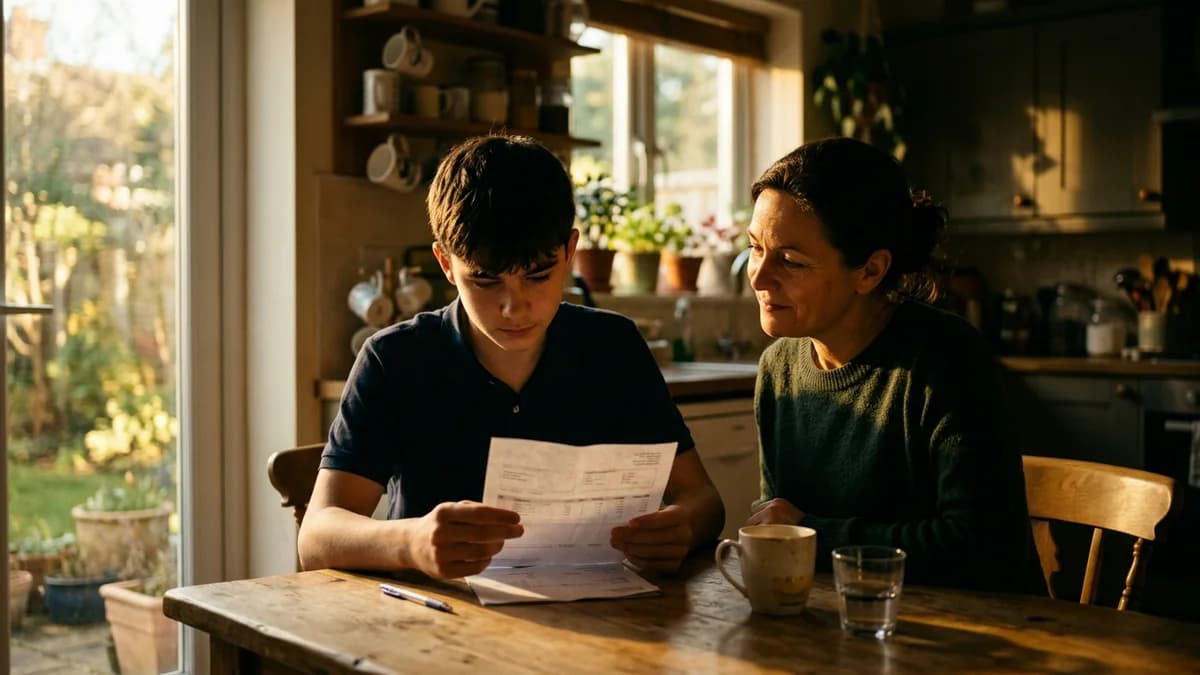
You do not have to share your income or your balances. You can teach most of what matters using one real bill. Pick the electric bill or the phone bill and walk through it together: what the service is, what it costs, when it is due and what happens if it is late. Then give them a real task, like planning one week of dinners for a set amount, or picking the phone plan for themselves from three options.
| Move | Why it works at 11 to 13 |
|---|---|
| Walk through one real household bill | Turns "money is tight" into a specific, solvable number |
| Hand over a fixed budget for one category, such as school clothes | Practices trade-offs with real stakes |
| Let them compare prices for one family purchase | Builds the habit of checking before buying |
| Explain one ad aimed at them | Shows that a lot of marketing is designed to get them to spend |
| Talk about a money mistake you made and what it cost | Makes mistakes normal and shows how to recover |
The last row is the hard one, and it ties back to the start of this guide. If nobody taught you, you have probably made some expensive mistakes. A preteen is old enough to hear about one. "I carried a credit card balance for years because I didn't understand how the interest worked" is more useful than any worksheet, because it is real and it is yours. You do not need to give amounts. The lesson is the pattern, not the number.
This is also the age when the spend, save and give split can move from jars to an account they can see on a phone, with you watching. The habit of looking at a balance before spending is worth building before the stakes get real.
The Math of Starting Early: $5 a Week From Age 5
The habits are the main event. But the math explains why the early years carry so much weight, and it is worth showing your kids when they are old enough to follow it.
Take $5 a week, the price of a snack, invested from a child's fifth birthday until their 18th, and then never added to again. The model is the one used across this site: deposits every week, with the balance growing at 10% a year. That is roughly the S&P 500's long-run average according to NYU Stern's dataset, where $100 invested at the start of 1928, with dividends reinvested, grew to $1,157,598.95 by the end of 2025, a 10.02% annual return.
$5 a Week Until 18, Then Never Touched Again
Value at 65 by the age the $5 a week started. Nothing is added after the 18th birthday.
Model: weekly deposits, balance growing 10% a year, the long-run S&P 500 average since 1928 (NYU Stern). Before taxes and fees, rounded to the nearest $100, in future dollars, not adjusted for inflation. Not a promise of future returns.
Figures are before taxes and fees, rounded to the nearest $100, and are not a promise. They are also in future dollars. Prices have risen about 3% a year on average since 1928, based on the BLS consumer price index from December 1927 to December 2025, and at that pace $589,500 sixty years from now would buy about what $97,800 buys today. That is still about 29 times the $3,380 that went in. Stock returns swing hard from year to year, and a child who starts at 5 will live through several crashes before 65. But the shape of the result does not depend on the exact rate. The child who started at 5 put in about three times as much as the child who started at 14, and ends up with more than five times as much, because their money had nine more years to compound. Most of that difference comes from time, not from the extra deposits.
Put the gap between the first and third rows in plain terms. Waiting from 5 to 14 saves the family $2,340 in deposits, $260 a year for nine years. It costs the child roughly $477,900 by 65 under the same model. To catch up, a family that starts at 14 would need to put in an extra $3,700 at once on top of the $5 a week. Starting at 5 gets the same result for $260 a year. That is the real price of the sentence "we'll teach them about money when they're older."
The table adds a fourth row for comparison: the same $5 a week from age 5, kept in an ordinary savings account at the FDIC's 0.38% national average instead of invested. By 65 it has barely moved past what went in.
| Starts at | Put in by 18 | Value at 18 | Value at 65, nothing added |
|---|---|---|---|
| 5 | $3,380 | $6,700 | $589,500 |
| 10 | $2,080 | $3,100 | $274,900 |
| 14 | $1,040 | $1,300 | $111,600 |
| 5, in a savings account at 0.38% | $3,380 | $3,500 | $4,100 |
Two practical notes. A child's own money can sit in a custodial account in their name that a parent manages until adulthood. A Roth IRA is different and only opens once the child has earned income, from a job or from self-employment such as babysitting. The IRS caps a contribution at the lesser of $7,500 for 2026 or the person's taxable compensation. We cover how that works in the custodial Roth IRA guide.
The point of this table is not to turn a five-year-old into an investor. It is to show you, the parent, why "we'll deal with money when they're older" is the most expensive plan in the house.
13 and Up: Earned Income Changes Everything
Somewhere around 13 or 14, the conversation changes. The CFPB's model starts its teen stage at 13, when "explicit financial knowledge and decision-making skills become more relevant," and when teens can act as "financial apprentices" to the adults around them.
The trigger is usually the first paycheck. Once a teen earns money, the most powerful tools open up: a Roth IRA funded from their own earnings, a debit card tied to their own paycheck, the first look at what taxes take out of a paycheck. Your job shifts from teaching to coaching. Let them make the call. Be there when it goes wrong.
We wrote a whole guide for this stage, addressed to the teen rather than the parent: financial literacy for teens. Hand it to them. It covers what a minor can legally do with money, how a summer job can fund a retirement account, and the traps aimed directly at their age group.
Three conversations are worth having before 18, whether or not school covers them:
- Interest on debt. What 22% interest does to a balance that only gets the minimum payment. That is close to the Federal Reserve's 22.36% average on card accounts charged interest in August 2026. Our credit card interest explainer has the numbers.
- What a paycheck really is. Gross pay, taxes, take-home, and why the number on the job ad is not what lands in the account.
- Why money loses value. Prices go up over time, cash in a drawer buys less every year, and that is the reason to own things that can grow.
What to Say When You Made the Mistakes Yourself
This is the part most guides skip, and it is the reason a lot of parents never start. You may be carrying debt. You may have no savings. You may feel like a fraud teaching any of this.
You are not. Kids learn from watching a parent handle a real situation, and a parent working out of a hole is still a real situation. In some ways it teaches more than a parent who never struggled, because the child sees the repair.
| What you might be thinking | What you can say instead |
|---|---|
| "I'm bad with money, so I shouldn't teach it." | "Nobody taught me this. I'm learning it now, and I want you to learn it sooner than I did." |
| "We're in debt. I don't want them to know." | "We owe money on a card, and we have a plan to pay it off. Here's how the plan works." |
| "I don't understand investing." | "I'm still figuring out investing. Let's look it up together." |
| "Money talk always turns into a fight." | "Money is just a tool. We're going to talk about it like any other tool." |
You do not need to share balances, and you should not hand a child an adult's stress. The goal is to show that money is something you can understand and fix, not something that happens to you. That one shift is most of what financial literacy is.
If you want to fix your own foundations as you go, our guide on why financial literacy is not taught in schools explains how the gap happened, and the step-by-step path to teach yourself about money starts from zero.
Frequently Asked Questions
Around age 3. The Consumer Financial Protection Bureau's 2016 research model says executive function, the ability to wait, plan and control impulses, develops rapidly from 3 to 5 and is the foundation for later money skills like saving and budgeting. At that age the lessons are simple: handing cash to a cashier, saving coins in a clear jar, and choosing between a small reward now and a bigger one later. Real money management starts around 6, when habits begin to form.
Match the lesson to the stage. From 3 to 5, teach waiting and that money is traded for things. From 6 to 12, give a regular allowance split into spend, save and give, and let them make small mistakes with it. Around 11 to 13, show them one real household bill and give them a budget for one category. From about 13 or 14, coach real decisions such as a first paycheck, a debit card and a Roth IRA funded from earned income. The CFPB describes the stages as 3 to 5, 6 to 12 and 13 to 21, and the stages overlap.
Start with honesty. Parents are typically the main way children learn about money, according to the CFPB, both through what children watch them do and what they are told, so a parent working through debt with a clear plan still models the right behavior. Say what you were never taught, share one mistake and what it cost without giving amounts, and learn alongside them. The earliest lessons, waiting and choosing, need no financial knowledge at all.
An allowance is the simplest way to give a child money of their own to manage, which is the point. A fixed amount on a fixed day, split into spend, save and give, lets a child practice choices and feel the result of a bad one at a cost of a few dollars. Whether it is tied to chores is a family decision. Consistency matters more than the amount.
Not on its own. The FDIC national average for savings accounts was 0.38% in its October 19, 2026 rate table, which pays about 8 cents a year on $20, too little for a child to notice. One common fix is a "family bank" where a parent pays a visible, capped rate, for example 5% a month on the first $20, so $20 left alone for a year becomes $35.92. Explain that this is a teaching rate and not what a real bank pays.
Invested every week from age 5 to 18, $5 a week is $3,380 put in. At a steady 10% a year, the S&P 500's average since 1928 in NYU Stern's data, it would be about $6,700 at 18 and about $589,500 by 65 with nothing added. That is in future dollars, before taxes and fees; adjusted for long-run inflation of about 3% a year it is roughly $97,800 in today's money. Real returns vary year to year and are not guaranteed.
The Bottom Line
You do not need to be good with money to teach kids about money. You need to start before school does, and you need to teach the stages in the right order: waiting first, then habits, then knowledge. None of it costs much. Most of it is a few minutes at a checkout counter, a jar on a shelf and a willingness to say out loud what nobody said to you.
| Age | The one thing to teach | The one move that teaches it |
|---|---|---|
| 3 to 5 | Waiting gets you something better | A clear jar and a "now or later" choice |
| 6 to 10 | Your choices have results | A regular allowance they are allowed to waste |
| 11 to 13 | A household runs on real numbers | One real bill and one category budget |
| 13 and up | Your own money, your own decisions | A first paycheck and an account in their name |
The system skipped your generation. It does not have to skip theirs. If your own foundations need work, start with the one idea that explains most of the math above, compound interest. Learning it at the same time as your kids is still the fastest way to make sure they learn it first.
Nobody taught you this. Teach them anyway.
Plain answers to the money questions school skipped.
This article is for educational purposes only and does not constitute financial advice. Untaught does not hold, move, or custody any funds. Past performance does not guarantee future results. Always do your own research before making investment decisions.
Quick calculator
Your coffee money could have become
$19,233
from $9,900 invested
Monthly buys, Oct 2021 to Sep 2026, at Coin Metrics month-end closes. Past results, not a forecast.